

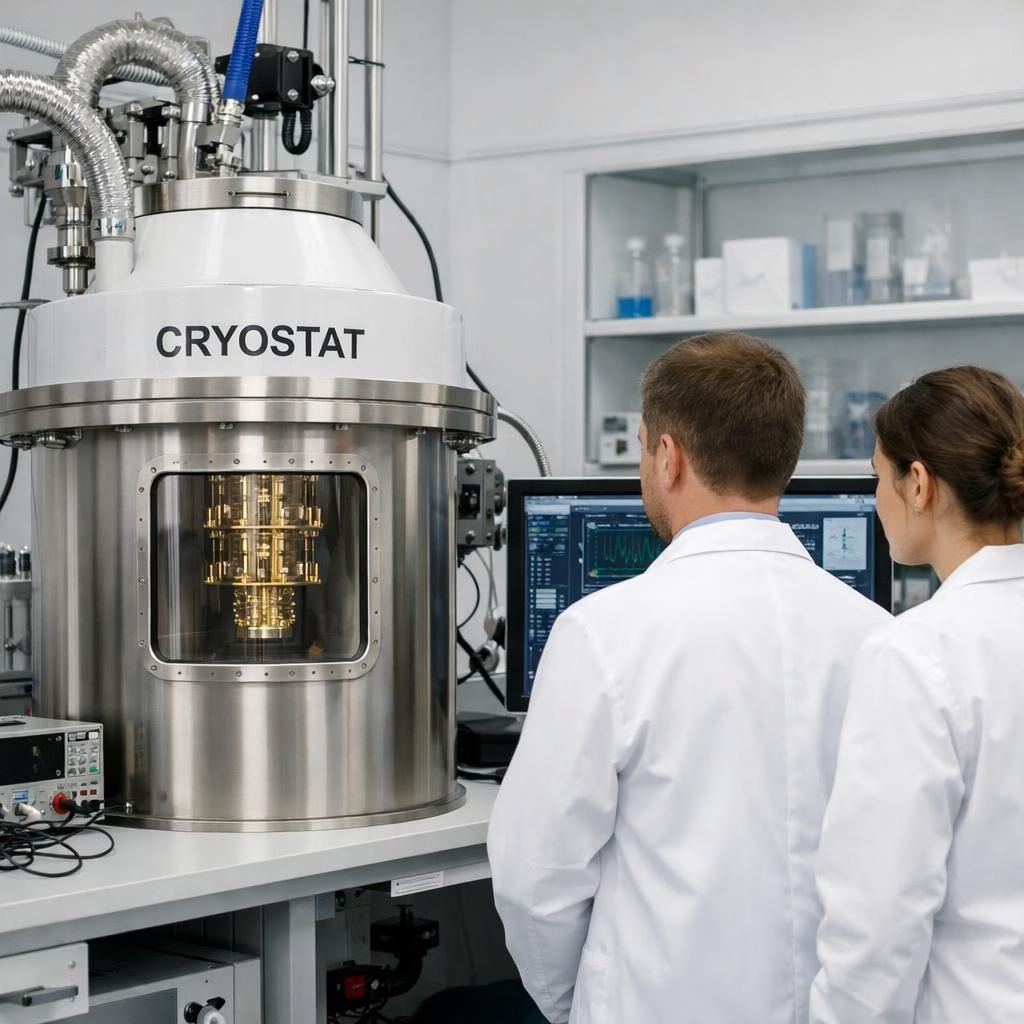
Willow’s early access: a Willow quantum processor gateway
Willow and quantum processor headline the week as Google opens early access to a new quantum processor and invites experimental proposals. This move blends curiosity with ambition, and it invites labs large and small to bring their best ideas forward. In the quantum world, real hardware reveals limits fast, and this program aims to surface those limits early.
Industry watchers describe Willow as a multi-qubit, superconducting chip kept at cryogenic temperatures. The goal is not magic but measurable progress, and the program promises a transparent review of experimental proposals. Researchers will submit tests that push gate fidelity, calibration routines, and simple benchmarks. The quantum parts of the project will be scrutinized, including how well error mitigation helps near-term tasks. The proposal window is narrow, but the prize is a rare chance to run real circuits on real hardware.
Submitting a proposal is not a free ride. Teams should outline the hardware setup, measurements, and expected insights. They must explain success metrics and risk mitigation. If Willow proves robust, teams could see follow-up access or expanded test scopes. The program also values diverse use cases, from optimization benchmarks to more exploratory experiments in the quantum realm. In the end, the evaluator team wants clear data sharing and documentation that helps the community learn.
Why quantum research benefits from Willow access
Why does this matter? Because Willow access signals a shift from purely theoretical papers to practical experiments with real hardware. The gate sets get tested outside idealized simulations, and researchers can benchmark real coherence times. The quantum ecosystem benefits when industry, academia, and startups share learnings. The Willow program nudges the field toward repeatable experiments, better tooling, and more robust data sets. Everyone gains clarity about what works now and what belongs in a longer roadmap for quantum tech.
Beyond the hype, the program emphasizes responsible use and careful scheduling. Google is mindful of power, cooling, and infrastructure demands. The collaboration model invites constructive critique rather than one-off demos. For participants, this means more than a sample run; it means a chance to contribute to a growing body of open, transparent knowledge in the Willow ecosystem and the broader quantum landscape.
Expect a phased rollout, with milestones that translate to measurable outcomes. Early experiments may test basic circuit blocks, readouts, and simple kernels. As confidence grows, researchers might tackle larger circuits, better error mitigation, and new algorithmic ideas. The Willow initiative shows that the quantum journey depends on patient repetition and shared lessons from both success and failure.
To prepare, teams should assemble a crisp proposal packet: goals, timelines, resources, and defined exit criteria. They should consider how they will measure success and what data they will publish. The program favors clear, interpretable results over flashy graphs. If you bring real-world use cases—optimization, chemistry simulations, machine learning in a constrained setting—the chances look brighter for Willow to deliver meaningful advances in the quantum space and within the broader technology ecosystem.
In sum, Willow access marks a deliberate step toward practical quantum science. It invites disciplined experimentation, thoughtful critique, and a spirit of shared progress. The effort has the potential to accelerate learning across the quantum community and to de-risk future hardware investments for researchers and industry alike.
Special thanks to The Quantum Insider for the original article and coverage, and to Google for opening early access so researchers can responsibly test ideas on Willow. Original article: The Quantum Insider via Google News. Thank you for the original source material.
Practical steps for a Willow proposal
- Prepare a concise goals statement, timeline, required resources, and exit criteria.
- Explain how the experiment would scale to more qubits or longer runs.
- Describe data sharing plans, reproducibility, and safety considerations.
- Offer a plan for cross-lab validation and open tooling when possible.
FAQ
- What is Willow offering in this program? Early access to a working quantum processor for targeted experiments with guided support from Google.
- Who can apply? Labs of any size with a clear plan for meaningful experiments and data sharing are encouraged to apply.
- What will evaluators look for? Clear objectives, measurable milestones, risk mitigation, and strategies for reproducibility.
Further reading
- Nature: Quantum computing overview
- IBM Research: Quantum computing today
- Scientific American: Quantum computing takes a step closer