

In Los Angeles’ South Bay, Tom Mueller moves through traffic with patient, practical speed. He treats space as if it is already on the road map, a field that can be mapped, optimized, and rerouted using the same discipline that governs rocket propulsion and orbital logistics. The pace shifts between orbital mechanics and Earth’s finite resources, with red lights interrupting the flow. Mueller’s engineering mindset remains intact, redirected toward what comes after launch—a blueprint for space infrastructure that moves faster than a press release.
Rocket Propulsion and Orbital Logistics in the Modern Era
Mueller’s roots stretch back to a small timber town in Idaho, where repair work and hands-on practice were part of daily life. He carried that realism into university and into the Los Angeles defense and aerospace scene in the 1980s, where government funding kept experimental programmes alive and allowed engineers to test ideas that later faced tighter controls. Decisions moved slowly, shaped by layers of oversight that did not sit well with builders who loved to prototype. Outside work, he joined informal desert projects where propulsion ideas could be tested without committees and he recalls that he worked on all kinds of crazy things.
By the early 2000s, Mueller was in El Segundo, chasing high-thrust concepts in a warehouse, when a young entrepreneur showed up seeking rocket technology. The meeting led to a job offer and a rapid exit from his old employer. At the new venture, he helped develop propulsion systems that would power reusable orbital launches and missions to the International Space Station. Engines were designed, tested, redesigned, and tested again under tight timelines and budget pressures. The effort built reliability that later dominated commercial satellite launches. Eventually, the core problem of reaching orbit became routine. The question shifted to movement once in space.
From rocket propulsion to orbital logistics: a career arc
In the early years, the craft was all about thrust, burn, and margins of safety. The shift toward orbital logistics required new thinking about how one spacecraft carries another from sunlit launch sites to crowded orbital highways, quickly and reliably.
Impulse Space: Repositioning in Orbit
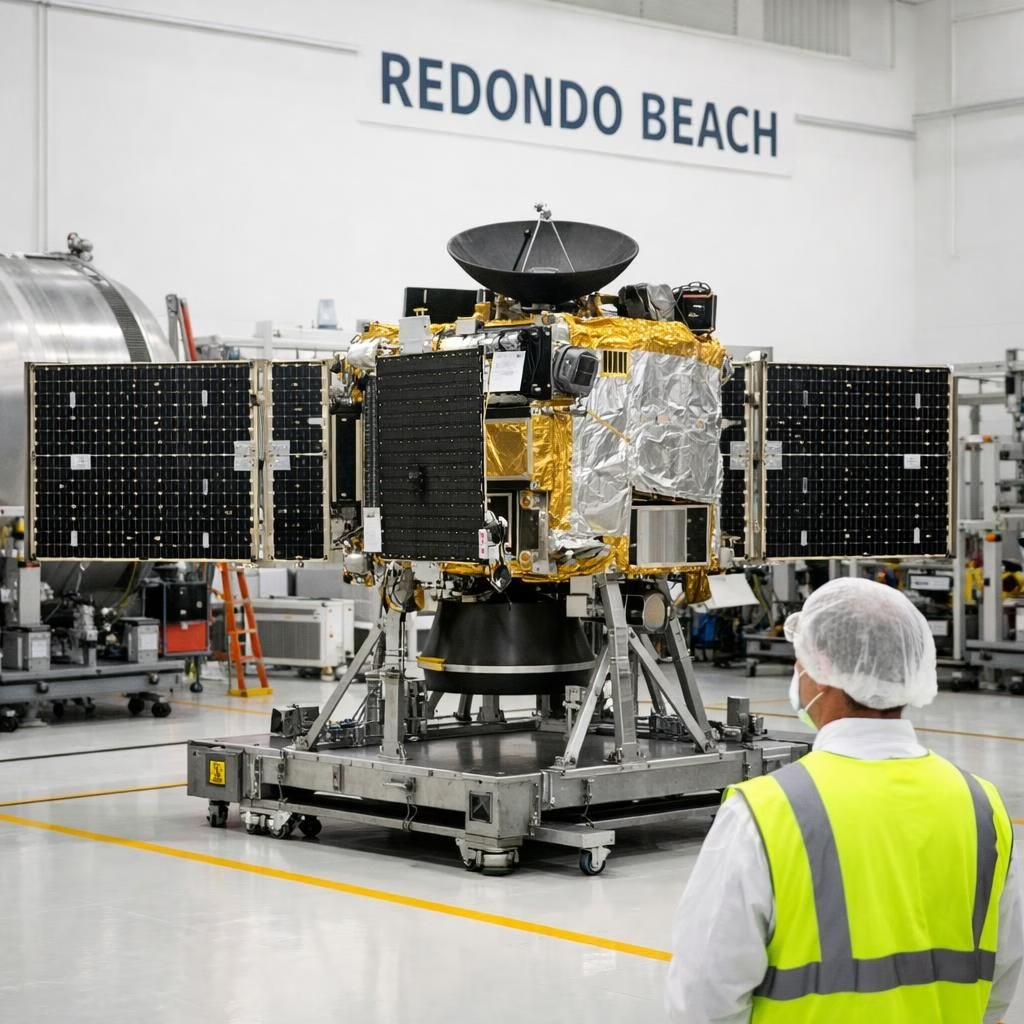
In 2021 Mueller co-founded Impulse Space in Redondo Beach, a warehouse filled with test rigs, metal components, and vacuum chambers. The goal is simple in principle and complex in execution: move stations and satellites quickly across orbital logistics, not just reach orbit. The company argues that satellites rarely reach exact final positions on their first pass. They drift months into place, and Impulse believes faster, chemical propulsion can move craft between orbits quicker than electric systems allow, trading a bit of efficiency for speed.
Inside the facility, production is tightly integrated. Components that might normally come from multiple suppliers are made in-house. The plan is control, not scale, so faster loops between design and testing cut delays and accelerate iteration. Mira is a compact craft about the size of a horse with solar wings that resemble a toaster. It has completed three missions already. Helios is a larger vehicle, like a futuristic water tank. It can haul four tons from low Earth orbit to geostationary orbit, over 20,000 miles, in under 24 hours. The first mission is slated for 2027.
Mira’s first two missions, in late 2023 and early 2025, went smoothly: a 150-km orbital logistics boost, rendezvous with another satellite, and CubeSat deployments. Yet, in its third mission earlier this year, star trackers produced noisy data, a hiccup that the team treated as a learning moment rather than a disaster.
Public funding currently fuels Impulse’s growth. The U.S. Space Force requests about 71 billion dollars for 2027, a substantial rise, as the Pentagon emphasizes space operations. NASA has outlined plans for a permanent lunar basecamp by the decade’s end. Impulse is well positioned to benefit from this pipeline of government contracts. The company has reportedly secured nearly 400 million dollars in contracts, most of which come from the government, according to Impulse president Eric Romo. Romo previously interned at SpaceX during business school, later founded and sold several companies, and eventually joined Impulse as it scales with this wave of space programs.
Original article: Thank you for the original material.
We’d love to hear your thoughts on how fast space traffic should move. Share your perspective in the comments below.
Practical steps for faster orbital logistics
- Define mission goals and the exact orbital window, then align propulsion choices with a orbital logistics plan that minimizes transfer time.
- Prototype in-house to shorten feedback loops between design and testing; faster iterations can reduce schedule risk for orbital logistics moves.
- Balance time and propellant use by simulating multiple transfer strategies and selecting the option that delivers reliability first.
- Coordinate with mission partners to ensure that each repositioning aligns with broader constellation or network needs, accelerating overall throughput in orbital logistics.
FAQ
- What is orbital logistics?
- Orbital logistics refers to planning and executing rapid repositioning and resupply of spacecraft and satellites once they are already in space, optimizing routes between orbits and minimizing dwell times.
- How does Impulse Space differ from traditional launch-focused companies?
- Impulse focuses on in-space repositioning and in-orbit transportation, using fast propulsion to move assets quickly between orbits rather than solely achieving initial orbit.
- Where can I learn more about propulsion technologies and orbit mechanics?
- Credible sources include official space agencies and industry publications. See NASA and ESA for foundational concepts, plus industry reports on modern propulsion.
Conclusion: a new infrastructure for space
The shift from getting to orbit to moving efficiently within orbit is reshaping how people think about space infrastructure. If rapid orbital repositioning becomes the norm, satellites, communications networks, and defense assets could respond with unprecedented speed. For now, the journey from propulsion to orbital logistics is being built in public warehouses, under tight schedules, and with a clear eye on the pace of space in the 21st century.
References
Original source: Times of India — The first SpaceX employee is not Elon Musk