

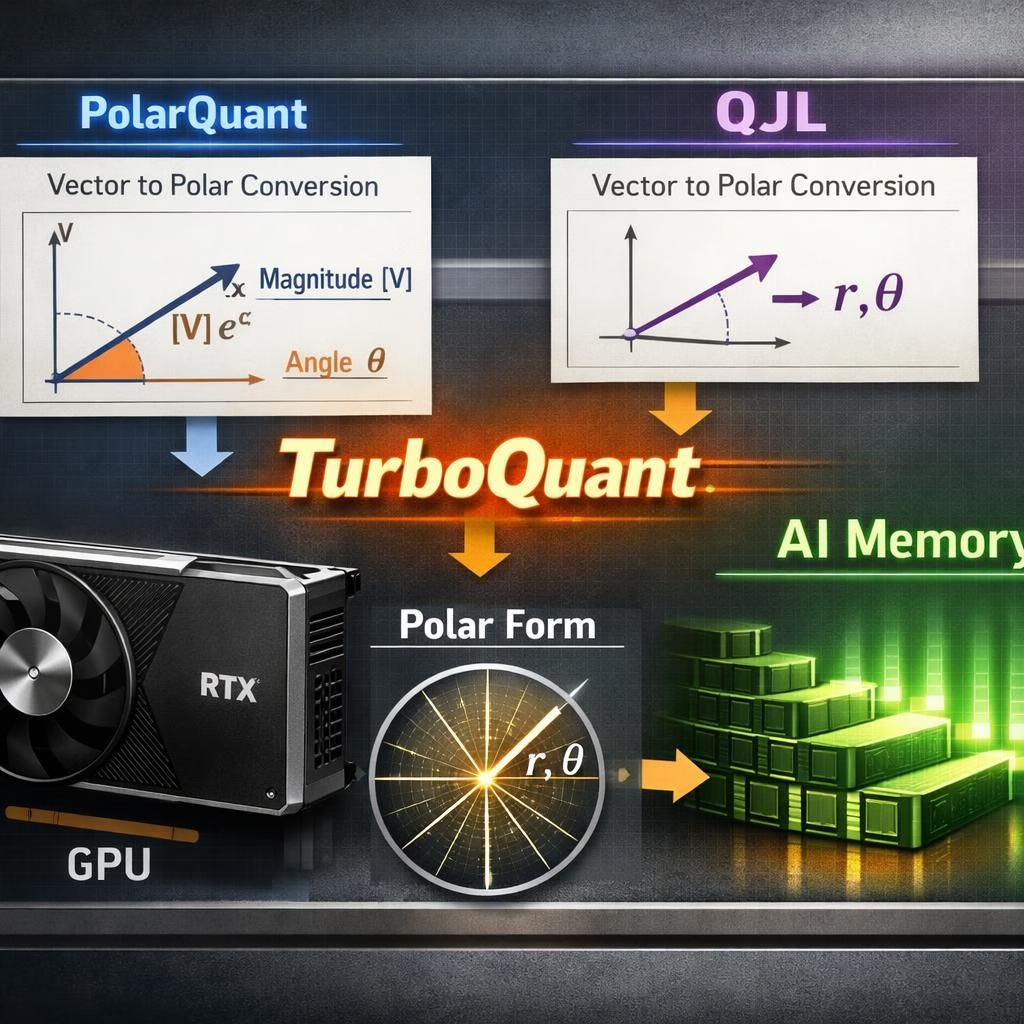
TurboQuant isn’t just a marketing buzzword. It’s Google’s bold wink to AI memory. The goal is to shrink the memory footprint during inference, with promises of roughly six times less memory use. In 2026, Google targets the key-value cache that stores past calculations to speed up chats. The two tricks behind TurboQuant are PolarQuant and Quantized Johnson-Lindenstrauss (QJL). The result sounds almost too good to be true, but the numbers are measured, tested, and ready to try. PolarQuant and QJL are already ported to local frameworks, making AI memory improvements accessible for edge devices.
TurboQuant and AI memory: Evolution or Revolution?
TurboQuant targets the KV cache—the AI memory that remembers conversations so it doesn’t redo work. PolarQuant converts high‑dimensional vectors into polar form, reducing data needs. QJL adds a 1-bit error‑correction pass to clean up drift. The combo enables 3-bit precision with no perceptible quality loss. On Nvidia H100 accelerators, Google reports an 8x speedup in attention logits. The practical upshot is more headroom, faster responses, and less memory pressure for long chats. In short, TurboQuant and AI memory work together to boost edge performance without retraining.
TurboQuant, AI memory: Market moves and what analysts say
The rollout stirred market chatter. NAND suppliers like Kioxia and Sandisk slid as traders adjusted memory demand forecasts. HBM and DRAM names fared relatively better, reflecting ongoing demand for training and high‑bandwidth workloads. Analysts split: some see this as evolutionary—a smarter notch in the memory stack that could lift AI hardware adoption—while others warn gains may be incremental. The Jevons Paradox even makes a cameo: efficiency can unlock new uses and expand overall consumption. JPMorgan and some others argued near‑term memory demand could stay resilient, while SemiAnalysis’ Ray Wang framed TurboQuant as evolving capacity rather than a leap forward. The mood is cautious, not catastrophic; markets are recalibrating to a world where memory efficiency becomes table stakes for AI growth. For readers tracking the math, see notes on the underlying ideas like the Johnson–Lindenstrauss lemma and quantization concepts. Quantization and Johnson–Lindenstrauss lemma provide background on the math behind these techniques.
TurboQuant, AI memory, and on-device AI reality
Practically, the value lands in edge and privacy‑minded deployments. Google released TurboQuant with no licensing restrictions and no retraining requirement, letting developers drop it into existing models immediately. Within 24 hours, people were porting it to local AI frameworks, including Apple Silicon ecosystems. A community benchmark tested Qwen3.5-35B across contexts up to 64,000 tokens with 2.5‑bit TurboQuant and reported perfect accuracy. That kind of result hints at strong on‑device AI potential: long conversations, sensitive data, and offline operation become more feasible without cloud reliance. The combination of 3‑bit precision, an 8x speedup in attention logits, and zero retraining represents a practical leap for AI memory in real devices.
Developers and the practical path forward
For developers, TurboQuant is a plug‑and‑play upgrade. No licensing friction makes it easy to experiment. Devices with limited RAM gain from more headroom and longer context capabilities. The 64k token proof point suggests rich, on‑device interactions without cloud roundtrips. In 2026, on‑device AI becomes increasingly attractive for privacy, latency, and autonomy reasons. The software story here is as important as the hardware one: better memory management unlocks new use cases and better user experiences without demanding new training data.
From memory math to market moods, AI memory reminds us that the bottleneck isn’t always model size but how we store and access data. PolarQuant and QJL demonstrate that clever math, paired with smarter hardware, yields tangible gains. As AI memory techniques mature, expect more devices to run smarter models locally, with cleaner energy profiles and happier developers.
We’d love to hear how TurboQuant and AI memory tactics might affect your projects. Share your thoughts in the comments below. A special thanks to the original article for laying the groundwork and sparking this discussion.
External context you may find useful: a deeper look at the math behind these methods — Quantization and Johnson–Lindenstrauss lemma — helps explain why 3-bit precision can work in practice. For a broader economic take, see Britannica on the Jevons Paradox and how efficiency can influence demand.
Practical steps for implementing TurboQuant on your AI projects
- Check framework compatibility and ensure your edge device can support 3-bit precision without retraining.
- Enable the KV cache optimizations and test with representative conversation lengths to measure memory savings.
- Benchmark latency improvements on local hardware, focusing on attention logits and inference time.
- Evaluate privacy and offline capabilities by testing long-running sessions without cloud access.
FAQ
- What is TurboQuant? A set of techniques that compress the AI memory used during inference, aiming to reduce memory footprints and speed up processing without retraining.
- Does TurboQuant require retraining? No. It’s designed to work with existing models and drop‑in into current pipelines.
- Will this affect on‑device AI performance? Yes—by freeing memory headroom and enabling longer contexts, especially on edge devices.
- How should I measure success? Compare memory usage, latency, and accuracy across standard prompts and longer conversations, using the same hardware in controlled tests.