

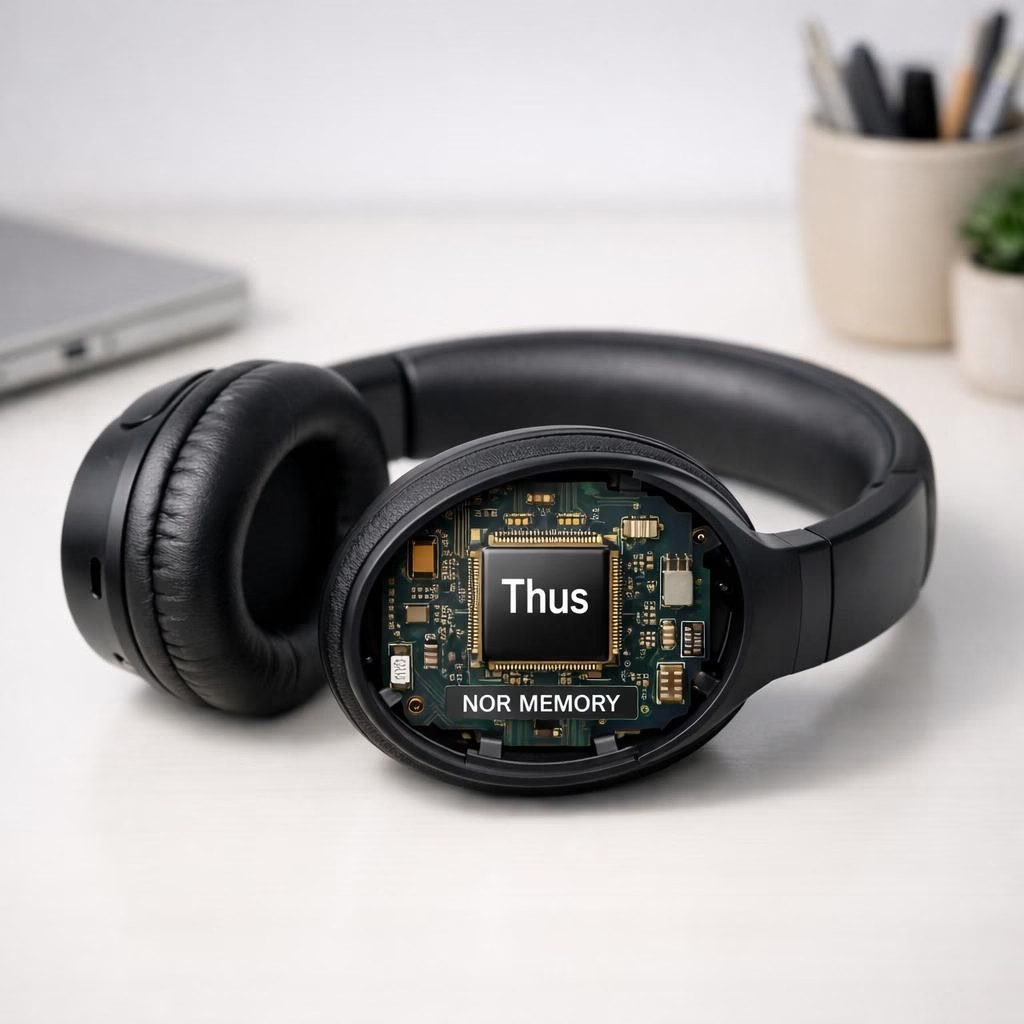
In 2026, Anker reimagines its tiniest hardware with Thus, a chip that makes AI audio smarter. It’s a bold example of Compute-in-Memory AI thinking—data stored and processed in one place, like a brain in a pocket. The goal is to push sophisticated on-device intelligence into headphones without begging a phone for power every millisecond. The idea isn’t just more features; it’s reliability on the move, in noisy spaces, and in shops that feel like libraries. The company frames Thus as a first step toward a future where memory and computation share a single schedule. If it works, latency drops and privacy improves. Fewer data travels to the cloud, a win for calls and peace of mind.
AI audio uplift: Thus’s impact
Thus uses NOR flash memory cells as both storage and computation nodes. That design enables faster reads than NAND and a tiny footprint ideal for wearables. The trick is to keep circuitry inside memory so the device can run neural networks locally. Anker frames this as the brain’s way of handling data—memory and processor cohabiting in harmony. Practically, that means fewer trips to the data center, quicker responses, and a privacy benefit. It also means designers can shrink the hardware stack, freeing space for batteries or features users actually want, like improved mics, better ergonomics, or mood lighting that fits your playlist. A Compute-in-Memory AI approach could push further gains by letting the chip adapt to surroundings without pulling data from the cloud. AI audio, too, gains from local inference.
Compute-in-Memory AI in practice for headphones
Headphones inhabit tiny chassis and operate on delicate power budgets, usually a few milliwatts, yet they must deliver ANC. Thus promises more compute headroom without the spikes that heat your ears or shrink battery life. In practice, this approach could enable smarter beamforming, faster speech recognition, and more adaptive noise suppression that learns from your environment. If CIM scales beyond headphones, Anker may repurpose the same architecture for earbuds and other wearables. That would turn wearables into compact edge AI hubs, balancing privacy with responsive interactions. This is a real test of the Compute-in-Memory AI concept. AI audio could also be improved as data stays on-device.
One announced feature, Clear Calls, aims to cancel noise with a large neural network running entirely on-device, supported by eight MEMS microphones and two bone-conduction sensors. Rather than routing audio to a server for interpretation, the model sits on the chip, learning to separate voice from noise. The practical effect could be crisper conversations in chaotic environments. The architecture emphasizes local inference and privacy, with the hardware designed to handle multiple streams of audio data in parallel. AI audio consistency benefits from edge processing too.
Beyond calls, Thus is pitched as a stepping stone toward broader device ecosystems. Anker hints this Compute-in-Memory AI approach could appear in other mobile accessories and IoT gadgets, all sharing a compact brain that helps decide when to wake the mic, how aggressively to cancel noise, and how to balance battery use with user experience. The messaging reads as optimistic: edge AI becoming practical, private, and pleasantly invisible in daily life. AI audio plays a role in improving everyday conversations in busy environments.
Still, there are questions worth answering before mass adoption. Cost matters in wearables, and manufacturing yields could push prices higher. Developers must adapt to a memory-centric compute model, which may require new tools and benchmarks. Power management remains the top constraint; even a few extra milliwatts matter during busy calls. Early days will reveal whether Thus holds up in rain, wind, and long meetings. If robust, this Compute-in-Memory AI path proves hardware and software can dance instead of arguing across ribbons of silicon.
Want to weigh in? Share your thoughts in the comments below. A big thank-you to the original article for the foundation of this rewrite; your material helped spark new ideas.
Practical takeaways for users and developers
- Edge AI in wearables can reduce cloud dependence and improve privacy for audio devices.
- Memory-centric design can free space for longer battery life and better sensors.
- Tooling and cost will shape how quickly CIM AI arrives in consumer gadgets.
FAQ
- What is Compute-in-Memory AI? It’s a model that blends storage and computation in the same memory hardware to run AI tasks on-device.
- Will Thus tax battery life? The design aims for low power, but adding real-time AI work always uses energy—trade-offs will matter as the chips scale.
- When will these features ship? Anker has teased a 2026 reveal, with broader rollout depending on supply and tooling.
- Will other devices use CIM AI? Anker hints yes, expanding into more mobile accessories and IoT if the approach proves robust.
Still, this collaboration between memory and computation signals a shift toward private, responsive devices that act closer to you rather than in the cloud.