

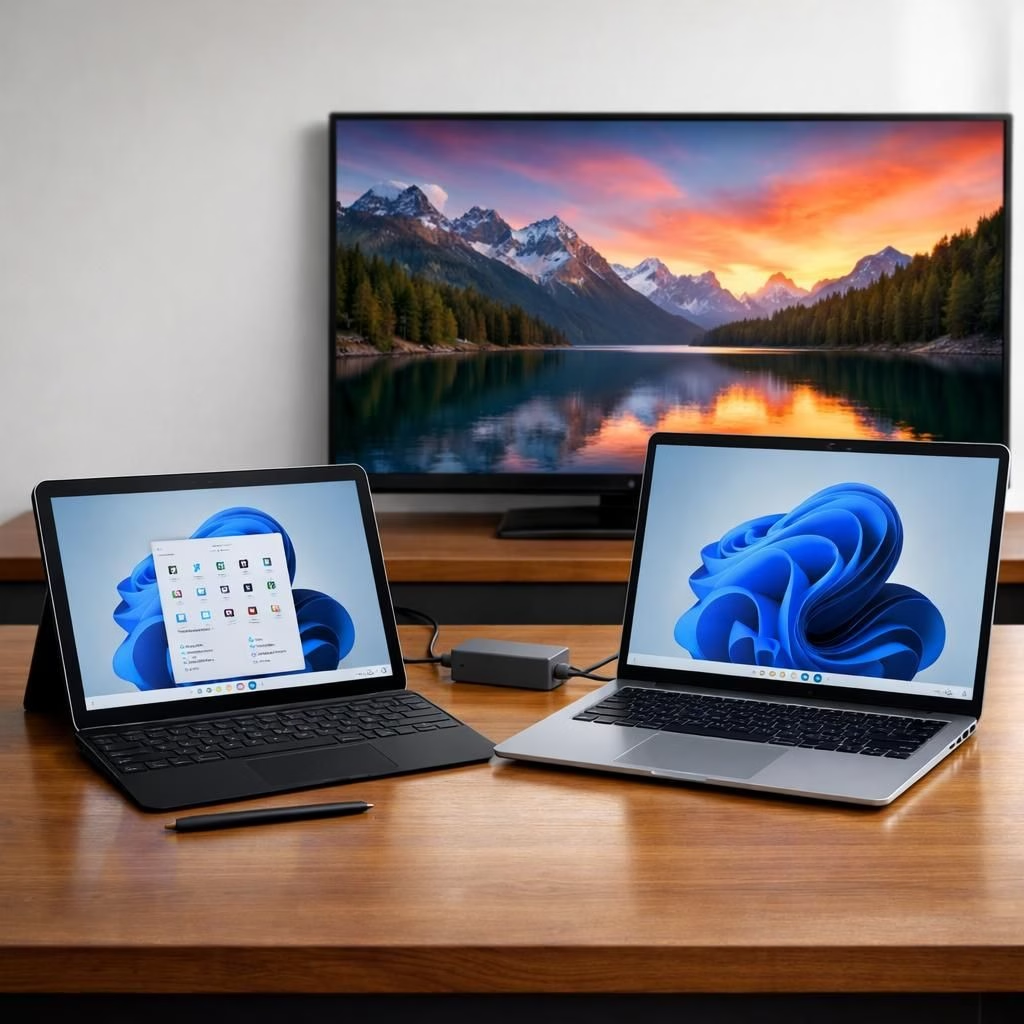
In 2026, Microsoft rolls out a fresh pair of business-friendly powerhouses: Surface Pro 12 and Surface Laptop 8, both packing Intel Core Ultra Series 3 processors. The duo arrives with a confident swagger, promising serious workstation chops without turning every meeting into a data sprint. You’ll find the Surface Pro 12 in the same sleek, familiar shell, and the Surface Laptop 8 carrying the baton with a focus on security, privacy, and a delightful touchpad that feels almost too clever for a business device. The packaging is premium, the price is premium-adjacent, and the era of RAMageddon continues, but with more OLED glow and Wi‑Fi 7 swagger than before.
First up, the Surface Pro 12 (for business, 13-inch, 12th Edition) starts at $1,949.99. The baseline configuration ships with an Intel Core Ultra 5, 16GB of RAM, and 256GB of storage. The aesthetic remains mostly unchanged from prior generations—the edit button here was never about the chassis, but about bending silicon to your workflow gods. For power users who crave bigger numbers, Microsoft offers Core Ultra 7 configurations with up to 64GB RAM and 1TB storage. The top-end model lands at $4,399.99, a price tag that signals ambition as much as performance. There are also OLED screen options and a 5G variant with a starting point at $2,249.99, making mobile business a real possibility—but you’ll pay a premium for the privilege.
The Pro 12 keeps the same two USB-C ports with Thunderbolt 4 support and the familiar Surface Connect charging port. Connectivity ticks all the right boxes: Wi‑Fi 7 and Bluetooth 5.4 are bundled in, along with a 1440p Quad HD front-facing camera and a 10‑megapixel 4K rear camera that’s perfectly adequate for boardroom demos and product unboxings that won’t bore your colleagues to tears. For businesses already invested in Surface hardware, the Pro 12 acts as a natural upgrade path, a promise of compatibility with existing peripherals and a smoother memory lifecycle. The OLED option adds a dash of brightness and color depth, though availability and pricing can vary by region and SKU.
Surface Pro 12: price, OLED dreams, and business-ready DNA
From a price perspective, the Surface Pro 12 user journey begins with the Core Ultra 5 baseline and climbs toward the Core Ultra 7 maxed-out build. The 5G model expands the mobility story, and the OLED option is more than a shiny feature—it’s a visibility upgrade for executives who present sales decks with a side of color fidelity. In practice, this means the Pro 12 can scale from a compact note-taker to a portable workstation capable of light design work, code execution, and data crunching, all while staying within the familiar Surface ecosystem. The design language remains consistent with the prior generation, which helps IT teams deploy and support devices without a steep learning curve. For buyers, the premium is clear: you’re paying for performance headroom, enterprise-grade security features, and accessories that ensure a smoother day in the field.
Meanwhile, the Surface Laptop 8 arrives with its own suite of upgrades and options. The 13.8-inch model starts at $1,949.99, featuring Intel Core Ultra 5, 16GB of RAM, and 256GB of storage. A larger 15-inch variant adds a higher-resolution panel, supporting a sharper visual experience for presentations and spreadsheet-heavy days. There’s also a 13-inch 1st Edition that launches at $1,499.99, with a high-end configuration that can push to $2,249.99. Microsoft keeps the Surface Connect charging port and the USB-C/Thunderbolt 4 pairing across both Laptop 8 sizes, ensuring a consistent ecosystem for docking stations and external displays. The 13.8-inch Laptop 8 also ships with the option of an integrated privacy screen—IT admins can toggle protection for sensitive data with ease, an important feature for remote work and BYOD environments.
Two notable design decisions stand out here: the Surface Laptop 8’s enhanced haptic touchpad and the privacy screen option on the 13.8-inch model. The haptic pad is not just a novelty; it provides tactile feedback that can help with precise dragging, resizing, and window management in Windows 11. You’ll feel subtle haptic cues when you hover near the close button or when you drag a slider—it’s small, clever, and surprisingly satisfying during long work sessions. The integrated privacy screen aims to balance security with usability, a feature IT teams can manage centrally, rather than relying on external privacy filters that get in the way of workflow. The practical upshot is a device that respects your day-long sanity while offering robust protection for sensitive documents.
In both lines, Microsoft sticks with strong core components: dual USB-C/Thunderbolt 4 ports, a Surface Connect magnetic charger, Wi‑Fi 7, and modern cameras that keep conferencing crisp. The Surface hardware retains the familiar chassis spirit, but the performance envelope is noticeably richer thanks to Core Ultra Series 3 processors. The RAM configurations for both devices scale up to support heavier multitasking, more demanding software, and longer lifespans before the upgrade cycle hits again. For enterprises, this is not just a specs sheet; it’s a pledge that the devices can handle complex workloads, heavy parking-lot of spreadsheets or design apps, and the constant stream of security updates that modern business life requires. RAMageddon may still be a running joke, but in 2026 the joke is paired with credible hardware and a viable upgrade path.
As the RAMageddon era persists, you’ll hear rumors about consumer models arriving later in the year, potentially with OLED displays or other niceties that raise the excitement level without sacrificing reliability. The pace of updates suggests Microsoft is aiming for a complete ecosystem refresh—one that keeps the Pro 12 and the broader Surface line relevant in a market that loves both premium design and practical performance. And if you’re chasing OLED-theater for pitches and product demos, know that the option exists on the Pro 12, while the emphasis remains on privacy and input precision as core strengths. The business user, after all, wants power with predictability, not drama with peripherals.
For organizations already invested in Surface devices, the new Ultra Series 3 lineup offers a familiar, upgrade-friendly path. The two devices embrace sleek design continuity, strong connectivity, and security-minded features that appeal to IT departments and executives alike. In practice, that translates to fewer compatibility headaches, smoother migrations, and more time spent on work that matters rather than chasing driver issues or feature gaps. The 13.8-inch Surface Laptop 8, in particular, underscores the balance between form and function: a premium look and feel with practical tools like the haptic touchpad and optional privacy screen that help teams stay focused and secure.
Looking ahead, the industry buzz centers on whether consumer models will follow with OLED screens across more SKUs and how pricing will settle as supply chains adapt to demand. Rumors point toward a mid-year reveal for new Surface Laptop variants and OLED-equipped options, with the objective of keeping Surface devices competitive in a fast-moving market. If nothing else, the 2026 refresh cements Surface Pro 12 and Surface Laptop 8 as credible, capable choices for professionals who want performance, reliability, and a dash of flair in their daily toolset.
In short, the Surface Pro 12 and Surface Laptop 8 symbolize Microsoft’s recalibrated approach: keep the design language familiar, empower users with stronger silicon, and offer practical features that support real work, not just benchmark bragging. The price points are steep, sure, but the value proposition comes from long-term performance, enterprise compatibility, and a roadmap that understands how work happens today—across devices, situations, and environments.
If you’re curious about how these devices will fit into your organization, or you’ve already formed an opinion after hands-on time, we’d love to hear from you. Surface Pro 12 and Surface Laptop 8 are not just new models; they’re statements about where business devices are headed in 2026. Share your thoughts in the comments below.
Original article: The Verge — Thank you for the original coverage and for documenting the evolution of Microsoft’s Surface lineup.