

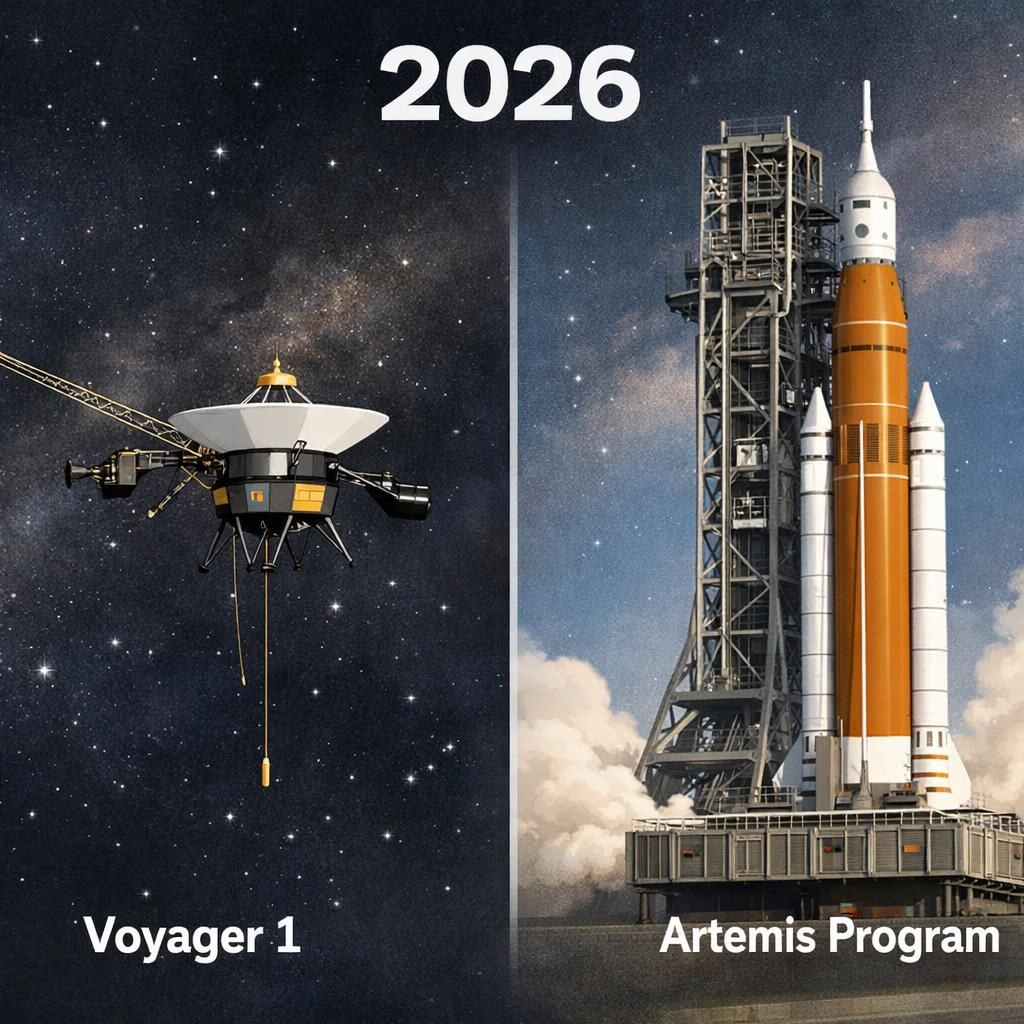
NASA and Artemis headlines of 2026 collide with a cheerful, data‑driven wink. This piece keeps the core truth intact: Voyager 1, the plucky interstellar traveler launched in 1977, is learning the fine art of power budgeting as the RTG quietly sheds watts year by year. At the same time, Artemis II becomes a social phenomenon, not just a mission, as a crewed lunar flyby rides the wave of public engagement and a surprisingly viral moment captured with consumer gear. The gist is simple: the cosmos is big, but the story of getting there is becoming delightfully approachable for everyone who has ever wondered what keeps a spacecraft alive while it drifts through the stars. NASA and Artemis share the stage, and the show blends meticulous engineering with human‑scale curiosity that keeps people watching.
On Voyager 1, mission engineers at JPL have begun trimming instruments to stretch what little power the craft has left. The Low‑Energy Charged Particles (LECP) instrument, which tracks ions, electrons and cosmic rays, was switched off on April 17 as part of a pre‑planned power budget. The RTG on Voyager 1 steadily loses about 4 watts per year, a clock we can’t reset. A February dip in power triggered extra caution to avoid tripping the spacecraft’s under‑voltage protection. Seven of ten instruments have already been shut down; LECP will be kept in a partial, standby mode with the spin motor drawing about 0.5 watts to keep the door open for future reactivation. The plan, nicknamed the Big Bang by the teams, aims to swap in lower‑power devices so the mission can linger in interstellar space for as long as possible. This is the kind of careful energy choreography that makes space exploration feel almost like a quiet, patient marathon rather than a sprint.
NASA and Artemis: Lifecycle hacks for Voyager and the Artemis program
Meanwhile, Artemis II marks a different flavor of endurance—human endurance, public engagement, and a video clip that turned spaceflight into a shared cultural moment. The crewed lunar flyby, launched in early 2026, tested orbital dynamics, life‑support systems, and the public relations muscle of NASA as it engages a global audience. The mission used Orion atop the Space Launch System (SLS) and delivered a high‑profile showcase of deep‑space operations. It was also the platform where a moment of everyday technology—a smartphone—became a storytelling tool. A crew member captured Earthset and lunar views through an eightfold zoom, a reminder that the line between cutting‑edge engineering and consumer tech is blurrier than ever. The footage went viral in a heartbeat, underscoring NASA’s strategy of connecting grand scientific aims with accessible, human‑scale moments that anyone can relate to. NASA emphasizes that each crewmate carried a modern device, yet safety checks were strict to ensure spaceflight safety. Artemis II demonstrates how the program blends formal engineering rigor with the charm of real‑world, shareable experiences—proof that science can be exciting without losing its seriousness.
Looking ahead, Artemis III continues the trajectory: moving the SLS core stage to Kennedy Space Center for vertical integration, outfitting, and stacking ahead of a 2027 lunar landing. The plan is to have Orion ride atop SLS, executing a rendezvous and docking exercise that tests critical in‑space operations. This is the kind of mission architecture that helps NASA validate a robust, scalable path to Artemis IV in 2028 and beyond. The collaboration between Boeing for overall design and assembly and L3Harris for engine production keeps the most demanding components in the hands of experienced aerospace teams, all while public‑facing milestones keep fans engaged. The juxtaposition of Voyager’s patient power management and Artemis III’s high‑energy launch cadence offers a balanced view of space exploration: slow, deliberate hardware maintenance on the one hand, and bold, ambitious steps toward crewed exploration on the other.
Back on the human side of things, Artemis II’s public‑facing moments—Earthset, the Moon’s edge, and the candid use of a familiar smartphone in a high‑stakes environment—have sparked a broader conversation about how spaceflight storytelling has evolved. The smartphone footage didn’t replace formal astronomy or astronaut training; it augmented them. NASA’s communications teams noted that these authentic, unscripted moments amplify interest, recruit new audiences, and demonstrate that serious science can be accessible, even entertaining. The blend of professional instrumentation and consumer‑grade optics in Artemis II is a microcosm of a larger trend: space agencies embracing transparent storytelling to foster public support and inspire future generations to imagine themselves among the stars.
In practical terms, Voyager 1’s Big Bang plan is a measured response to a spacecraft that has already outlived its original mission window by decades. The LECP’s shutdown is a step in a carefully choreographed sequence designed to maintain core science while extending operational margins. The remaining instruments—magnetometer and plasma wave subsystem—continue to deliver valuable data as NASA tests low‑power configurations and explores long‑term strategies for both Voyagers. The lessons learned from this patient power management feed into mission design philosophies for Artemis and future deep‑space endeavors. It’s a reminder that even in the era of rapid advancement, some of the best space stories hinge on careful power budgeting, strategic instrument selection, and a willingness to let a venerable probe teach us how to live with less energy while still pushing the envelope.
NASA’s Artemis cadence: public buzz, iPhone footage, and mission joy
Artemis II’s cultural impact isn’t about flashy technology alone; it’s about creating a narrative that resonates beyond the technical circles. The Moon becomes a backdrop for human achievement, a stage where scientists, engineers, and the public can share in the wonder. NASA’s use of social media, the quick turnaround of video highlights, and the candid storytelling around safety checks and mission milestones all contribute to a more informed and engaged citizenry. The balance between rigorous mission planning and the spontaneous delight of an Artemis II Earthset demonstrates that NASA can pursue difficult engineering goals while inviting the world to witness the journey in real time. NASA and Artemis are not merely names on a schedule; they’re living platforms for curiosity, learning, and a little humor about the reality of spaceflight—where every watt saved matters and every new view from the cosmos fuels the imagination of millions of people around the globe.
As the Big Bang plan for power optimization progresses, Artemis II’s counterpart Voyager 2 will be brought into the testing loop to validate lower‑power configurations before applying the approach to Voyager 1. The aim is not only to keep the probes alive but to preserve the ability to reactivate instruments if future power budgets allow. The arc from Voyager’s quiet endurance to Artemis III’s ambitious assembly and Artemis II’s public‑facing triumph captures a season of NASA that is practical, optimistic, and just a touch playful. And that balance—between exacting science and accessible storytelling—may be what keeps the public invested in these grand journeys through the solar system and beyond.
Have thoughts about how NASA blends technical rigor with public engagement? Share them in the comments below. Original article: NASA original material — thanks to the source for the detailed timelines and mission context that inspired this piece.
Original article attribution: Special thanks to NASA for the source material that informed this narrative about Artemis power management and Artemis II/III developments.
Practical takeaways for space enthusiasts
- Power budgeting matters: long‑lived missions rely on careful, planned instrument shutdowns and low‑power reconfigurations.
- Artemis demonstrates how public storytelling can accompany engineering milestones without compromising safety.
- Public moments can amplify understanding: Earthset and other candid views help connect complex mission goals with everyday experiences.
- Future mission design will consider lessons from the Big Bang approach to keep probes alive longer with modest power budgets.
Frequently asked questions
- What is LECP and why was it shut down on Voyager 1?
- LECP stands for Low‑Energy Charged Particles. It was turned off to conserve power as the RTG decays, buying time for other instruments.
- What does the Big Bang plan involve?
- It is a phased strategy to replace high‑power devices with lower‑power alternatives, starting with Voyager 2, to extend life while preserving science outputs.
- Why did Artemis II capture Earthset with an iPhone?
- The moment highlights authentic storytelling and the human side of spaceflight, showing how crew members use consumer tech responsibly to share the journey.
- What is Artemis III aiming to test?
- Rendezvous and docking in lunar orbit, a key step toward a sustained human presence on the Moon and the path to Artemis IV.
References
Original source linkback: https://www.bez-kabli.pl/technology-news-20-04-2026/