

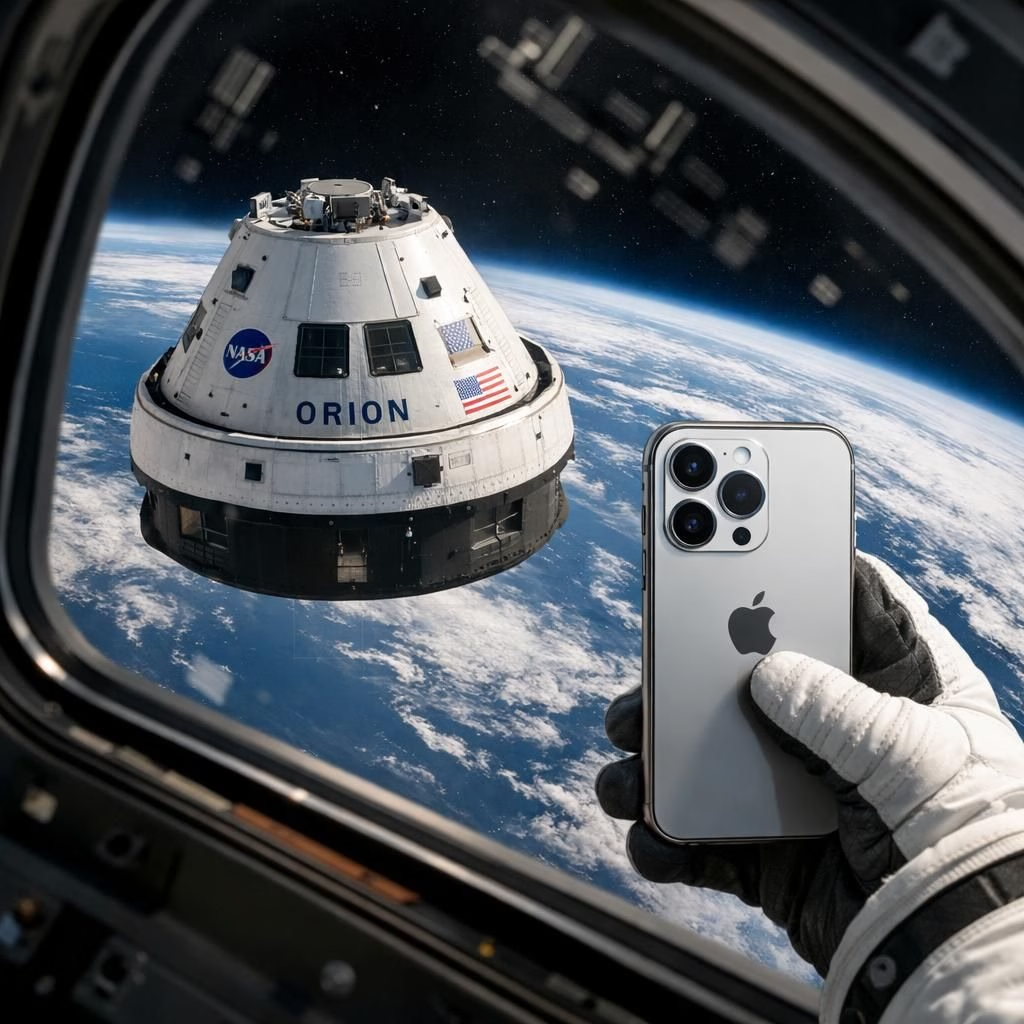
Artemis II marks a pivotal moment in spaceflight: four astronauts heading toward the Moon with decades of engineering behind them and a pocketful of consumer tech in plain sight. Artemis II isn’t just a NASA mission; it’s a cultural moment where storytelling embraces smartphones as part of the crew’s toolkit. The mission shows that even the boldest aerospace efforts benefit from everyday accessibility. In this voyage, iPhone 17 Pro Max devices sit in pockets and flight suits, signaling a new era of human-centered documentation. Artemis II features Reid Wiseman, Christina Koch, and two other crew members whose names are etched in mission logs, reminding us that space exploration is as much about communication as propulsion. This era, where the iPhone 17 Pro Max becomes a mission asset, turns personal devices into storytelling instruments against a cosmic backdrop. The result is a rising, human-centric chronicle that pairs curiosity with the discipline of spaceflight, as Earth fades into the blackness outside the cabin windows.
Artemis II: Mission Details and Cameras
The mission launches with a bold mix of precision engineering and practical reality. NASA approved the use of personal smartphones aboard Artemis II, making it one of the first missions where astronauts bring their own handsets into space. The four units of iPhone 17 Pro Max aren’t just for photos; they symbolize a shift toward accessible, human-centered mission storytelling. Yet the approval wasn’t a walk in the lunar crater. The clearance process followed a four-phase protocol that would make any project manager smile: a safety panel introduction, hazard identification, mitigation planning, and a validation that fixes actually work under microgravity stress. This is NASA’s way of saying, in the nicest possible terms, that you don’t want a glass screen shattering in a weightless environment, even if the glass is ceramic-shielded. The iPhone 17 Pro Max is built with Ceramic Shield 2, which Apple touts as tougher than most consumer glass. Still, NASA’s concerns go beyond fragility. In microgravity, devices behave differently—heat dissipation changes, batteries behave unlike their Earthbound cousins, and storage requires contingency planning that would impress even the meticulous archivists at NASA Goddard. The iPhone 17 Pro Max is not a replacement for the mission’s cameras; it’s a complementary tool that offers an unfiltered, human perspective on events that mission control would rather keep in the knowns rather than the unknowns.
Despite the spotlight on personal devices, the mission’s technical backbone remains robust and safe. Artemis II still relies on traditional imaging equipment for mission-critical documentation. The crew uses Nikon D5, Nikon Z9, and GoPro HERO4 Black cameras to capture high-resolution scientific and operational imagery. The iPhone 17 Pro Max provides accessible, everyday snapshots from the astronauts’ point of view—moments that humanize the mission and help the public connect with the awe of space travel. The juxtaposition of consumer tech and professional-grade aerospace gear is not chaos; it’s a deliberate blend designed to maximize both scientific value and storytelling potential. The iPhone 17 Pro Max’s role is not to outpace the Nikon or the GoPro but to offer a candid complement: quick cabin-light captures, a glance toward Earth through an Orion window, or a humorous moment in the cramped quarters of a spacecraft. Artemis II demonstrates that high-stakes exploration and everyday technology can share a common stage without stepping on each other’s toes, a balance NASA has learned to strike with care and a touch of humor.
In practical terms, durability and performance matter. The iPhone 17 Pro Max earns its keep not merely because it’s a phone with a cool camera, but because it can survive the rigors of spaceflight’s environment. Ceramic Shield 2 is one thing; battery stability and heat management in microgravity are another. NASA’s engineers kept a keen eye on how the devices are stored, charged, and safeguarded against the unique stressors of space. The four devices were tested against the same safety standards that govern any payload that leaves Earth orbit, including checks for electromagnetic interference, data integrity, and habitability concerns for crew members. The narrative surrounding Artemis II is not a carnival of gadgets; it’s a responsible, well-managed campaign to expand what we can document, share, and learn from a crewed lunar mission. The iPhone 17 Pro Max becomes a symbol of how far consumer tech has come and how far NASA is willing to go to tell a story that resonates with broad audiences, without compromising the mission’s integrity or safety. This is the future of space storytelling: a cooperative dance between advanced engineering and everyday devices, each playing its part with respect for the other.
As the images began to emerge—Earth glowing through cabin windows, astronauts with thoughtful expressions, the subtle hum of life-support systems in the background—people around the world got a glimpse of a space program that can still surprise us with a touch of human charm. The iPhone 17 Pro Max is not a prop; it’s a tool that, when used thoughtfully, adds texture to the official mission narrative. NASA’s approach—preserving high-quality, mission-critical imagery while welcoming personal devices for citizen-scale storytelling—offers a blueprint for future explorations. Artemis II shows that the line between professional-grade instrumentation and personal gadgetry can be both useful and inspiring, provided safety, reliability, and scientific value remain the guiding stars. The result is a richer, more accessible chronicle of humanity’s return to lunar orbit, one that invites curiosity, discussion, and a new sense of wonder about the intersection between space, technology, and everyday life.
For readers who wonder what this means for the future of space exploration, the answer is simple: expect more stories told from the ground up, using a blend of best-in-class gear and the phones we carry every day. Expect lighter, more personal angles on the science, the engineering, and the human experience of living and working beyond Earth. And expect that the line between professional tool and personal device will continue to blur in constructive, well-regulated ways. Artemis II teaches us that progress does not demand a sacrifice of simplicity; it calls for thoughtful, disciplined innovation, where even the smallest gadget can help illuminate the vastness of space for a global audience.
Original article: https://www.nasa.gov/artemis-ii — Thank you to the original source material for fueling this thoughtful rewrite and for the ongoing work toward lunar exploration.
We’d love to hear what you think about this blend of mission rigor and consumer tech. Please share your thoughts in the comments below.
iPhone 17 Pro Max: Space Smartphone on Artemis II
The idea of a space-bound iPhone 17 Pro Max isn’t just about a shiny camera; it’s about the human touch on a high-stakes journey. In cabin shots and spontaneous moments, the device provides a relatable lens for the public, without interfering with the mission’s safety and data protocols.
Artemis II and the iPhone 17 Pro Max: A Human-Centric Mission
In practical terms, the pairing of Artemis II’s engineering rigor with iPhone 17 Pro Max storytelling offers a blueprint for how future crews might document exploration while preserving data quality and mission safety. The human perspective—captured in real time—helps audiences connect with the voyage from a place of wonder rather than distance.
Practical Takeaways: Artemis II and the iPhone 17 Pro Max
- Four-phase clearance for personal devices ensures safety and reliability in microgravity.
- Ceramic Shield 2 and careful storage mitigate heat, battery, and breakage risks.
- Consumer tech complements pro-grade gear, enhancing public storytelling without compromising data integrity.
- Public-facing imagery balances immediacy with mission-critical documentation, expanding accessibility to a broader audience.
Frequently Asked Questions
- Why were personal smartphones allowed on Artemis II? NASA approved the devices after a four-phase safety review to ensure they don’t affect mission safety or data integrity.
- Do iPhones replace professional cameras on the mission? No. They supplement the imaging suite, providing personal, cabin-level perspectives that enrich storytelling.
- What does this mean for future missions? It signals a broader acceptance of consumer tech as a storytelling tool, with strict safety and data standards.
- How is data safety maintained with personal devices on board? Devices are subject to electromagnetic, storage, and operational checks as part of the mission’s safety protocols.
Takeaway and Next Steps
Artemis II demonstrates a balanced approach to space storytelling, combining high-grade engineering with everyday devices. The takeaway is clear: we can expect more missions to embrace human-scale tech while maintaining rigorous safety and scientific standards. Stay tuned for official imagery and mission updates from NASA as Artemis II progresses.
Original article: https://www.nasa.gov/artemis-ii — Thank you to the original source material for fueling this thoughtful rewrite and for the ongoing work toward lunar exploration.