

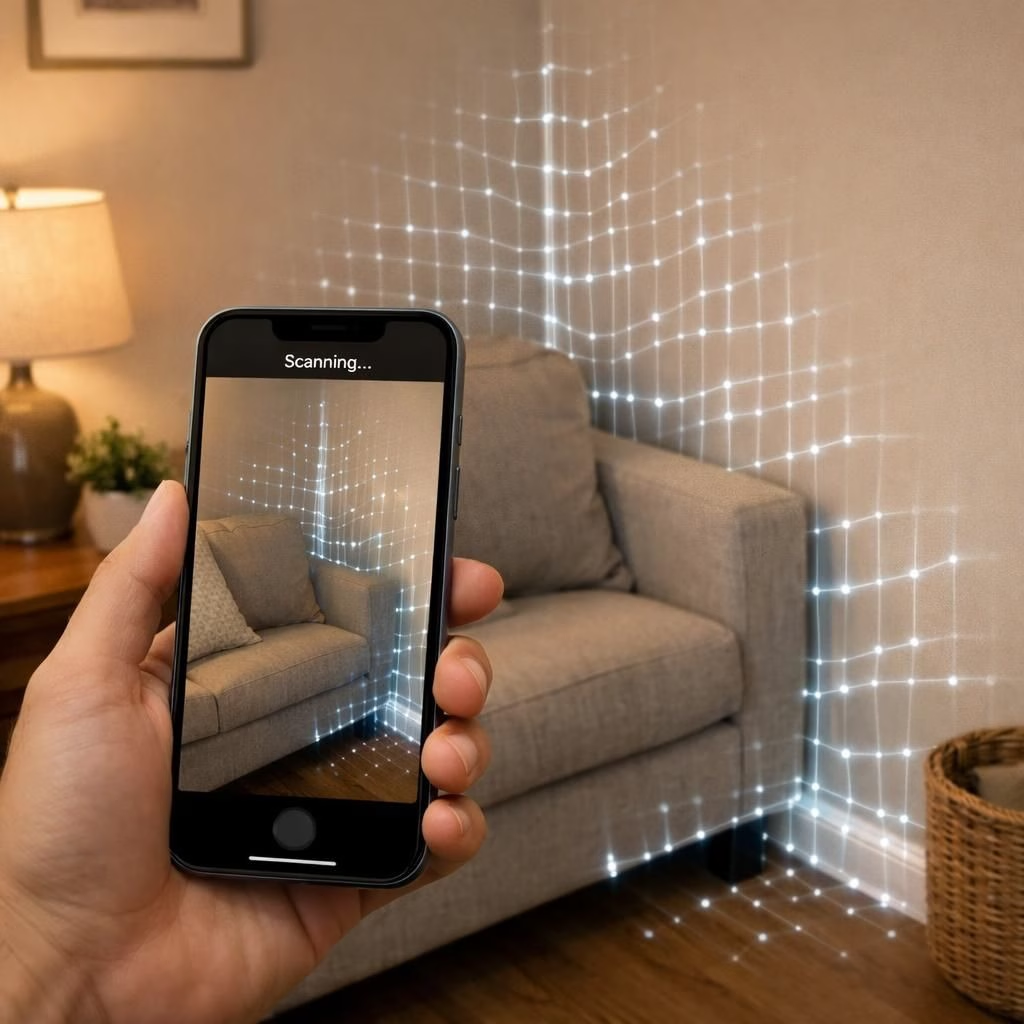
LiDAR and motion-induced sampling collide in a playful, practical tour of imaging hidden objects with consumer sensors. The premise is simple: your device’s motion becomes a tool, turning a flat scan into a richer map. In 2026, this isn’t science fiction; it’s a rising-tide capability that tech reporters call out with both caution and curiosity.
LiDAR curiosity meets motion-induced sampling in daily life
We start with the basics: LiDAR uses light to measure distance. That core idea remains, but the trick now is to pair it with motion-induced sampling. The result is a data stream that fills gaps as you move. Instead of a single snapshot, you get a sequence that paints a scene from multiple angles. This combo helps reveal objects hidden behind corners, under clutter, or inside a shallow cabinet. The practical upshot is simple: better room understanding with consumer hardware.
In this space, researchers are not selling dreams; they are showing patterns. Nature’s coverage points to experiments where everyday LiDAR becomes an around-the-corner camera. MIT Media Lab demonstrations use motion to synthesize views that peek around edges. The math is familiar: parallax, registration, and a dash of clever reconstruction. The result looks almost magical, yet it is built from ordinary hardware and careful software. The tone is hopeful, not reckless, which matters in 2026 as sensors spread into phones, cars, and home devices.
From a practical point of view, motion-induced sampling means we do not need a high-end lab rig to see what hides behind a chair. When you move slowly and purposefully, your sensor captures multiple angles that feature different shadows, occlusions, and reflections. A hidden object is no longer a moving mystery. It becomes a candidate for fusion into a single, more complete image. This is not about peeking at private spaces. It is about safer navigation, better design, and smarter robotics that learn from exposure to real rooms.
Practical examples are appearing in homes and offices, including devices that blend LiDAR with smart software for mapping and safety checks. If you own a modern device, you can start experimenting with guided motion to collect richer data without specialized rigs.
For readers curious about consumer-ready examples, several projects illustrate the trend. For instance, iRobot has integrated lidar mapping into Roombas, expanding home-cleaning with spatial awareness. And drone makers explore LiDAR-enabled perception, as hinted by upcoming features in the DJI Mavic 4 Pro. See: iRobot launches eight new Roombas and finally adds lidar mapping and Upcoming DJI Mavic 4 Pro premium drone could deliver new camera skills and LiDAR.
Seeing around corners with LiDAR and motion-induced sampling
These advances are echoed across outlets. IEEE Spectrum’s question, Can Your Phone’s Lidar Sensors See Around Corners? is not a gimmick claim; it is an invitation to rethink sensing. Bioengineer.org and MIT Media Lab also showcase how consumer LiDAR can reveal hidden objects with clever sampling. The thread is consistent: LiDAR data, when paired with motion-induced sampling, yields richer maps that fill in the gaps where sight alone misses. The practical upshot is not a future lab toy; it is a feature that may soon ship in ordinary devices and routine workflows. The blend of hardware and software makes a shared future more tangible, even in cluttered rooms and sunlit halls.
Of course, there are limits. The algorithms are sensitive to motion quality. Too much shake can scramble the data. Noise, occlusion, and reflective surfaces pose ongoing challenges. Yet the direction is clear. A consumer LiDAR world that learns from motion is kinder to batteries, faster to answer, and more forgiving of imperfect setups. For creators and researchers, the aim is to lower barriers so that a hobbyist with a phone can experiment responsibly, while engineers scale up to assist professionals in architecture, manufacturing, and healthcare. In other words, LiDAR plus motion-induced sampling is a bridge between curious experiments and practical tools.
In 2026, the social and ethical dimensions deserve attention too. As sensors grow more capable, the dialogues around privacy, consent, and safety become more urgent. The promise is powerful—but it requires thoughtful implementation. The public interest is best served when developers publish clear usage guidelines, and when platforms offer transparent controls that let users decide what to share and how. The conversation is ongoing, and the pace is encouraging. People who adopt LiDAR for simple tasks—like decorating a room, analyzing space for accessibility, or guiding a robot vacuum—will appreciate the balance of magic and method that motion-induced sampling brings.
For enthusiasts and practitioners, here are a few practical notes:
- Use a device with a modern LiDAR camera; you do not need exotic hardware to start experimenting with motion-induced sampling.
- Move deliberately to collect varied perspectives; gentle parallax helps reconstruction without overwhelming the processor.
- Combine data with lightweight AI tools that can fuse frames and fill gaps safely, with privacy in mind.
As we move through 2026, the trend remains clear: LiDAR is no longer just a niche sensor for maps and games. It is becoming a general tool for perception, and motion-induced sampling is the technique that unlocks more of its potential. The small, honest challenge is to make this capability accessible, reliable, and responsible for everyday use.
Original article and thanks: Special thanks to Nature for the inspiration behind this piece. Original article: Imaging hidden objects with consumer LiDAR via motion-induced sampling (Nature).
Have thoughts, questions, or ideas to test in your own setup? Please share your thoughts in the comments. Your feedback helps everyone learn and improves how we apply LiDAR and motion-induced sampling in the real world.
External references:
Can Your Phone’s Lidar Sensors See Around Corners? and MIT Media Lab.
FAQ: motion-induced sampling
- What devices support LiDAR + motion-induced sampling? Most modern devices with built-in LiDAR cameras can experiment with guided motion and frame fusion, without specialized lab gear.
- Is it safe for privacy? Privacy depends on settings and sharing controls. Use clear opt-ins and limit data sharing in public environments.
- What are best practices for beginners? Start with slow, deliberate movements, use lightweight fusion software, and test in non-sensitive spaces.