

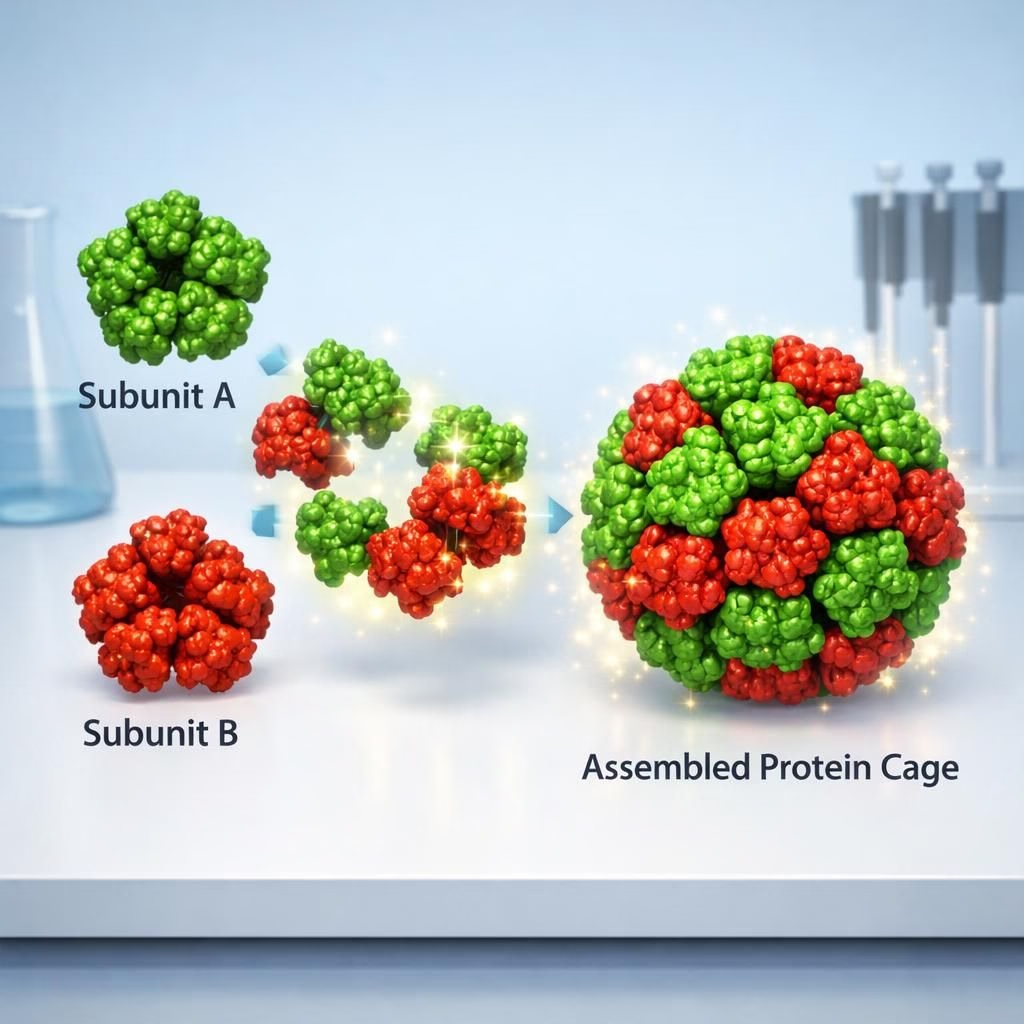
Let’s talk protein cages and design, two terms that keep science from becoming a snooze-fest. In 2026, researchers achieved de novo quasisymmetric two-component protein cages, a mouthful that basically means: build a tiny, modular container from scratch that behaves reliably enough to hold cargo and amuse your lab mates.
But how does this work without turning into a rust-belt of experiments? The core idea is to assemble two distinct protein components into a single, self-contained enclosure that looks like a geometric sculpture under cryo-EM supervision. The de novo aspect means the researchers started from scratch rather than repurposing a natural cage, which is like building a cake from scratch rather than frosting an existing one and calling it new. The quasisymmetry part gives a little room for imperfection, which is useful when two components don’t line up perfectly but still manage to cooperate to form a stable cage. The result is a robust architecture that tolerates slight misregistries while maintaining the overall geometry.
protein cages in de novo design: a quick tour
In practice, the scientists designed two modular subunits that fit together through a curated set of contact surfaces. They then validated that the two-component cage assembles as designed using structural techniques such as cryo-electron microscopy and computational modeling. The two components carry complementary interfaces so that mixing them increases fidelity without locking the system into one rigid arrangement. Because the assembly process is modular, researchers can tweak surface chemistries, flexibility, and binding strength without rewriting the entire blueprint. That modularity is the secret sauce for rapid iteration in synthetic biology.
Quasisymmetry means the cage does not require perfect symmetry across all subunits. Some subunits may have slightly different sequences or interfaces, but the global shape remains highly symmetric. This tolerance is essential when you assemble two different components because exact symmetry would demand perfect matching of all parts, which is rarely practical in real proteins. Quasisymmetry therefore reconciles the elegance of geometry with the messiness of biology. Designers can implement a small number of variant interfaces while preserving the overall polyhedral geometry, enabling a family of cages with shared architecture but diverse cargo capabilities.
Design principles for quasisymmetric cages
From a design perspective, the main win is that you get a predictable container that can host enzymes, therapeutics, or diagnostic payloads without turning into a misbehaving artifact. The de novo approach lets engineers tailor the interior environment, the exterior display, and the mechanical leeway all at once. The two-component strategy adds flexibility: instead of crafting a single monolithic protein, you mix two distinct scaffolds that present matching docking surfaces. If one component mutates or folds a bit differently in a new host, the other can compensate, preserving the overall architecture. In practice, this means researchers can explore a family of cages with shared geometric rules but varied, cargo-friendly properties. This is design with a dash of resilience, which, frankly, sounds like a startup pitch you would actually want to back.
Practical takeaways for readers include the idea that modularity and symmetry need not be enemies. You can design complex assemblies by sequencing simple parts and letting them find each other in the right way. You can also appreciate the balance between rigidity and flexibility — too rigid, and the cage snaps; too floppy, and the cargo leaks. The quasisymmetric approach offers a middle path where a handful of variant interfaces co-exist within a stable, symmetric framework. For researchers and students, this means you can iterate quickly by swapping interfaces and reusing the same geometric template, rather than drafting a new cage from square one every time.
Beyond the science, there is a practical thrill. Protein cages built on design principles de novo with quasisymmetry could serve as nanoreactors that encase catalytic enzymes, shielding them from competing reactions while granting controlled access to substrates. They could also deliver payloads to specific cellular environments, or act as scaffolds for vaccines and imaging agents. The design ethos here is to harness symmetry with a pragmatic allowance for variation, striking a balance that supports both precision and creativity. In short, the field has learned to embrace a little imperfection as a tool, not a liability, and that is a refreshing turn for anyone who has ever fought to align subunit interfaces at 2 a.m.
- Modularity as a design principle means you can swap parts without reengineering the whole cage, speeding up iteration cycles.
- Quasisymmetry provides tolerance to small misalignments, improving yield and robustness in real-world production.
- Two-component cages expand the design space, enabling diverse cargos and functionalities without bloating the code of life.
As with any new paradigm, challenges remain. Misassembly, expression levels, and stability under physiological conditions can bite. The computational models that guide design are powerful but not perfect; the real world still loves a stubborn fold or a stubborn aggregation event. Researchers address these issues by refining interfaces, testing alternative subunit pairs, and using orthogonal assembly pathways to guard against cross-talk. The practical upshot: a toolkit that keeps getting better, with more predictable results and fewer sleepless nights for the design team.
Looking forward, we can expect more sophisticated cages with tailored pore sizes, selective permeability, and cargo-release triggers. The same principles that power design in de novo protein cage systems could help in areas such as enzyme cascades, targeted delivery, and diagnostic reagents. The goal is not just to build pretty shapes but to give these cages real chemical and biological utility. The underlying design ethos here could unlock containers that operate in harsher environments or under tighter regulatory constraints, broadening the range of possible applications for synthetic biology in medicine and industry.
Original article: Nature. De novo design of quasisymmetric two-component protein cages. https://www.nature.com/articles/XXXXXX. Thank you to Nature for the original material that inspired this post.
If you found this exploration intriguing, please share your thoughts in the comments. I’m curious to hear your ideas, questions, and the occasional skeptical takeaway on how these cages could reshape biotech in 2026.
FAQ
- What are quasisymmetric two-component protein cages?
They are modular protein assemblies built from two distinct subunits that join to form a stable, symmetric container capable of housing enzymes or cargo.
- Why de novo design?
Starting from scratch lets researchers tailor interior chemistry, exterior features, and the tolerance to imperfect interfaces, improving flexibility and robustness.
- What challenges remain?
Misassembly, expression levels, and stability under physiological conditions continue to be addressed with iterative testing and interface refinement.
- Where can I learn more?
Check the original Nature article and related reviews on protein cages for broader context.
Conclusion
In short, de novo quasisymmetric two-component protein cages illustrate how modularity, symmetry, and a pragmatic tolerance for variation can accelerate innovation in synthetic biology. They offer a tangible route to new nanoreactors, targeted delivery, and diagnostic tools, while keeping the door open for iterative improvement. For students and researchers, the key takeaway is that small, well-made changes to interfaces can yield big, predictable gains in performance.
Original article reference: https://www.nature.com/articles/s41586-026-10464-0
References
- Original Nature article: De novo design of quasisymmetric two-component protein cages
- Protein nanocages on Nature
- Protein nanocage – Wikipedia