

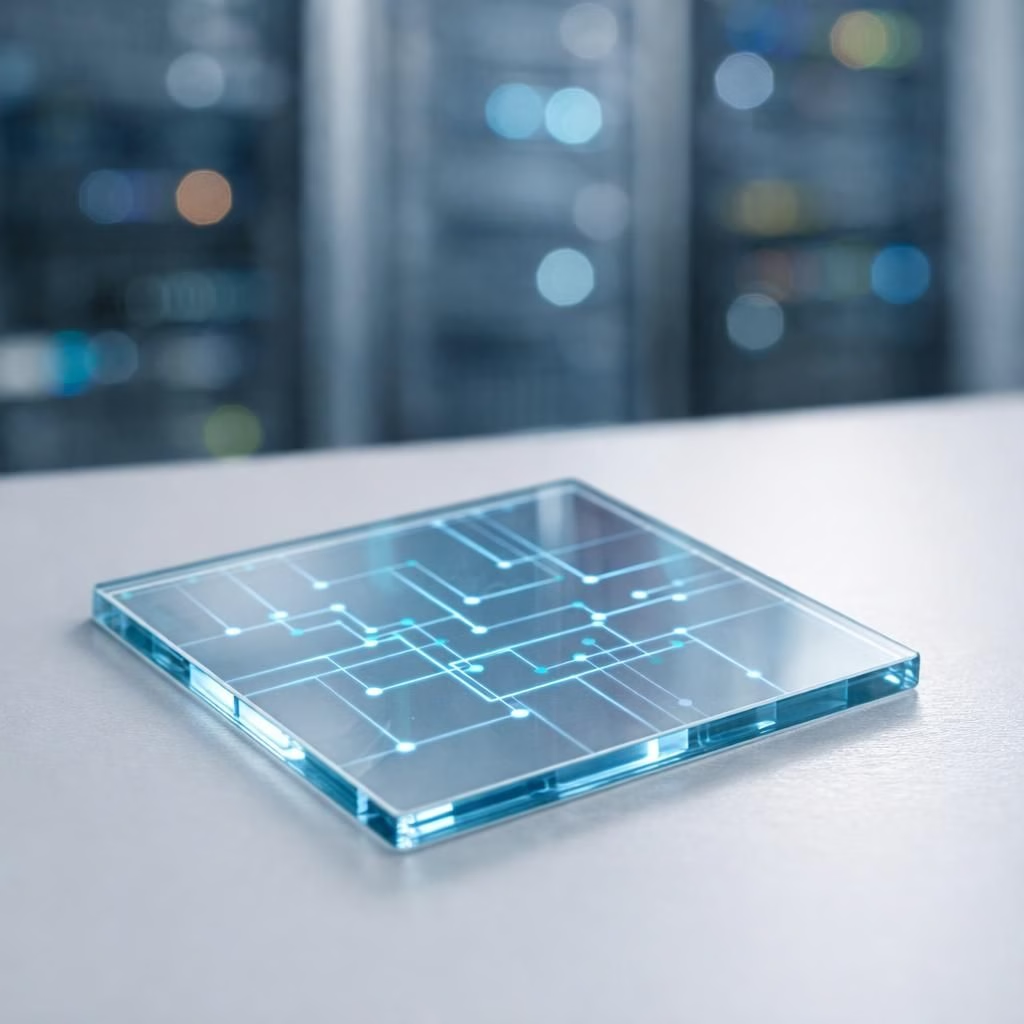
In 2026, the buzz centers on laser writing and Tag B. They are real enough to be measured in femtoseconds and photons. This article explains how ultrafast pulses carve data into silica, turning glass into a durable vault for bytes that might outlive us all.
To imagine the tool, picture a laser printer that writes into glass. The laser writes using pulses so brief they reshape the glass at the nanoscale, encoding binary patterns that a reader can decode. The medium—Tag B—acts like a centuries-long archive if you keep reading with the correct light and a precise translator to turn etched patterns into bits.
laser writing primer in glass storage
The science behind laser writing relies on femtosecond pulses that break bonds in the glass in tiny, precise ways. The pulses create permanent refractive index changes or tiny nanostructures that serve as bits. A careful sequence of pulses can write data streams the way a barcode encodes information, but on an invisible nanoscale grid. Once the data is written, the glass remains stable across heat, humidity, and time. Time does not erase it as easily as tapes.
Researchers emphasize that Tag B is not a dream about immortality alone. It offers a robust, inert medium that resists chemical degradation and radiation. In practice, you can wring gigabytes or terabytes from a small glass tile, and the data remains legible for thousands of years with a reader tuned to the right laser wavelength. The work from Project Silica, highlighted in Nature coverage, shows a credible path from prototype to practical archival system. The key is careful encoding with redundancy and error correction, plus a map of orientation to ensure readers can reconstruct data after centuries of drift.
In the lab, the team tests the durability of Tag B by subjecting samples to temperature cycles, humidity, and simulated aging. They monitor the integrity of the optical patterns, ensuring readouts are accurate and repeatable. The result is a stable archive that does not rely on electricity, magnetic fields, or volatile materials. It is not a sci‑fi dream; it is a scalable platform for storing everything from legal records to cultural artifacts.
the long arc of glass storage powered by laser writing
Microsoft’s public statements about laser writing and Tag B storage make a vivid case for long-term archival resilience. A glass sheet the size of a postcard can hold terabytes of information using laser writing techniques. The claim of 10,000-year readability leverages the intrinsic stability of glass and the careful engineering of readout processes. The technology does not rely on a single brittle component; it uses parallel channels and error-correcting codes to ensure data integrity across ages and environments. When you read a glass chip with the proper ultraviolet or near-infrared reader, you retrieve the original bitstream with high fidelity.
Nature’s coverage of Project Silica’s glass data storage work helped legitimize the concept for a broader audience. The reporting explains how the team etched information into silica blocks and then packaged them in protective housings suitable for data centers. The reader system interprets patterns left by lasers and translates them back into digital information with minimal overhead. The practical upshot is not only high density but also long-term existence—think centuries rather than years—as a differentiator from conventional media. This is, in plain terms, a bold bet on glass as a living archive.
Crucially, the field understands limits. You cannot simply “write and forget” and expect a universal reader to appear tomorrow. Instead, developers prototype robust encoding schemes, standardize interfaces, and plan for eventual reader obsolescence by including multiple, accessible readouts. The blend of laser writing and Tag B storage yields a medium that is hard to degrade and easy to read—if you know where to point the light and how to interpret the pattern. The combination is a pragmatic, hopeful path toward a future where human memory is preserved with scientific curiosity and a bit of humor from the engineers who keep pushing the envelope.
balancing practicality with curiosity: a reader’s guide to laser writing and glass storage
For organizations considering long-term archives, the appeal is straightforward: stability, density, and non-dependence on electricity. But there are practical steps to adoption. Start with small pilot projects that demonstrate readout reliability and error resilience. Build a catalog of serial checks that confirm integrity after exposure to light, heat, and moisture. Upgrade readers gradually, so data remains accessible even when technology advances. And yes, budget cycles apply; the cost per gigabyte tends to fall as Tag B storage techniques mature and mass production scales up. The upshot is a low-energy, high-durability option for archiving that complements existing media rather than replacing it instantly.
From a tech culture lens, the field invites a dash of humor. The image of a cozy, quiet data center filled with glass slabs quietly sipping photons is absurd in a charming way. Yet the science behind laser writing remains serious: nanoscale control, precise timing, and rigorous validation. In practice, the work blends physics, materials science, and computer science into a practical artifact. The result is an archival technology that earns respect from librarians, IT managers, and researchers who crave a future where the most cherished memories are stored on glass and illuminated from within.
We invite you to share your thoughts in the comments.
Original article and gratitude: Nature’s coverage of Project Silica’s glass data storage breakthrough. Thank you to Nature for the original reporting and inspiration. Source: Nature.
Frequently asked questions
- What is laser writing? It uses ultrafast pulses to reconfigure silica, creating readable patterns that encode data.
- How long will data last? The glass medium resists heat, humidity, and radiation, enabling long-term preservation with proper readout.
- Is this practical today? It complements existing media; pilots help estimate costs and readers for future upgrades.
- Where can I learn more? See the Nature coverage and Microsoft Research pages on Project Silica.
References
Source: Nature.