

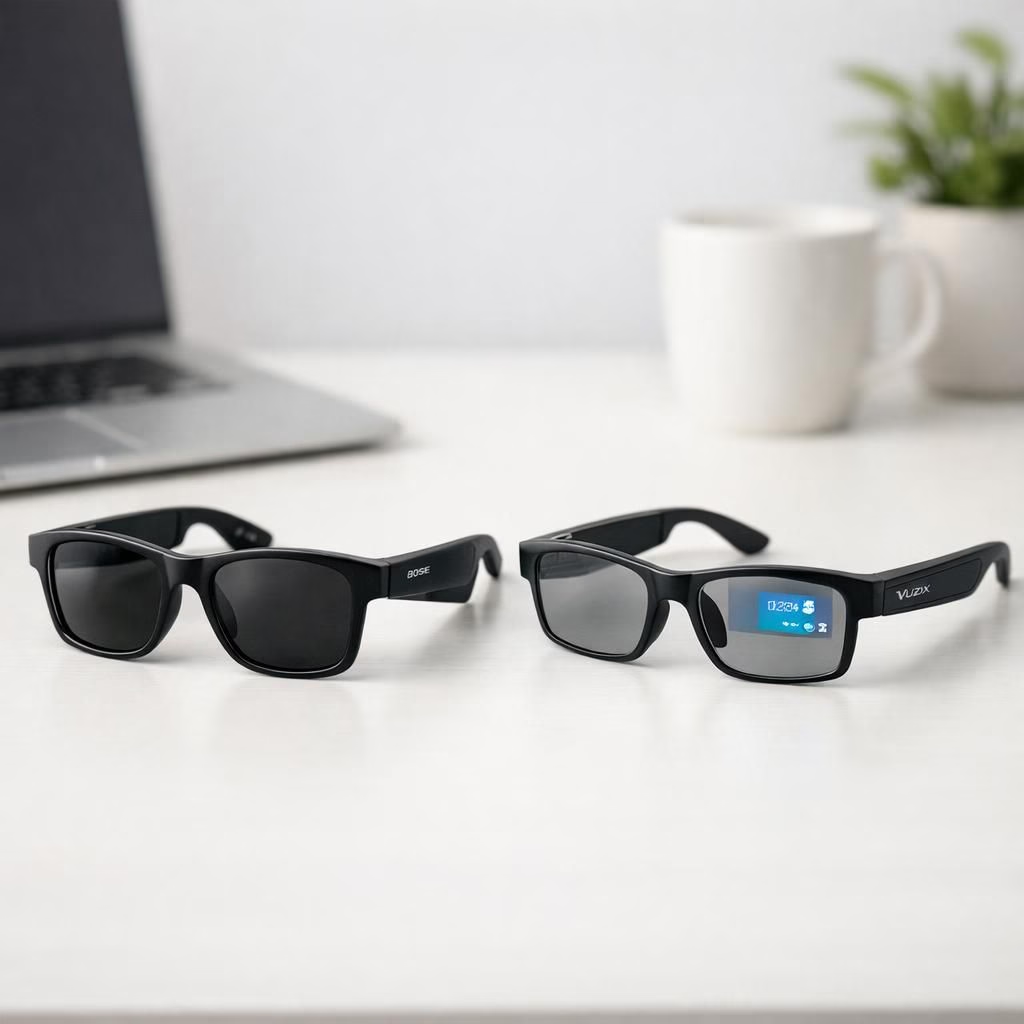
Welcome to a bright future where Intelligent Eyewear and AI glasses are no longer sci-fi props but everyday gadgets. Google and Samsung announced Intelligent Eyewear at Google I/O, in partnership with Gentle Monster and Warby Parker. Two variants are planned: an audio-only model arriving this autumn and a version with a tiny in-lens display launching later. The audio model provides private, spoken AI assistant support, while the display version overlays notes, directions, or notifications into the wearer’s view. In practice, this means walking around with a sleek headset that also doubles as a fashion statement. They emphasize privacy, as conversations and visuals stay controlled by the wearer, not broadcast to the world. Intelligent Eyewear is pitched as a bridge between apps and ambient intelligence.
Intelligent Eyewear and AI glasses: The XR Awakening
Google and Samsung describe Intelligent Eyewear as an Android XR experience that works across Android and iOS. The audio-only variant focuses on private voice interactions, while the display variant overlays contextual data into the wearer’s sightline. This combination aims to keep you connected without reaching for your phone, reinforcing the idea that Intelligent Eyewear can be a natural companion in daily life.
AI glasses and the Fashion-Forward XR Push
Two eyewear brands join the project: Gentle Monster and Warby Parker. Gentle Monster’s elongated oval sunglasses contrast with Warby Parker’s classic rounded-square frames, underscoring the emphasis on style first. The teams want AI glasses to feel stylish and approachable, not like cloning hardware. Design choices are intended to spark conversation while keeping technology visible, yet celebrated.
From a technical standpoint, Intelligent Eyewear builds on the Android XR platform and is designed to work across Android and iOS. The glasses rely heavily on voice control for most actions, and the optional tiny display shows contextual data that blends into the real world. Google frames this moment as a milestone for XR and as a distinct category, rather than a simple evolution of wearables. The comparison to Meta’s Ray-Ban AI glasses is inevitable, but this is Google’s move to re-enter the space after the earlier Google Glass era. Privacy concerns, battery life, and comfort remain central challenges as XR experiences aim to merge seamlessly with daily routines.
Market dynamics are heating up. The smart glasses market is growing quickly, with Meta reportedly moving millions of AI-powered units last year. Privacy remains a hot topic, with ongoing scrutiny around how wearables capture video or data in public spaces. The partnerships stress transparency and user control, yet observers remain cautious about default data collection. For developers, the challenge is to craft meaningful experiences without becoming intrusive. For consumers, the question is whether the technology adds value without complicating everyday life.
In sum, Intelligent Eyewear and AI glasses mark a bright chapter in wearable tech. The goal is to overlay helpful AI in real time while respecting privacy and consent. The design teams aim to celebrate technology without overpowering style or human interaction. The XR horizon is wide, with Android XR at the center and Gemini AI guiding the journey. Google’s return to the category signals maturity and a willingness to iterate, with more styles and in-lens options expected as the year progresses.
Practical uses with Intelligent Eyewear
- Use voice to play music, capture photos, or access apps hands-free while keeping your phone stowed away.
- Follow directions with a discreet in-view overlay, useful for walking or commuting without pulling out a device.
- Respond to messages or check calendar reminders through natural speech, reducing screen time.
FAQ about Intelligent Eyewear
Q: When will these glasses be widely available?
A: Google and Samsung have announced a staged rollout starting with an autumn audio-only model and a later in-lens display variant. Availability details may vary by region.
Q: How does privacy work on these devices?
A: The devices are designed to keep conversations and visuals under the wearer’s control, with surfaces and data not broadcast by default. Privacy and user consent remain central topics as features evolve.
Q: Are these compatible with all smartphones?
A: The system is built to work across Android and iOS, emphasizing cross-platform compatibility rather than a single ecosystem.
Q: How do developers build for Intelligent Eyewear?
A: Google describes it as an Android XR platform, encouraging apps and services to integrate through voice-first interactions and contextual overlays.
References
Original source and attribution: Dezeen. Original material available at Dezeen.