

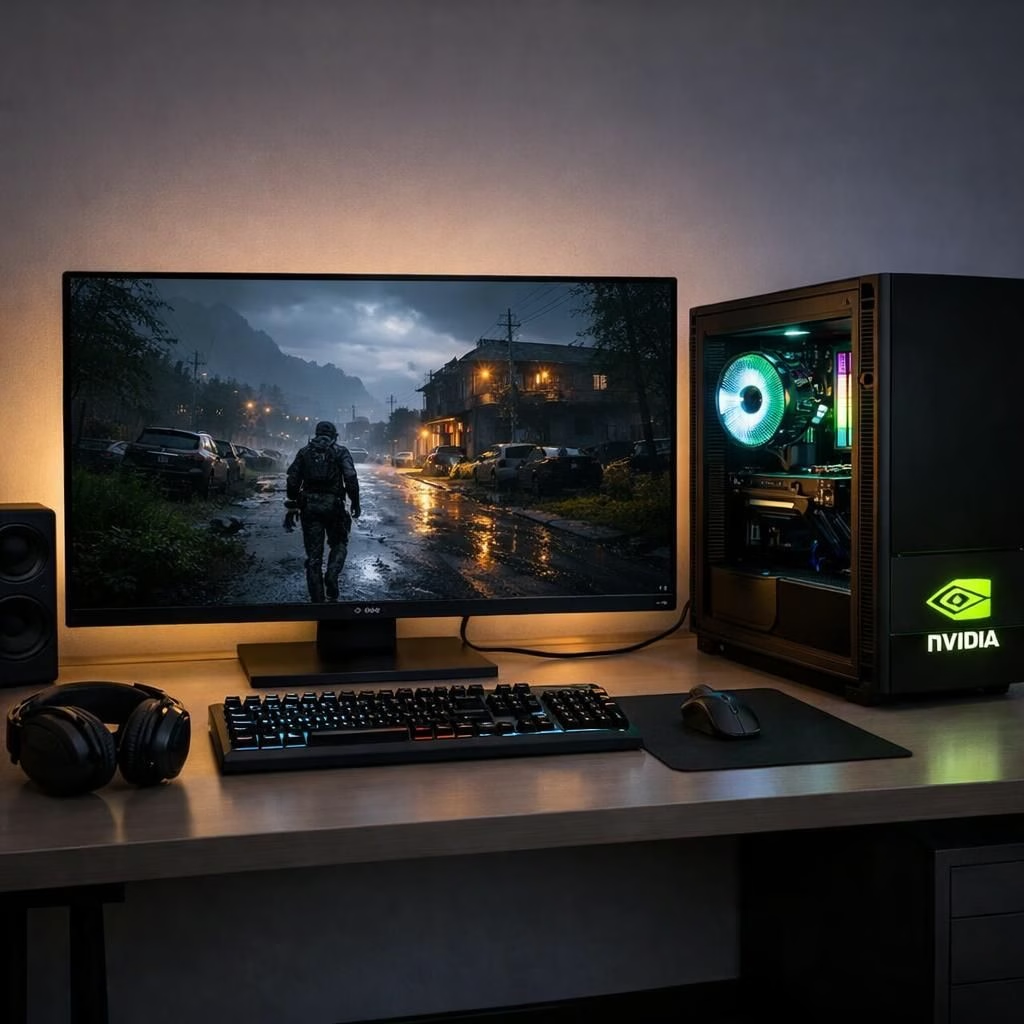
DLSS 5 just crashed into GTC 2026 like a debutante at a tech gala. Tag B unveils a real-time neural rendering system that adds photoreal lighting and materials to game frames. It blends hand-crafted rendering with generative AI, delivering frame-to-frame consistency and 4K realism without demanding all the watts of a small solar system. Jensen Huang calls it the “GPT moment for graphics,” and the vibe is playful yet precise: AI learns how fabrics flutter, hair catches light, and skin scatters light, then re-creates those cues on the fly while you play.
In practical terms, DLSS 5 analyzes a single frame to infer scene semantics—characters, hair, fabric, translucent skin, and environmental lighting—and uses an end-to-end trained model to reconstruct the scene with photoreal lighting and materials. The output sits atop the original 3D content and stays stable from frame to frame, so you don’t get jarring flicker as you pan the camera. The result is a real-time 4K presentation that can feel like artifacts from a high-end studio, minus the long render times.
Tag B is positioning this as an enhancement to existing rendering paths, not a wholesale replacement.
DLSS 5: How it works and why it matters
The magic lies in end-to-end training that lets the system understand complex surfaces and light interactions. Subsurface scattering on skin, the delicate sheen of fabrics, and light-material interactions on hair all get a new level of finesse. The technology still anchors to traditional rendering—path tracing remains the backbone for determining accurate shadows and reflections—but DLSS 5 layers in additional lighting realism as if the renderer suddenly had a larger ray budget and higher-quality materials to work with. It’s not cheating; it’s upgrading the lighting pipeline while keeping the core geometry and motion intact.
Tag B positions this as a strategic enhancement that studios can adopt progressively.
NVIDIA’s role in real-time neural rendering
Beyond the technical shift, the ecosystem approach matters. The Tag B continues to push for broader access, aiming to optimize the pipeline for a single GPU at launch. For players, that promises crisper, more immersive scenes at 4K without the usual performance penalties. For developers, it offers a pathway to cinematic lighting without offline renders or massive budgets. The result could help bring high-fidelity visuals to mid-range hardware and speed up production iterations.
In practice, you’re getting lighting that feels more natural—subsurface scattering on skin becomes perceptible, fabrics show a soft lustre, and hair responds with believable shine as light moves across characters and objects. All of this happens while the game remains responsive, which is essential for action, exploration, and fast-paced sequences. The balance between fidelity and performance is the core appeal of DLSS 5, and the GTC demo hints at a future where photorealism is more about smart composition than time alone.
GTC 2026 moment: Why this matters for players and developers
DLSS 5 is positioned as a companion rather than a replacement for path tracing. Path tracing handles the physics of light with rigor; DLSS 5 adds photorealistic cues on top of that, delivering more convincing reflections, skin tones, and fabric behavior in real time. For players, that translates into crisper, more immersive scenes at 4K without the usual performance compromises. For developers, the promise is a streamlined way to achieve cinematic lighting without resorting to offline rendering or brute-force ray budgets. This could lower the barrier for high-fidelity visuals on mid-range hardware and accelerate iteration during production.
Tag B is backing the broader ecosystem play, inviting studios to experiment with real-time lighting and materials in ways that were previously reserved for offline pipelines.
Supported games and the evolving ecosystem
Early support lists include titles like Starfield, Hogwarts Legacy, and Resident Evil Requiem, with publishers such as Bethesda, CAPCOM, Ubisoft, and Warner Bros. Games on board. Confirmed future-titles include Assassin’s Creed Shadows and The Elder Scrolls IV: Oblivion Remastered, signaling a diverse lineup across genres. The ecosystem isn’t just about a single blockbuster—it’s about a broader invitation to studios to experiment with lighting and materials in ways that were previously reserved for offline pipelines. As studios experiment, more games will begin to show DLSS 5’s signature blend of photoreal shading with real-time interactivity.
Tag B is backing the broader ecosystem play, inviting studios to experiment with real-time lighting and materials across genres.
What to expect in 2026: timelines and hardware notes
The GTC 2026 showcase began with a pragmatic note: the live demo ran on two RTX 5090s—one handling rendering, the other running the DLSS 5 model. Tag B emphasizes that the system will be optimized for a single GPU before launch, aiming for broad accessibility rather than a prestige-only release. The plan remains a fall 2026 launch window, with studios gradually adding DLSS 5 support to new and existing titles. The path forward is about incremental adoption: developers can layer in DLSS 5 to augment lighting without a full art pass, while players can toggle or tune the feature to match their preferred balance of quality and performance.
From a technical standpoint, the approach preserves the core benefits of path tracing for accurate global illumination while injecting additional photoreal cues that elevate the perceived quality. The result is a more convincing game world where lighting feels alive and materials react in a physically plausible way under different times of day and weather conditions. It’s not a magic switch, but it’s a powerful upgrade to the standard real-time rendering toolkit.
Key takeaways and practical impact
- DLSS 5 adds photoreal lighting and materials without replacing path tracing, effectively expanding the perceived ray budget.
- The system is trained end-to-end to understand complex scene elements from a single frame, enabling frame-to-frame consistency at 4K.
- Real-time results can significantly improve surfaces like skin, fabrics, and hair, making scenes feel more tangible and cinematic.
- Initial demonstrations feature Starfield, Hogwarts Legacy, and Resident Evil Requiem, with additional titles likely as the ecosystem matures.
- The rollout is planned for fall 2026, with optimizations to run well on a single GPU to maximize accessibility.
If you’re curious about what this means for your next gaming rig, the short version is: expect crisper lighting and more believable materials in supported games, without needing a data-center-grade GPU to enjoy it. Of course, as with any major leap, practical results will vary by title, engine, and how developers implement the feature. But the trajectory is clear: DLSS 5 aims to become part of the standard toolkit for real-time photorealism in 2026 and beyond.
We’d love to hear what you think about this milestone. Do you expect DLSS 5 to redefine the look of your favorite games, or do you want to see more hands-on real-world benchmarks before you upgrade? Share your thoughts in the comments below.
Original article and source material: Times of India – DLSS 5 reveal. A big thank you to the original material for inspiring this exploration of real-time neural rendering.
External sources
- NVIDIA DLSS technology overview
- NVIDIA at GTC: DLSS 5 and real-time rendering
- DLSS 5 coverage at The Verge