

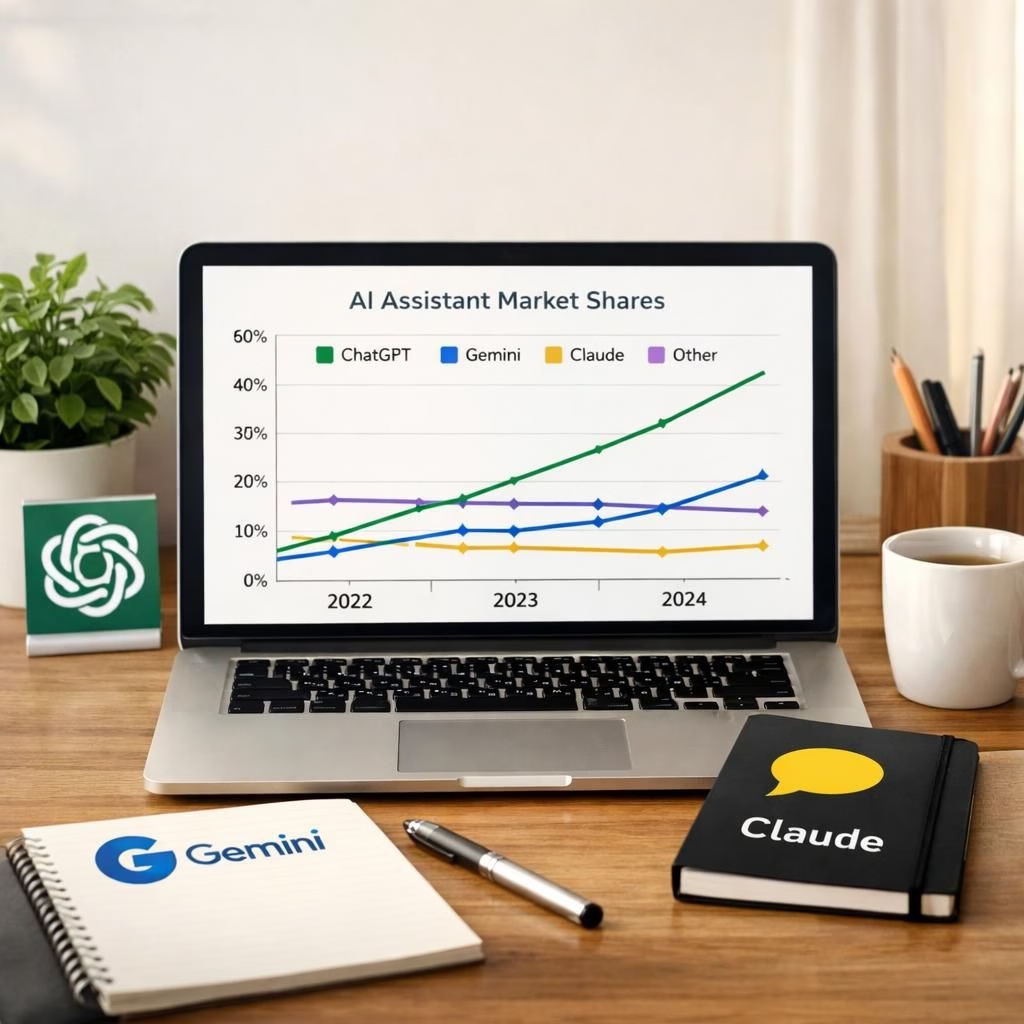
AI Assistant landscapes are evolving in 2026 with surprising pep. ChatGPT has lost its majority—though far from collapse—as Gemini and Claude gain traction, according to Sensor Tower’s State of AI Report 2026.
Sensor Tower’s report shows the AI Assistant share for ChatGPT slipped to 46.4% by May, while the broader AI Assistant field swells with new ecosystem plays and growing paid tiers. The news looks like a renaissance of choice for users and developers rather than a collapse. If you build apps or just enjoy a versatile helper, the shift is your cue to learn the new terrain and pick your companions wisely.
AI Assistant momentum: Gemini and Claude redraw the map
Gemini now holds 27.7% of the AI Assistant market and has 662 million monthly users, making it the strongest challenger to ChatGPT so far. The growth isn’t luck; it’s driven by deep integration across Google Search, Gmail, Android, and Workspace. When a user opens a map, emails, or a note app, Gemini can shadow the moment with context and suggestions. This isn’t hype; it translates into real engagement and, for developers, incentives to build within Google’s AI ecosystem.
Gemini’s traction shows that multi-product platforms can move markets by weaving AI features into everyday tools. This momentum confirms that ecosystems can win broad adoption and push user engagement higher across services.
Anthropic’s Claude is also taking a healthy bite out of the old order, reaching 10.3% market share with about 245 million monthly users. Claude leads in paid subscriptions, with 13% of its users paying for premium plans—an early sign that people value performance, reliability, and enterprise-grade controls. This trend suggests a bifurcated market: broad free access and distinct paid tiers for advanced capabilities.
Beyond Gemini and Claude, Grok, Perplexity, DeepSeek, and Meta AI are growing steadily. Each remains below 5% of the market individually, but together they contribute to a more robust, multi-vendor AI landscape. For users, this means more options, less vendor lock-in, and a healthier ecosystem where features improve through competition. For developers and product teams, it’s a reminder to diversify toolchains and to design experiences that gracefully handle multiple assistants rather than pinning all hopes on a single platform. The market correction isn’t a crisis; it’s a chance to craft more resilient, interoperable AI experiences.
ChatGPT under pressure, but still king of the hill
ChatGPT remains the household name and the most-used AI assistant by a wide margin, but the growth curve is no longer a straight line to monopoly. The installation of new players and the expansion of existing ecosystems have broadened the AI Assistant horizon. The report notes 1.1 billion monthly active users for OpenAI’s flagship, a testament to durable appeal and a habit of turning questions into quick answers. Yet the competitive pressure is real enough to prompt meaningful optimizations: faster responses, better handling of niche tasks, more transparent pricing, and tighter privacy controls. In short, ChatGPT is still the quarterback, but the roster has expanded, and the game plan is more versatile than ever.
From a product and strategy standpoint, the market shift encourages better integrations, more accessible APIs, and clearer value propositions. Users are rewarded with richer cross-service experiences; developers gain opportunities to embed AI capabilities directly into familiar workflows. The AI Assistant ecosystem is not collapsing into one dominant party but maturing into cooperative competition with clear winners in specific segments and use cases.
What this means for users, developers, and businesses
For everyday users, the era of one-size-fits-all AI Assistant is ending. You can expect context-aware assistants that slide into different apps more smoothly, offering relevant recommendations without forcing a switch in your mental model. The Gemini cross-product reach means your search, email, calendar, and docs can feel like a single, well-trained assistant team rather than a loose group of separate tools. The resulting experience is not just smarter; it’s more seamless across devices.
For developers, the shifting market script is a call to embrace interoperability. Writing code that talks to multiple AI backends or that can gracefully switch between assistants depending on the task becomes a competitive advantage. The focus shifts from chasing a single dominant AI to designing flexible architectures, robust prompts, and clear attribution of capabilities. Interoperability unlocks new business models, such as AI-powered workflows that span across tools or paid plugins that extend a core assistant with domain-specific intelligence.
For businesses, the changes unlock opportunities to embed efficient AI assistants into customer support, sales, and internal operations. The premium tier dynamics observed with Claude hint at attractive margins for high-trust, enterprise-grade features. Meanwhile, the broad base of free access across multiple platforms keeps user adoption high, enabling a funnel into paid plans for those who need more. The key for leaders is to choose an AI strategy that aligns with their product ecosystem, data strategy, and customer needs, rather than chasing the latest buzzword alone.
Looking ahead to 2026 and beyond
In the near term, expect greater emphasis on data privacy controls, better safety layers, and improved transparency about how AI assistants make recommendations. We may also see more AI assistants specializing by domain—legal, medical, technical support, education—with tuned personas and capabilities. Time spent with AI apps is forecast to nearly double in the first half of 2026, and consumer spending on AI apps is projected to exceed 4.2 billion dollars in the same period.
If that proves true, developers and platforms will chase not just users but time spent, expertise built, and trust earned. The AI Assistant market is maturing toward specialization and reliability, not merely broader reach.
As a reader, you can benefit by staying curious about which ecosystem best fits your workflow. If you rely on a single tool, stay aware of new partnerships and feature updates. If you enjoy testing a variety of assistants, prepare a simple comparison matrix that highlights response quality, speed, privacy, and pricing. The landscape is no longer about choosing a single champion; it is about designing your own balanced toolkit for productivity.
Original article: Sensor Tower’s State of AI Report 2026 provides the foundation for this analysis. A heartfelt thank you to Sensor Tower for the data and insights that sparked these reflections. For the complete dataset and methodology, you can explore Sensor Tower’s official release and blog post here: Sensor Tower – State of AI Report 2026.
If you enjoyed this synthesis and have thoughts, questions, or predictions of your own, please share your thoughts in the comments below. We learn best when we hear from diverse perspectives—and yes, you are welcome to disagree with us in a constructive way. And as always, thank you for reading and for contributing to a more informed AI conversation.
Image credits and attribution: This post uses data inspired by Sensor Tower’s State of AI Report 2026. Special thanks to the Sensor Tower team for their diligent research and public insights.
Image reference and attribution: Original Sensor Tower Report – State of AI 2026.