

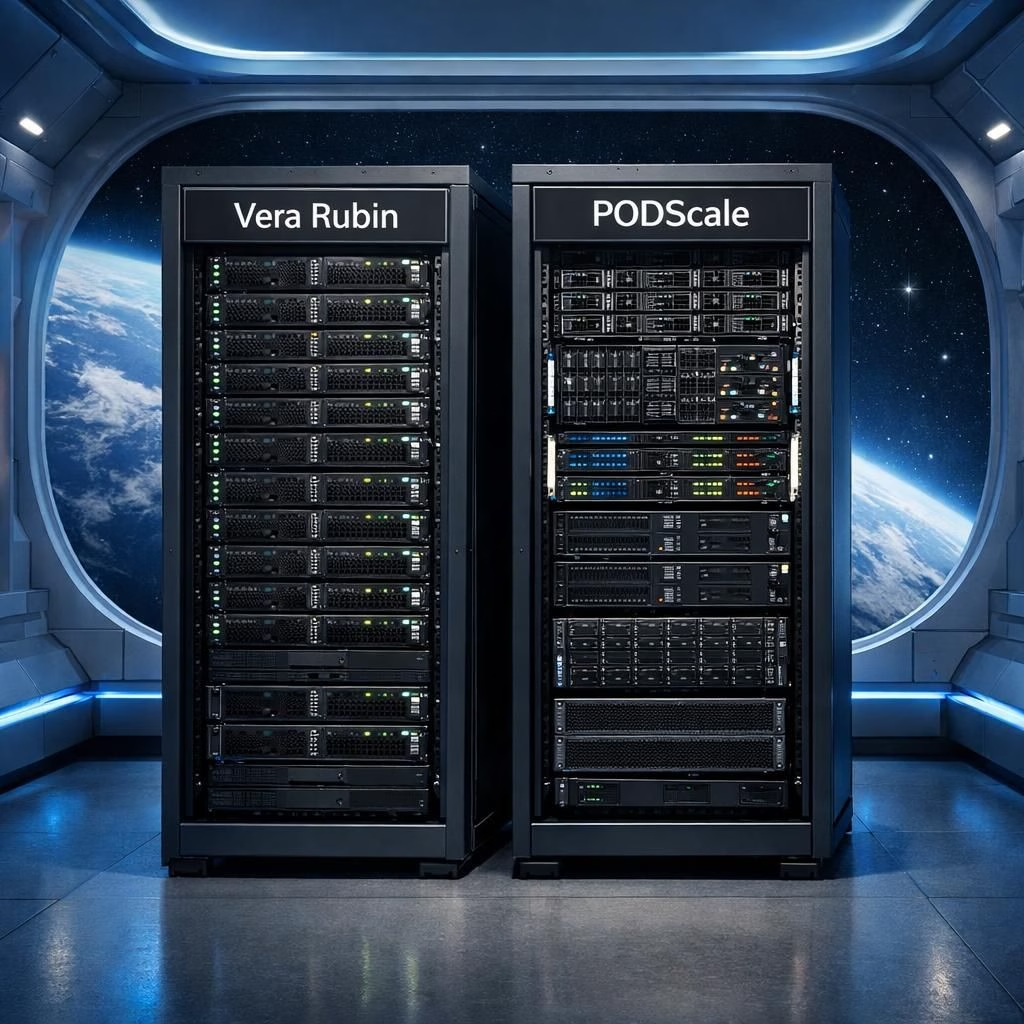
NVIDIA has unveiled the Vera Rubin chip, designed to power orbital data centers as part of the Pod Seven system. The pairing of Vera Rubin with PODScale signals a future where space AI workloads—ranging from satellite imagery analysis to autonomous spacecraft operations—receive the same engineering rigor we apply on Earth, only with a cleaner view of our planet. In 2026, engineers insist this combo is practical, not cosplay, delivering real compute for satellites, defense applications, and global communications while keeping a sense of humor about zero-G logistics.
Vera Rubin in Orbit: Space AI in Practice
In orbit, the Vera Rubin-based pods deliver 1,152 GPUs across 40 racks, generating 60 exaflops of compute power and 10 PB/s bandwidth for ultra-fast data transfer. Built on the third-generation Nvidia MGX rack architecture, the system handles mixture-of-experts (MoE) and large-context inference with ease. In terms of energy, these pods offer up to 10x better inference per watt than Blackwell on comparable tasks. The PODScale orchestration ties the whole thing together, ensuring coordination across the 40 racks for reliable space AI workloads.
PODScale: Orchestrating 40 Racks in Orbit
The PODScale family is built for edge and space workloads. It aims to deliver up to 60 exaflops of compute, 10 PB/s bandwidth, and 40 NVL72-like racks that can scale to NVL576, with all-to-all NVLink that staggers latency and keeps data flowing. The architecture favors MoE and large-context inference, letting models run longer contexts while consuming less energy per operation. In practical terms, this means satellite operators can run more complex models for real-time detection and decision-making, while aerospace missions gain safer autonomy and smarter fault handling.
Energy and Cooling Innovations
Energy and cooling innovations include Dynamic Power Steering, Rack-Level Energy Storage, Intelligent Power Smoothing, and Liquid Cooling at 45°C. These tweaks smooth power swings, boost efficiency, and enable cost‑effective free cooling, keeping hardware reliable in space and reducing heat woes on Earth.
Scalability: From NVL72 to NVL576 and Beyond
NVL72 racks scale up to NVL576, with an all-to-all NVLink topology that minimizes bottlenecks. Future Kyber NVL1152 racks will double GPU domains, expanding PODScale and enabling even larger AI workloads. The result is a flexible platform that invites governments, aerospace firms, and private space ventures to craft new workflows without fighting hardware limits.
What this means in practice
For operators, Vera Rubin and PODScale translate to more capable satellite analyses, smarter autonomous missions, and faster turnaround on orbit. The architecture emphasizes reliability, energy efficiency, and scalable performance that can adapt to evolving space programs.
Frequently Asked Questions
- What is Vera Rubin? A GPU-based chip designed to power orbital AI workloads within the PODScale-enabled system.
- What is PODScale? A scalable rack-scale architecture optimized for edge and space AI workloads, enabling MoE and long-context inference.
- Why space AI? Real-time satellite processing, autonomous spacecraft control, and robust communications benefit from on-site compute.
- How does this relate to Earth data centers? It extends Nvidia’s AI-dominant stack to space, addressing power, cooling, and latency in harsh environments.
In sum, the Vera Rubin chip and the PODScale architecture demonstrate that space-based AI is a serious engineering path with real performance and reliability gains. If you enjoy clever hardware and a dash of space-age optimism, this combo makes a compelling case for orbital data centers, satellite analysis, and autonomous spacecraft alike.
Thanks to the original article for inspiration: Original article.
References
- Times of India Article (Original source)
- IEEE Spectrum coverage of AI at the Edge
- NVIDIA Data Center Overview