

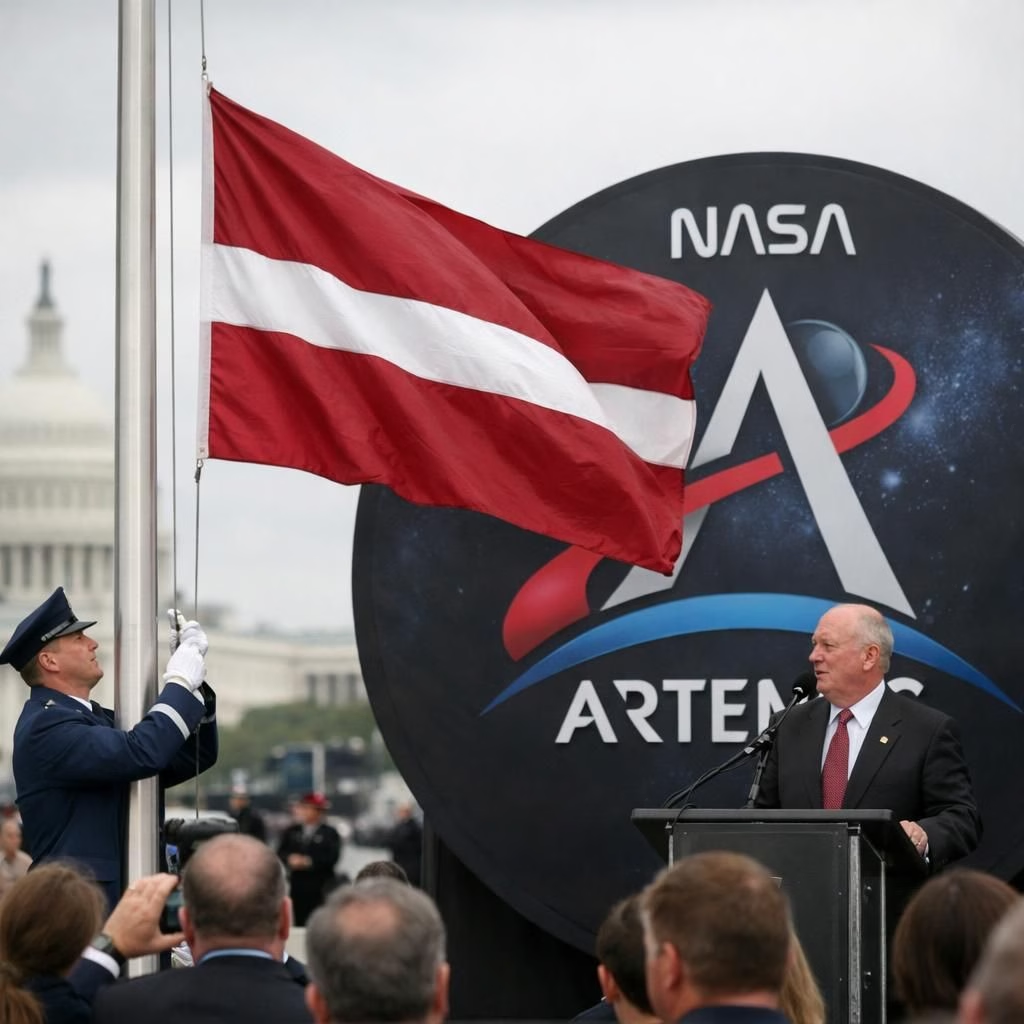
Latvia took a public leap into space diplomacy this week by signing the Artemis Accords and joining the Artemis family of nations, united in transparent, peaceful, and cooperative exploration. The move signals a practical path toward the Moon and beyond, with a framework that emphasizes safety, data sharing, and joint missions. The ceremony at NASA’s Washington headquarters underscored that international collaboration can drive real missions as well as ceremonial goodwill.

Artemis Accords Expansion: Latvia Joins the Artemis Coalition
The signing makes Latvia the 62nd nation to sign the Artemis Accords, a pragmatic, safety-minded set of principles for lunar, Mars, and beyond. This is more than ceremony; it is a commitment to real missions and real cooperation in space. Latvia’s Education and Science Minister, Dace Melbārde, framed the move as an investment in future scientists, researchers, and innovators, while signaling readiness to deepen ties with the United States and NASA under the Artemis framework. Latvia already contributes to the global space ecosystem through its research institutions and industry, and this signing is presented as a natural step in expanding that collaboration.
- Peaceful, transparent exploration as a core value of the Artemis Accords
- Open access to data and results to advance learning for all humanity
- Non-interference with others’ activities and preservation of scientifically valuable sites
- Commitment to render aid to those in need during space operations
The broader context shows this moment as part of a rapid push to establish a sustainable, enduring human presence beyond Earth. NASA leadership frames the Artemis initiative as a long-term, cooperative enterprise that can accelerate shared goals while keeping risk in check. The Artemis momentum rests on trust, common standards, and a willingness to invest in education and industrial capacity at home. Latvia’s participation is positioned not only as a national achievement but as a signal of European alignment with a set of principles designed to guide all signatories toward peaceful exploration and broad participation in future space activities.
Artemis Momentum: The Artemis Accords Bring Global Collaboration
With more than 40 signatories from six continents represented at the Washington event, the Artemis Accords showcase a global trend: space activities are increasingly a collaborative enterprise rather than a single-nation effort. The accords outline safety protocols, data-sharing norms, and transparent coordination practices that help prevent overlap and reduce risk. The expansion is consistent with ongoing plans to return humans to the Moon routinely and affordably, establish a sustained lunar presence, and explore cislunar space with widely distributed expertise. Latvia’s involvement emphasizes how national programs can align with international priorities, blending domestic research strengths with a wider mission framework that invites participation from universities, startups, and established industry alike.
Historically, the Artemis framework began as a vehicle to harmonize exploration among like-minded nations. It seeks to ensure that progress on the Moon, Mars, and beyond proceeds under common safety and humanitarian standards. The growing coalition reflects a pragmatic belief that shared learnings and joint missions amplify impact, reducing duplication and fostering innovation across borders. Latvia’s adherence to these norms signals a readiness to contribute to large-scale, cross-border projects that blend science, engineering, and education with real-world outcomes for students and professionals alike.
Educational and Economic Sparks: Latvia and Global STEM Under Artemis
Latvia’s entrance into the Artemis ecosystem is framed not just as a political gesture but as an education and industry catalyst. The national emphasis on STEM aligns neatly with Artemis-era opportunities: joint research programs, shared laboratories, internship pipelines, and exposure to lunar mission planning that can inspire classrooms and laboratories back home. For Latvia, this means potential partnerships with NASA and European partners, access to data streams, and pathways for students to participate in international projects. In practical terms, the Artemis Accords create an environment where Latvian universities and companies can contribute to mission-critical tasks such as propulsion research, space materials analysis, and robotics—areas that can translate into high-tech jobs and stronger STEM pipelines for a future-ready workforce.
On the policy side, the Artemis Accords encourage transparent reporting and coordination, ensuring that research outputs, safety protocols, and regulatory standards keep pace with advancing capabilities. The immediate benefits for Latvia include heightened visibility in the European and global space community, opportunities for joint funding, and the chance to influence how Artemis-era activities unfold in ways that keep learners and communities at the center. The result is a positive feedback loop: stronger academic programs fuel stronger industry, which in turn supports more ambitious research and education—exactly the kind of ecosystem the Artemis platform is designed to nurture.
Beyond Latvia, the Artemis Accords serve as a bridge between government-led programs and private sector innovation. This synergy helps ensure that discoveries reach classrooms, inspire the next generation of scientists, and lead to practical technologies that benefit life on Earth while expanding humanity’s reach into the solar system. The dual emphasis on peaceful exploration and public benefit keeps the focus on broad access to knowledge, cooperative problem-solving, and responsible stewardship of space heritage sites and artifacts for future generations.
As the Artemis framework matures, expect more nations to explore partnerships that blend national interests with shared responsibilities. Latvia’s example shows how a smaller nation can magnify its impact by aligning with international standards and collaborative missions. In turn, larger players gain new channels for cooperation, fresh ideas from diverse ecosystems, and a more resilient global space program that learns from a wide range of experiences and expertise.
In sum, Latvia’s adoption of the Artemis Accords under the Artemis program signals a deliberate, constructive approach to space exploration. It blends national talent with international cooperation, emphasizing safety, transparency, and education as the bedrock of a prosperous, peaceful future in space for all humanity. The road ahead is long and collaborative, with the potential to transform how we teach, research, and imagine the final frontier.
We invite readers to share their thoughts in the comments and join the conversation about how Artemis and the Artemis Accords might shape science, education, and industry in your country.
Original article attribution: Thank you to NASA for the official materials on the Artemis Accords. Original source: NASA Artemis Accords.
Artemis Accords – Practical steps for classrooms and labs
- Learn the core principles of the Artemis Accords and how they apply to school programs.
- Establish partnerships with universities or industry to access data and experiments related to Artemis missions.
- Develop student projects that mirror mission design, safety, and data sharing standards.
- Engage government and non-profit groups to support STEM initiatives aligned with Artemis-era activities.
FAQ
What are the Artemis Accords?
The Artemis Accords are a set of practical principles for peaceful, cooperative space exploration among signatories, including safety, data sharing, and responsible heritage stewardship. They help align national programs with shared standards.
Why did Latvia join?
Latvia joined to support a long-term, peaceful space agenda and to strengthen ties with the United States and NASA within the Artemis framework. It also aims to boost its STEM ecosystem and education pipelines.
How does the Artemis framework affect students?
It creates opportunities for internships, joint research, and access to data from missions, helping to inspire classrooms and future careers.
Are more countries signing up?
Yes. NASA has indicated that additional signatories are expected as the partnership matures and expands to include more partners and regions.
Conclusion: Latvia’s move illustrates how a smaller nation can influence larger international endeavors. By embracing the Artemis framework, Latvia demonstrates practical leadership in education, industry, and international cooperation that could inspire others to participate.
References
- NASA News Release: Latvia signs Artemis Accords
- Artemis Accords — U.S. Department of State
- NASA Artemis program overview
- Original source: NASA Artemis Accords – https://www.nasa.gov/artemis-accords