

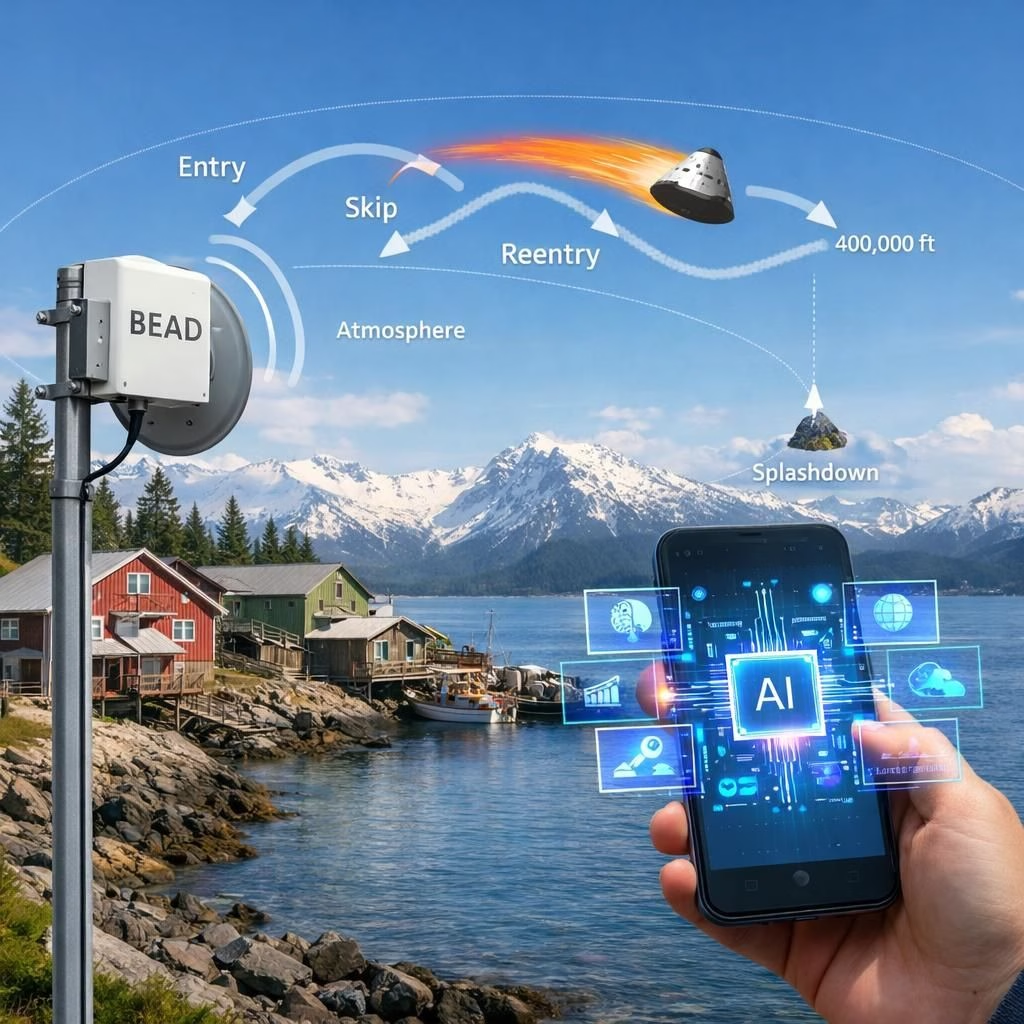
AI Artemis roundup for 2026: in an era where intelligent tools shape decisions and ambitious space programs loom large, the tech cosmos keeps turning with gusto. This edition stitches together Alaska’s BEAD broadband push to Atka and Nikolski, a regulatory thumbs‑up for Artemis FSD in Europe, Artemis II heat‑shield preparations and reentry risk, Samsung’s expansion of AirDrop‑style Quick Share across Galaxy devices, and a wave of AI governance and infrastructure news that would make a policy brief blush. If you thought this year would be quiet, think again: AI and Artemis aren’t just buzzwords, they’re the weather pattern of the moment—driving conversations about access, safety, and what comes next for both ground networks and interplanetary flight.
AI governance and infrastructure: policy, licensing, and energy in 2026
AI governance keeps expanding in 2026. Analysts and regulators debate how to govern fast‑moving systems like mythic models and edge AI devices without stifling innovation. Several reports spotlight the tension between open exploration and responsible deployment, with industry players arguing for guardrails that don’t become productivity tax. AI energy use remains a recurring theme: hyperscalers are expanding compute capacity, which means more power draw and more need for transparent, measurable data on efficiency. In practice, this means more conversations about post‑quantum cryptography, safer AI workflows, and governance frameworks that don’t treat every new model as a fire alarm. The takeaway: governance is no longer a dusty appendix; it’s the operating manual for the near future, and companies that pair thoughtful policy with practical tooling will win trust as the AI frontier grows.
Against this backdrop, big players are testing how to license, track, and govern autonomous tools. Licensing models for AI assistants, along with transparency and interoperability requirements, show up in boardroom conversations and policy experiments around “responsible AI” at scale. Some researchers highlight that AI systems often mirror popular trends more than they deliver context‑rich guidance; others argue that governance should emphasize explainability, safety, and human accountability without disconnecting teams from real work. In parallel, industry watchers note AI energy demand rising as data centers scale, prompting discussions about grid capacity, renewables, and the carbon footprint of trillions of tokens moving across compute‑heavy cycles. In short: AI governance isn’t a sideshow; it’s the stage on which technology meets society, and the audience is paying attention.
Meanwhile, corporate chatter about AI economics hints at licensing, risk, and the tricky balance between innovation and control. Some executives caution that aggressive monetization or opaque vendor practices could undermine long‑term trust. The story isn’t just about chips or cloud; it’s about how companies orchestrate policy, people, and platforms to deliver value while avoiding brittle governance that slows progress. The AI governance narrative, much like a well‑timed update, aims to keep features useful, secure, and navigable for users and operators alike. And yes, AI governance is also about protecting privacy, ensuring safety in automated decision‑making, and helping executives sleep at night while their teams experiment with new capabilities in the lab and the field.
In this environment, the tech press continues to spotlight not just the latest model but the infrastructure that makes it usable at scale: secure data pipelines, auditable training data, reproducible results, and the human oversight that keeps AI from becoming a self‑driving chaos machine. If you’re building, investing, or simply reading the headlines, the signal is clear: AI governance works best when it’s pragmatic, transparent, and grounded in real‑world use cases that improve outcomes rather than just look impressive in a slide deck. And yes, AI visibility matters—so stakeholders can see how decisions are made, where data flows, and what safeguards exist to prevent runaway systems from misbehaving in production.
Artemis II heat shield and human‑centered reentry design: safety comes first
Artemis II headlines continue to orbit the same core truth: safety first, even as humanity aims higher. NASA confirms the Artemis II heat shield, identical to the proven shield used on Artemis I, is ready for reentry. The Orion capsule will hit the atmosphere at roughly 24,000 mph (11 km/s) over the Pacific, with temperatures spiking near 5,000 degrees Fahrenheit. Four astronauts—Reid Wiseman, Victor Glover, Christina Koch, and Canada’s Jeremy Hansen—are counting on a shield and parachutes to weather peak heating during a six‑minute plasma bloom before splashdown. Engineers have mapped precise trajectory adjustments to minimize heat exposure, a necessary dance after Artemis I revealed damage patterns that demanded a shield rethink and new thermal models. Wiseman and colleagues have spoken about root‑cause analyses and the need for robust margins; the short version is that there’s a plan, there’s data to back it up, and there’s a crew depending on it with a mix of calm and courage.
Artemis II isn’t just about reentry physics; it’s about human factors in extreme environments. NASA scientists and researchers have repeatedly stressed seats and controls designed to accommodate a broad range of physiques, ergonomic layouts that remain operable under heavy G‑loads, and intuitive interfaces that reduce cognitive load when every second counts. The mission’s protective systems get a final stress test in a real‑world scenario, which means better training, better simulations, and better readiness for Artemis III and beyond. The emphasis on human‑centered design echoes broader engineering trends: equipment that can be used by different people under demanding conditions without requiring a PhD in aerospace engineering to operate.
For those following the orbiting drama, Artemis II also serves as a reminder that failure isn’t failure unless it’s tolerated. NASA’s willingness to adjust trajectories rather than replace the shield shows disciplined risk management. The public narrative around Artemis II blends awe with caution, a balance that signals the mission’s seriousness while keeping the door open for future exploration.
In short: Artemis is about safe exploration, credible science, and the occasional astonishment you feel when you glimpse the Earth from the dark side of the Moon. The crew’s camaraderie and the data streams from Orion remind us that progress in space is a team sport—humans, machines, and the careful choreography between them.
To cap off the roundup, we note the Alaska broadband story—an example of how ground infrastructure undergirds every other headline. BEAD funding is delivering home‑to‑home wireless internet to remote Alaska communities like Atka and Nikolski, with predicted speeds of at least 100 Mbps download and 20 Mbps upload, pricing between $70 and $120 a month, and Lifeline discounts for eligible households. The plan envisions in‑home service via radio waves rather than trenching or sprawling satellite dishes, a logistics‑savvy approach that could accelerate online access for residents while reducing long‑term maintenance headaches. Adak’s legal standoff slows roughly $4.3 million of BEAD funds for another day, but Alaska’s 29 funded groups overall have already clocked more than $629 million in BEAD commitments. The Alaska example demonstrates how infrastructure investment creates the stage for everything else—education, commerce, healthcare, and yes, the occasional space launch documentary in your feed.
As always, your thoughts matter. Share what stood out to you in this Artemis and AI phase of 2026, and tell us how you see these threads weaving into daily life, business, and exploration.
Original article attribution and thanks: a heartfelt nod to the original source material that inspired this synthesis. Original article: https://www.bez-kabli.pl/technology-news-10-04-2026/ — thank you for the wealth of information and the prompt to rethink how we connect the dots across ground, air, and star systems.
Practical steps for AI governance
- Audit data pipelines and training datasets for privacy, bias, and provenance.
- Implement explainability dashboards that show how decisions are made in real time.
- Adopt energy‑efficient deployment practices and monitor compute‑to‑outcome efficiency.
- Establish clear governance owners and escalation paths for safety concerns.
Artemis safety culture in tech and space
- Emphasize human‑in‑the‑loop design for critical systems, from software to spacecraft controls.
- Prioritize ergonomics and usability to reduce error risk under stress.
- Use trajectory and risk simulations to inform training and operational readiness.
- Translate space‑tested safety practices into terrestrial infrastructure projects.
References
Original source linkback: https://www.bez-kabli.pl/technology-news-10-04-2026/