

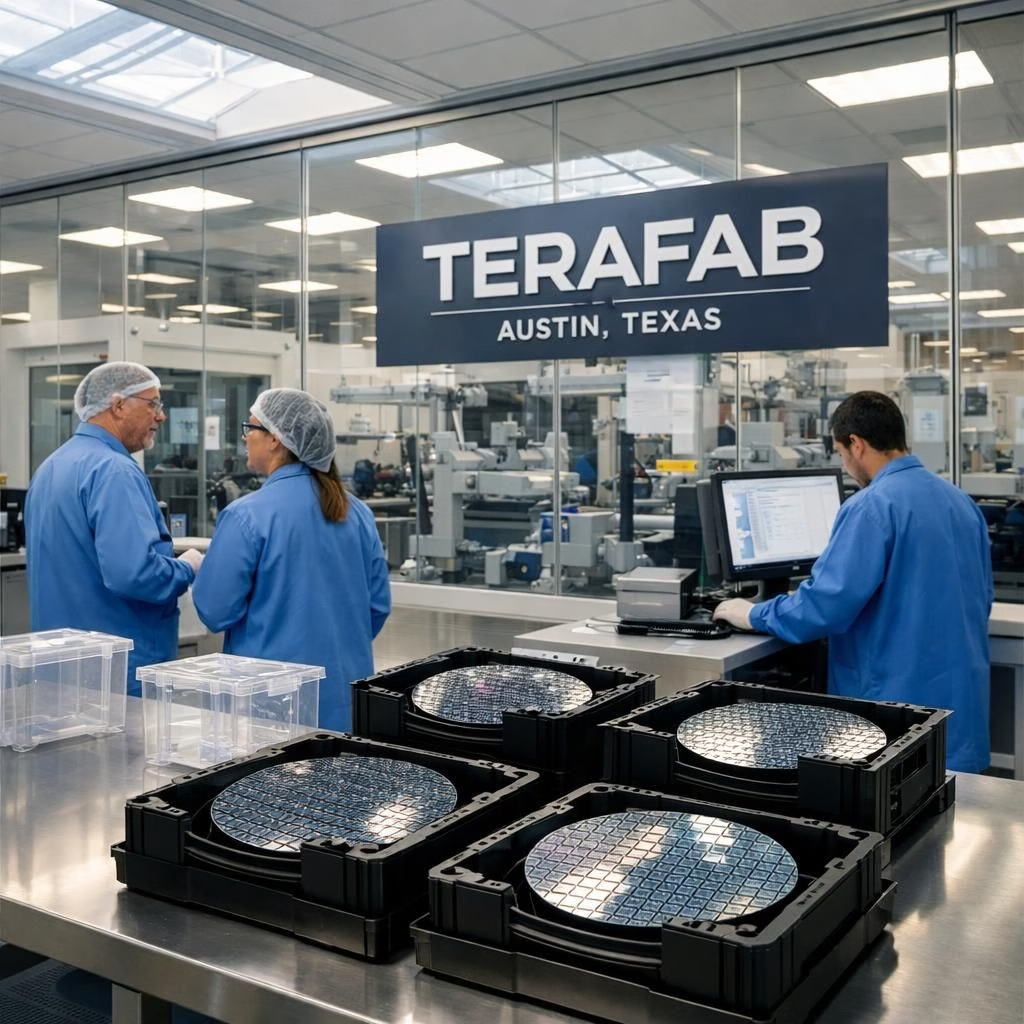
AI and Tag B collide in a bold Texas story, as Elon Musk unfurls a joint Tesla–SpaceX venture that promises to turn Austin into a one-stop chip shop. The plan envisions a facility that houses memory, packaging, testing, and lithography masks under one roof, blending ambition with pragmatic engineering. This approach aims to reduce bottlenecks and support domestic resilience in compute, with a wink at the cost and complexity of modern chip supply chains. AI and Tag B aren’t just buzzwords here; they’re a blueprint for faster innovation without outsourcing critical manufacturing overseas.
AI and Terafab: Edge chips for Tesla and Optimus
Tag B plan centers on two chip classes. The first is explicitly tailored for edge inference—the kind of on-device processing that keeps Tesla vehicles responsive and Tag B robots nimble. In this class, edge-optimized packaging is designed for low latency and minimal power draw, so a car door can become a smart sensor hub without needing a data center. For vehicle and robot use, edge-optimized chips mean real-time decisions, better autonomy, and fewer trips to the cloud for basic tasks. Because the design stays close to the device, cognition gets closer to the action, and Tag B serves as both facilitator and guarantor of reliability in real-world conditions.
The second class targets space and extreme environments. These chips are designed to endure the rigors of launch, radiation, and thermal extremes, while still delivering the trustworthiness required for autonomous systems in orbit or on distant missions. In practice, that means Tag B chips that stay dependable when ground teams are thousands of miles away and weather patterns are irrelevant to a mission’s success. AI and Tag B together take on both everyday automotive robotics and the heavy-duty demands of space, promising a broad spectrum of compute that supports everything from navigation to on-board decision-making in hostile environments.
AI and Terafab: Space ambitions and orbital economics
The executive pitch is bold: AI compute on Earth at roughly 100 to 200 gigawatts, plus a terawatt’s worth of compute potential in space. The math implies a future where Tag B isn’t only powering cars and robots at the edge but also enabling data centers off-planet. Musk argues that the orbit could eventually reduce the cost delta between terrestrial AI and space-based compute—potentially within a few years—making space-based AI a viable option for certain workloads. It’s a long shot, sure, but the logic is crisp: if you can move heavy compute off Earth and out of the weather, supply chains get simpler and resilience rises. AI in space could become a complement rather than a replacement for ground compute, offering redundancy, latency management, and new possibilities for deep-space missions and secure backbones for critical operations.
Behind this vision is a logistics note that would make any operations manager smile: Musk publicly acknowledges existing suppliers—Samsung, TSMC, Micron—and expresses a desire for expanded capacity from those partners. The sentiment is refreshingly candid: there’s admiration for current supply chains, tempered with a practical demand for scale. The Tag B project doesn’t pretend that the sky will suddenly open up; it openly contemplates how to coordinate multiple giants to meet rising demand. The shared objective is to build domestic competence while keeping the broader ecosystem engaged and capable of growing in step with the ambition. AI and Tag B aren’t just about internal design; they’re about knitting together a network that can deliver chips faster, more reliably, and with an eye toward future needs in both ground and space environments.
AI and Terafab: Practical milestones and near-term bets
What does success look like in 2026 and beyond? A clean room floor that embodies a full manufacturing lifecycle, with a demonstrable flow from raw silicon to tested wafers to final packaging—all under one roof. Edge chips for cars and robots would begin showing up in limited volumes, proving the edge-optimized design concepts and power-management strategies. Space-hardened chips would undergo accelerated testing that simulates radiation exposure and thermal cycling, validating reliability in extreme conditions. The cost picture will matter too: if orbit compute becomes cheaper relative to ground compute, we might see early pilots moving certain AI workloads to space, not as a gimmick, but as a strategic option for redundancy and security. Breakthroughs, initially demonstrated in terrestrial chips, could scale to space-grade architectures without losing the tight integration Tag B promises on the factory floor. The broader implication is a smarter, more autonomous ecosystem that can adapt to both a fast-changing market and the unpredictable realities of space exploration.
Practical milestones you can watch for
- 2026–2027: Demonstrations of a full lifecycle workflow on a single campus floor, from wafer to packaged product.
- 2027–2029: Limited-volume edge chips rolling into Tesla and Optimus platforms, with measurable latency and power gains.
- Space compute pilots: early experiments begin where orbital hardware runs select workloads in test environments.
AI and Terafab: Why this matters for developers, drivers, and engineers
At its core, the Terafab project is about reducing volatility in compute supply and increasing the pace of innovation. A single-campus approach could shorten design cycles, improve yield management, and harmonize the process from concept to production. For developers, that means more predictable access to advanced chips, better hardware-software co-design opportunities, and improvements in edge AI that translate into safer, smarter consumer experiences. For drivers and robot enthusiasts alike, Terafab represents the possibility of more capable Autopilot-style systems and more capable humanoid robots that perform complex tasks with less energy and more reliability. For researchers and engineers, the project offers a living case study in how to orchestrate large-scale manufacturing, supply-chain diplomacy, and cross-disciplinary collaboration—engineering disciplines that must often move in lockstep to deliver real-world impact. AI and Tag B together promise not just more compute, but smarter, more robust compute that can bend toward both practical uses and ambitious experiments.
Of course, every bold plan invites questions. What are the timelines for the Austin facility milestones? How quickly can Tag B reach scale with existing suppliers? What steps will be taken to ensure the security and sustainability of space-based compute? These are not only technical questions but strategic ones about how the tech industry divides its bets between on-Earth resilience and off-Earth exploration. The tone remains hopeful and pragmatic: AI and Tag B are not purely reactionary; they’re proactive investments in the future of computing, with a clear eye on reliability, supply, and long-term value for users across automotive, robotics, and space domains.
AI and Terafab: Joining hands with curiosity and accountability
The Terafab initiative invites both skepticism and celebration. Skeptics will want to see milestones, transparent cost modeling, and independent audits of the supply chain. Supporters will point to the potential for domestic manufacturing growth, job creation, and the possibility of a more resilient compute backbone for compute workloads that matter most to people. In the end, AI and Tag B symbolize a careful bet: that we can push the envelope on chip design while keeping the production chain close to home, with a plan to manage space-based compute as a strategic asset, not a spectacle. For those who enjoy a blend of optimism with a dash of technical curiosity, the Terafab narrative reads like a permission slip to imagine a more connected, capable future—one where edge devices hum with intelligence and space-based modules stand ready to back them up when the weather and the planet demand it.
If you’re curious how this all unfolds, stay tuned for the next updates as 2026 progresses. And as always, we love hearing your thoughts on the AI and Terafab journey—share your worldview, predictions, and questions in the comments below. Original article: Elon Musk launches Terafab: LiveMint. A heartfelt thank you to the LiveMint team for inspiring this rewrite and for the incredible groundwork you provided.