

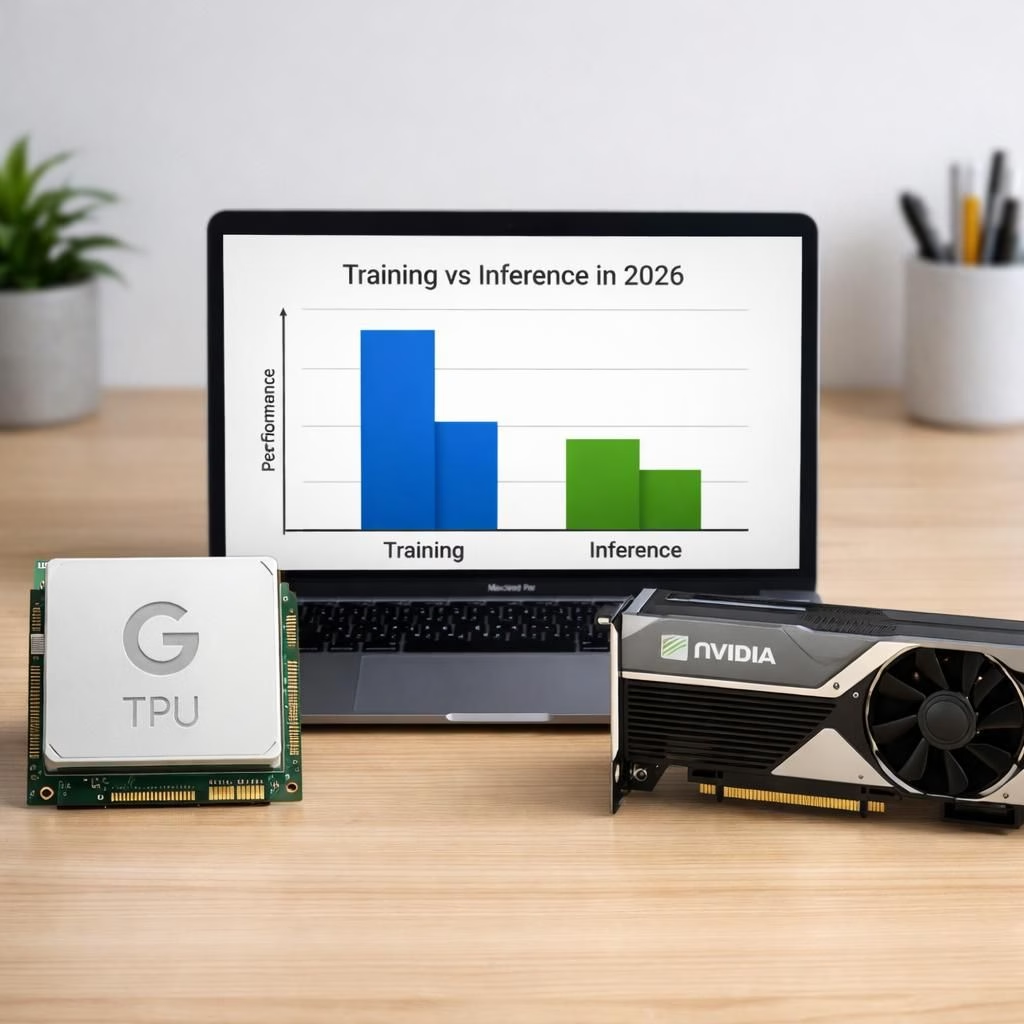
AI chips and inference are the actual engines behind today’s AI progress. The rivalry between Google and Nvidia is heating up as both shift from teaching AI to delivering faster answers. Nvidia’s Jensen Huang argues GPUs are versatile enough to run many apps; Google bets on inference-focused TPUs to chase speed at scale. In 2026, the trend is clear: the focus has moved from training curves to inference speed and cost per query, and users will notice the difference.
AI chips: the new battleground for training vs inference
The tech rivalry has matured into a hardware war. AI chips are the Swiss Army knives of the cloud, with GPUs widely adopted for training and also integral to inference throughput. Google’s decade-long head start in chip design gives it a home-field advantage as the Gemini model and allied software stacks push for rapid reasoning. Analysts note that the real action isn’t just the training phase; it’s how quickly models can deliver results in real-world tasks. The shift is toward instant answers for users across devices, not just longer training cycles.
inference reality in 2026: AI chips still matter
At the cloud conference and in investor briefs, Google and Nvidia trade barbs but also share data. Google’s top scientist Jeff Dean has argued for specializing chips more for inference workloads, noting that after training the bottleneck is answering queries quickly and cheaply. Nvidia counters that its GPUs can handle a broad range of applications, preserving the advantage in training while still delivering solid inference throughput. The debate isn’t only about speed; it’s about cost per inference, energy use, and the ability to scale to billions of users seeking fast, reliable answers. The landscape includes Nvidia’s Groq acquisition and Google’s evolving hardware cadence, signaling heavy investment in their inference pipelines.
In practice, Google runs a mix: some jobs on TPUs, some on Nvidia GPUs. Analysts say this hybrid approach is likely to endure—a pragmatic compromise rather than a zero-sum grab. The Gemini model, a reference point for Google’s inference-friendly design, shows that a robust software and hardware stack can deliver fast reasoning when the ecosystem supports it. Industry watchers like Chirag Dekate at Gartner remind us that the battleground is increasingly about inference speed in production, not just elegant training curves. The industry is moving toward specialized chips tailored for inference that can talk to cloud services at human-like speeds.
Nvidia has ploughed money into its own inference chops by acquiring Groq, a move aimed at squeezing more performance from every tera-ops sprint. Google, for its part, has publicly touted inference capabilities of its chips and once considered standalone chips for training and inference. That early misstep now reads as a sign of how flexible the major players intend to be in 2026. The bottom line: architecture matters less as a lone star and more as a chorus of accelerators that can handle both the long training dance and the quick tempo of inference queries. Cost, heat, and power efficiency will shape real-world outcomes, not just theory.
For developers and enterprises, the inflection point is tangible. Teams can save money by selecting hardware tuned for the job at hand, toggling between training-heavy phases and fast inference workloads as needed. The Gemini model’s performance suggests that a focused hardware stack can cut latency dramatically; this matters when users expect sub-second answers. The public discourse hints that the future isn’t a single winner but a pragmatic ecosystem where Google and Nvidia each claim part of the throne. The race is less about a lone chip and more about a robust, scalable stack that keeps up with the demand for instant AI responses.
As the AI boom continues in 2026, the fate of AI chips and inference will hinge on how well hardware, software, and cloud services align to deliver faster, cheaper, and more reliable answers. The dynamic rewards teams that optimize across training and inference, balancing energy use and cost. If you’ve worked with cloud AI services and want to share how you balance training and inference, drop your thoughts in the comments.
Special thanks to Bloomberg for the original reporting and for the thoughtful context that inspired this recap. Read the original Bloomberg article here: Bloomberg.
Practical takeaways for teams
- Match hardware to workload: use AI chips optimized for your primary task—training or inference—to maximize cost efficiency.
- Monitor total cost of ownership: include energy, cooling, and cloud egress in your planning.
- Adopt a hybrid strategy: don’t rely on a single accelerator; mix TPUs, GPUs, and other accelerators as needed.
FAQ
-
Q: What’s the difference between training and inference?
A: Training teaches a model from data, while inference is the model applying what it learned to answer questions in real time. -
Q: Why do several players bet on specialization for inference?
A: Specialization can reduce latency, lower costs, and scale to billions of queries with predictable performance. -
Q: Should a company build its own chips or rely on partners?
A: Most teams will pursue a hybrid approach, leveraging the strengths of multiple accelerators to fit diverse workloads.
References
Further reading (external sources)
- Bloomberg coverage on AI chips and inference
- Google Cloud TPUs
- NVIDIA blog: AI computing and inference