

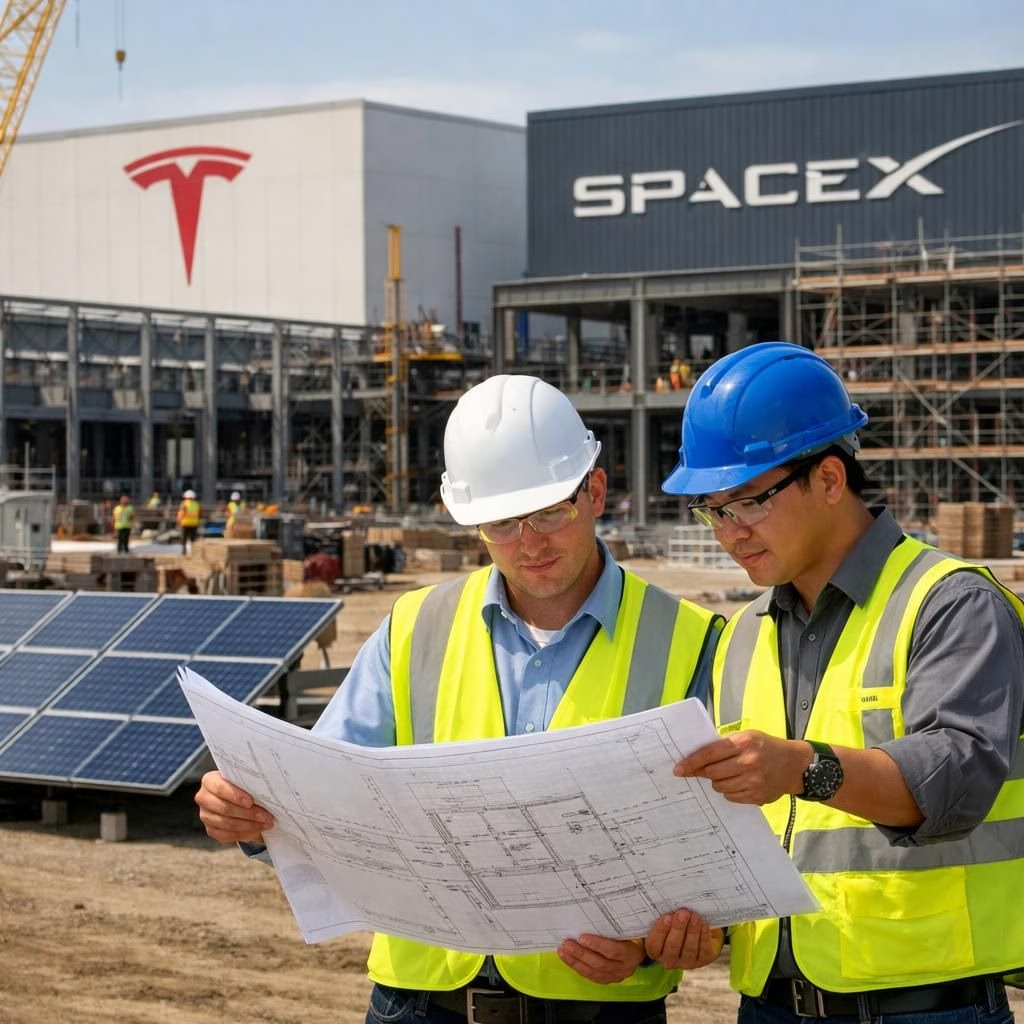
2026 marks a bold moment where AI and SpaceComputing converge under a plan called TeraFab. Elon Musk describes it as a full-stack semiconductor venture that could fuse Tesla hardware, SpaceX’s orbital ambitions, and xAI software. The aim goes beyond chips—this approach intends to bring logic, memory, packaging, testing, and mask design under one roof to power a new era of computation.
AI and SpaceComputing: TeraFab’s Bold Blueprint
The blueprint centers on an almost end-to-end workflow, with two chip families: terrestrial processors for Autopilot and Optimus, and SpaceComputing-friendly chips designed for SpaceComputing environments. The plan envisions 100–200 billion 2-nm AI chips per year, a scale that could reshape supply chains and chip economics. Tesla leads the effort, with SpaceX and xAI in close support, and a cost range of $20–$25 billion. That blend of automaker, rocket maker, and AI firm promises cross-pollination that could accelerate experimentation and production cycles.
From Earthbound AI to SpaceComputing Orbit
On Earth, the terrestrial chips would power Autopilot, Optimus, and edge data centers. In Space, SpaceComputing networks could run orbital data centers aboard satellites SpaceX might deploy with Starship. Musk argues that solar energy abundance in space could lower operating costs by relaxing ground-powered constraints, enabling higher uptime for AI workloads without the usual grid limitations. This is a key point: AI-enabled systems could benefit from cleaner, solar-powered operation in orbit, reducing dependence on terrestrial power grids.
Energy efficiency, resilience, and access to abundant solar power strengthen the appeal. The D3 chips would be engineered to withstand radiation, thermal extremes, and micro-meteoroid jitter, while the terrestrial chips would exploit 2-nm lithography to boost performance and cut energy per operation. Musk frames TeraFab as a step toward a broader galactic civilization, where memories and ideas can be archived across generations, maybe even across stars.
But this plan isn’t a sci-fi pitch. It is a real capital project with a formal launch in Austin and a staged production timeline. The facility would unify steps usually spread across separate factories and use ongoing redesign loops to stay ahead of the curve. That means quicker iterations, ambitious specs, and a pragmatic optimism about space-based computing’s potential.
- Terrestrial chips powering Autopilot and Optimus
- SpaceComputing chips for space environments
- Single-campus integration of logic, memory, packaging, testing, and design
- Solar-powered orbital AI networks and satellites
As the plan threads SpaceComputing into a single campus, it invites readers to imagine a future where computation travels with humanity into the vacuum—and perhaps beyond. If successful, TeraFab could redefine manufacturing, energy use, and the meaning of civilization itself.
Attribution: Special thanks to Divya Bhati for the original reporting on this topic.
References
- Original source: India Today — Musk’s TeraFab coverage
- NASA Space Solar Power: Space Solar Power overview
- ESA Space Solar Power: Space Solar Power
- IEEE Spectrum on Space Solar Power: Space solar power