

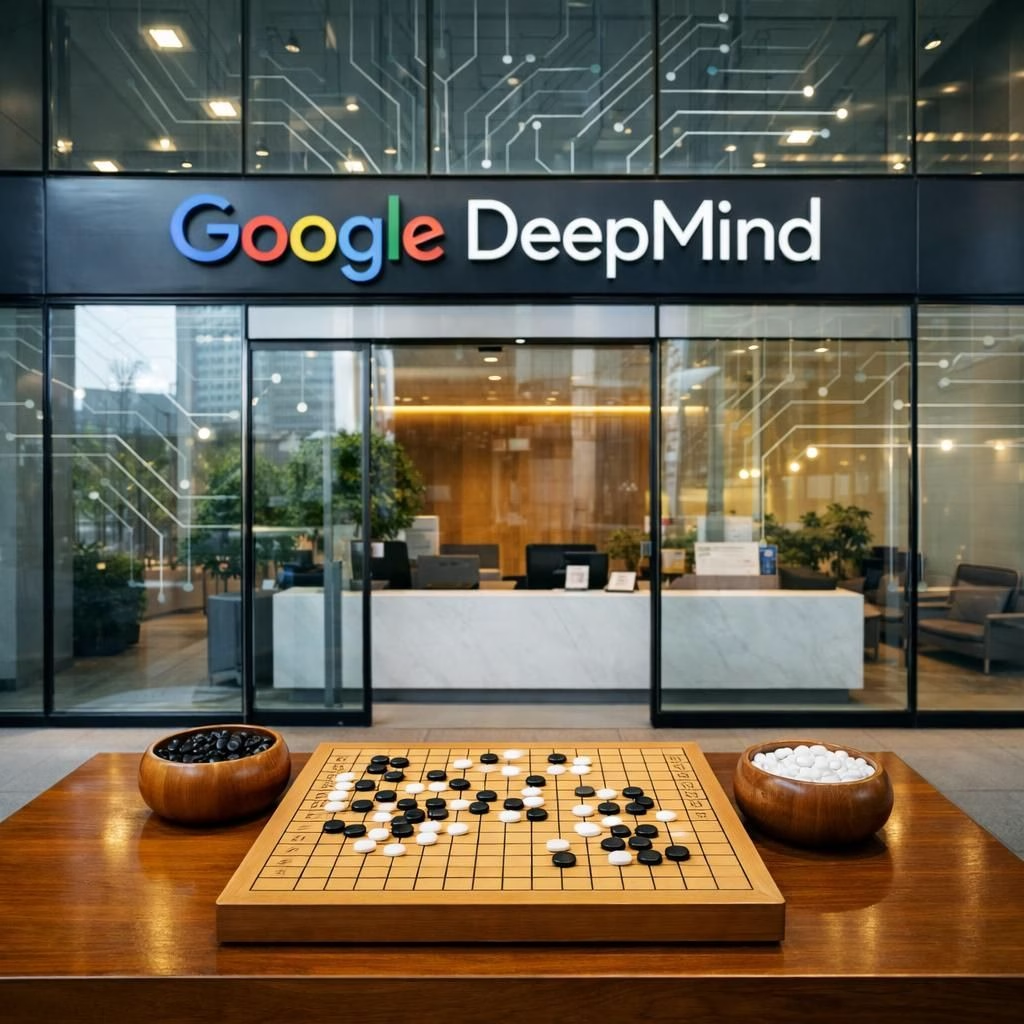
AI Korea is catching a big wave. Google announces an AI campus in South Korea before year-end. It will be the company’s first such facility outside the United Kingdom. The announcement followed a face-to-face meeting in Seoul between Google DeepMind CEO Demis Hassabis and Korea‘s President Lee Jae Myung at Cheong Wa Dae. The campus aims to connect Google researchers with Korean startups and engineers. It’s a move to accelerate AI collaboration across the peninsula. Seoul asked Hassabis to send at least 10 Google researchers from the U.S. headquarters. He smiled, nodded, and welcomed the plan on the spot, perhaps daydreaming about coffee-fueled brainstorms powering AI breakthroughs in Korea.
AI in Korea: Google’s Campus as a Catalyst
The Science Ministry of Korea and Google DeepMind signed a memorandum of understanding. It covers joint AI research, skills development, and responsible AI use. The deal fits Korea‘s ambitious K-Moonshot program. That program targets 12 major challenges—from advanced biotech to space to semiconductors—using AI to accelerate progress by 2035. In short, Korea bets big on AI. The aim is to move from niche lab work to scalable industrial solutions.
The AlphaGo moment frames the visit: ten years ago, DeepMind’s AI beat Go legend Lee Se-dol in Seoul. Hassabis marked the anniversary with a signed Go board gifted to the president. That 2016 match is widely credited with kicking off the modern AI era. Since then, DeepMind’s AlphaFold cracked one of biology’s hardest problems—predicting protein structures—earning Hassabis a share of the 2024 Nobel Prize in Chemistry. Korea pitching itself as an AI industrial hub.
AI in Korea: From AlphaGo to a National AI Moonshot
Korea described as a great industrial base for AI across chips, robotics, and beyond. DeepMind wants deeper ties with local giants like Samsung, SK Hynix, Hyundai’s Boston Dynamics unit, and LG. This could help Korea turn AI research into real-world productivity. Hassabis is not alone in this pursuit. OpenAI’s Sam Altman, Nvidia’s Jensen Huang, and SoftBank’s Masayoshi Son have visited Seoul in recent months. The visits signal a global race to deploy AI in everyday life. The conversations emphasize collaboration, not conquest, and invite Korea to lead with a practical, scalable plan.
Beyond headline drama, the partnership emphasizes responsible AI use and skills development. Korea‘s government frames AI as a national capability, not a trend. The collaboration aims to train local talent, foster startups, and speed the transfer from lab benches to assembly lines. The result could be a bolder, more resilient AI industrial hub in Korea. It will be powered by both hardware and thoughtful software ethics. In this mix, AI is about people, not slides and demos.
AI in Korea: Realistic optimism for 2026 and beyond
Looking toward 2026, the alliance between Google DeepMind and Korea signals a practical path to digital prosperity. The alliance builds on a history of collaboration, competition, and curiosity. It is not a magic wand, but it is a well-considered step toward a future where AI helps solve real-world problems in Korea and around the world. The dialogue among Hassabis, policymakers, and industry leaders stays lively, pragmatic, and perhaps a touch playful as everyone fits the next puzzle piece into Korea‘s growing AI ecosystem.
One takeaway is clear: AI progress follows people who invest in partnerships. The Korea plan aligns with the K-Moonshot ambitions, pairing solid research with practical deployments. The result could be better chips, more robust robotics, and smarter health technologies that improve daily life in Korea and beyond. Ambition is not the enemy of execution; it is the spark that fuels ideas into tested, useful realities—bright and practical.
If you enjoyed this overview, share your thoughts below. What do you think about AI in Korea? How should Korea balance investment, innovation, and ethics as these AI initiatives grow? Tell us what topics you’d like to see next in this ongoing AI in Korea series.
Original article attribution: Thank you to the Times of India for material.
Practical implications for AI in Korea: what this could mean for startups and workers
- Access to global AI research talent could accelerate product development for Korean startups.
- Skills programs may raise local expertise in machine learning, robotics, and data ethics.
- Public-private collaboration could speed the transfer of AI innovations from lab benches to factories and clinics.
FAQ about Google’s AI campus in Korea
- What is this campus for? It aims to connect Google researchers with local startups and engineers to co-create practical AI solutions.
- How does it relate to Korea’s national AI ambitions? It aligns with Korea’s K-Moonshot program by emphasizing joint research, talent development, and responsible AI use.
- When will it open? The plan targets the end of the year, with ongoing collaborations beyond that milestone.
- Will this affect jobs? The initiative emphasizes skills development and collaborative projects that could create new roles in AI engineering and manufacturing automation.