

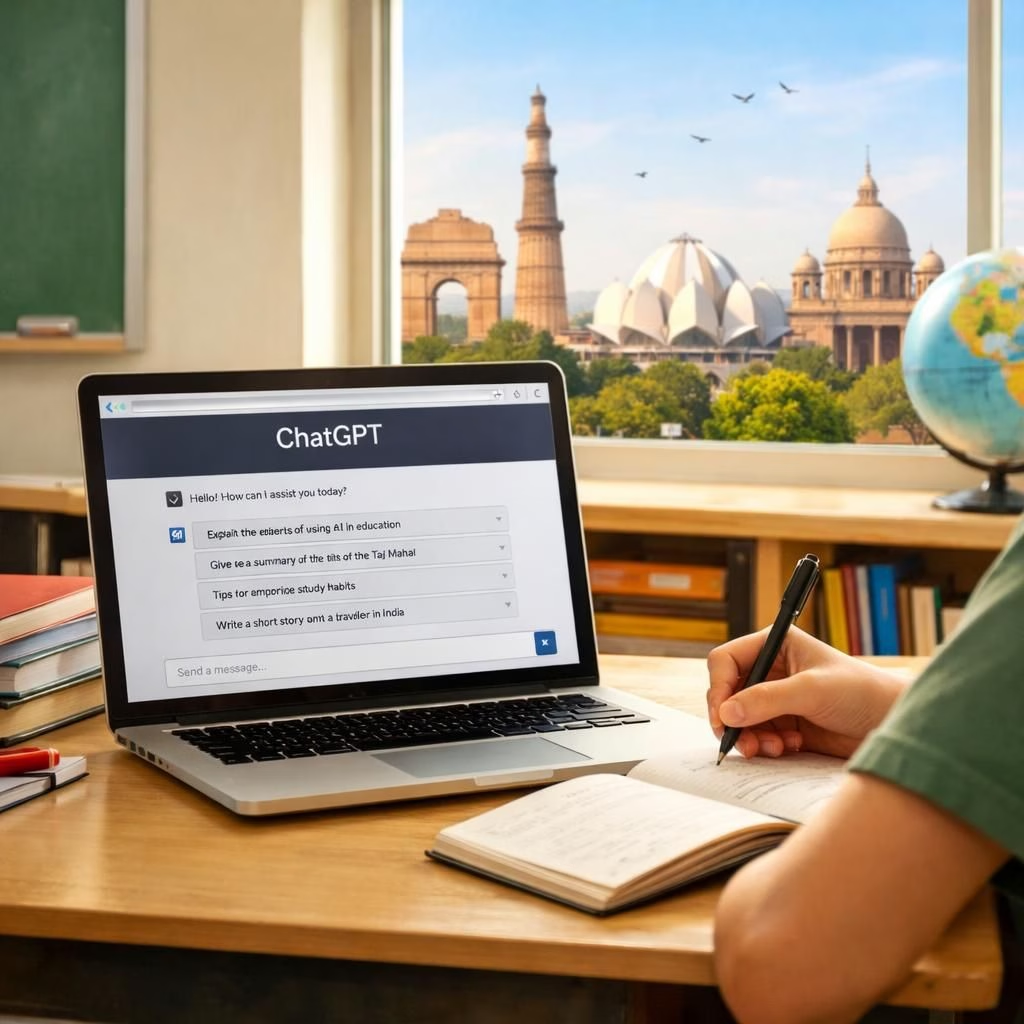
AI in India is on fire, and this isn’t just hype—it’s a turning point where 100M weekly ChatGPT users are shaping classrooms, startups, and everyday workflows. The momentum is tangible: the country isn’t waiting for permission to adopt the latest AI tools, it is building a daily habit around them. In this landscape, AI is not a distant upgrade; it’s a practical companion for students, teachers, professionals, and policy makers alike, and the energy around it feels a bit like a sprint with a clearly defined finish line.
India‘s student population is a dramatic driver here. Reportedly, a large share of ChatGPT usage comes from learners who rely on the platform for homework help, coding guidance, exam prep, language practice, and research drafting. OpenAI has highlighted Prism as a free, collaborative tool for scientific work, which resonates with India‘s researchers who want fast exchange of ideas across labs and campuses. With more than a billion people online, India‘s talent pipeline is growing rapidly, and that pipeline is caffeinated by AI-enabled study and inquiry. The result is a feedback loop: better learning outcomes, more experiments, and a steady rise in AI literacy across urban and rural classrooms alike.
AI in India: Education, Exams, and Everyday Use
OpenAI has not just observed the momentum; it has acted. A pricing strategy tailored to India‘s users—ChatGPT Go priced under USD 5 per month, with a year-long free access offer in some markets—lowered the barrier to entry and encouraged experimentation. A New Delhi office opened in August 2025, signaling a long-term commitment to the market. Meanwhile, Google’s Gemini has targeted students and young professionals, turning the AI conversation into a practical education program that blends software with classroom realities. India thus becomes a testbed where big tech platforms learn how to scale AI ethically, affordably, and inclusively.
Beyond pricing, the ecosystem is thick with partnerships and localized content. Language support, regional data centers, and school-level pilots are shaping how AI tools are used in real classrooms, not just in glossy demos. The narrative is pragmatic: AI helps teachers craft better lessons, assists students in tackling tough topics, and supports administrators in data-informed decision making. The result is stronger outcomes, as India‘s teachers and students learn to ask better questions of AI, and AI learns to answer them with context and nuance.
Bridges with AI, Gemini, and Growth in India
In parallel with the OpenAI push, Gemini’s expansion into India has become a notable part of the conversation. The market is not simply about fancy chatbots; it is about integrating AI into the broader tech and education infrastructure. Reliance Jio has announced a cooperative model to offer Gemini AI Pro access to hundreds of millions of users for 18 months, focusing on the 18–25 demographic. This kind of widespread access accelerates experimentation, with young people trying new AI-powered study aids, coding assistants, and productivity tools on devices they already use every day. The resulting surge in adoption is a signal to developers and policymakers alike: AI can be scaled responsibly when partnerships align with local needs and digital literacy priorities. India, this represents both opportunity and responsibility.
India‘s AI market is more than a high-volume playground; it is a sophisticated ecosystem where researchers, engineers, and industry leaders collaborate to shape practical AI solutions. Professionals across sectors—healthcare, manufacturing, finance, governance—are turning to AI to analyze data faster, automate repetitive tasks, and generate insights that drive smarter decisions. This broad adoption is not a speculative trend; it is a real-world acceleration that strengthens both private sector capabilities and public services. The country is not just a consumer market; it is a co-creator of AI-enabled workflows that span education, research, and enterprise software.
Practical steps for educators and students using AI
Here are practical, classroom-friendly steps to start integrating AI in everyday learning and teaching:
- Assess needs: Identify one or two subjects where AI can clarify tough topics or automate repetitive tasks.
- Choose tools carefully: Start with classroom-friendly AI assistants that offer parent and teacher controls.
- Pilot with teachers: Run small pilots in a single grade or subject before scaling.
- Measure outcomes: Track performance, engagement, and equity to guide rollout decisions.
FAQ: Quick answers about AI in India
- How many people use ChatGPT weekly in India?
- The numbers highlighted by OpenAI leadership point to a very large weekly user base, with India representing a major share.
- Why is India considered a growth engine for AI?
- It combines a large online population, a young talent pool, and active collaboration among government, universities, and industry.
- How can educators use AI responsibly?
- Focus on augmenting teaching with clear boundaries, privacy safeguards, and equitable access for all students.
To close this section with a practical takeaway: AI in India is not a distant forecast; it is a current, evolving practice that touches education, work, and daily routines. The balance of affordability, accessibility, and accountability will determine how quickly and how well the benefits spread across age groups and geographies. And while the headlines may focus on big numbers and bold partnerships, the real story is the people—teachers, students, researchers, and entrepreneurs—who are leveraging AI to learn more, build better, and connect more deeply with one another.
Curious about how this AI surge might affect your own field or daily routine in 2026? Share your thoughts in the comments below. Which AI tools have already changed the way you work or study, and where do you see the biggest opportunities for improvement in your community?
Special thanks to the original article for the material: Original article on AI in India. We’re grateful for the insights and the generous foundation they provided for this rewrite.
External sources
OpenAI blog: openai.com/blog
Google AI: ai.googleblog.com