

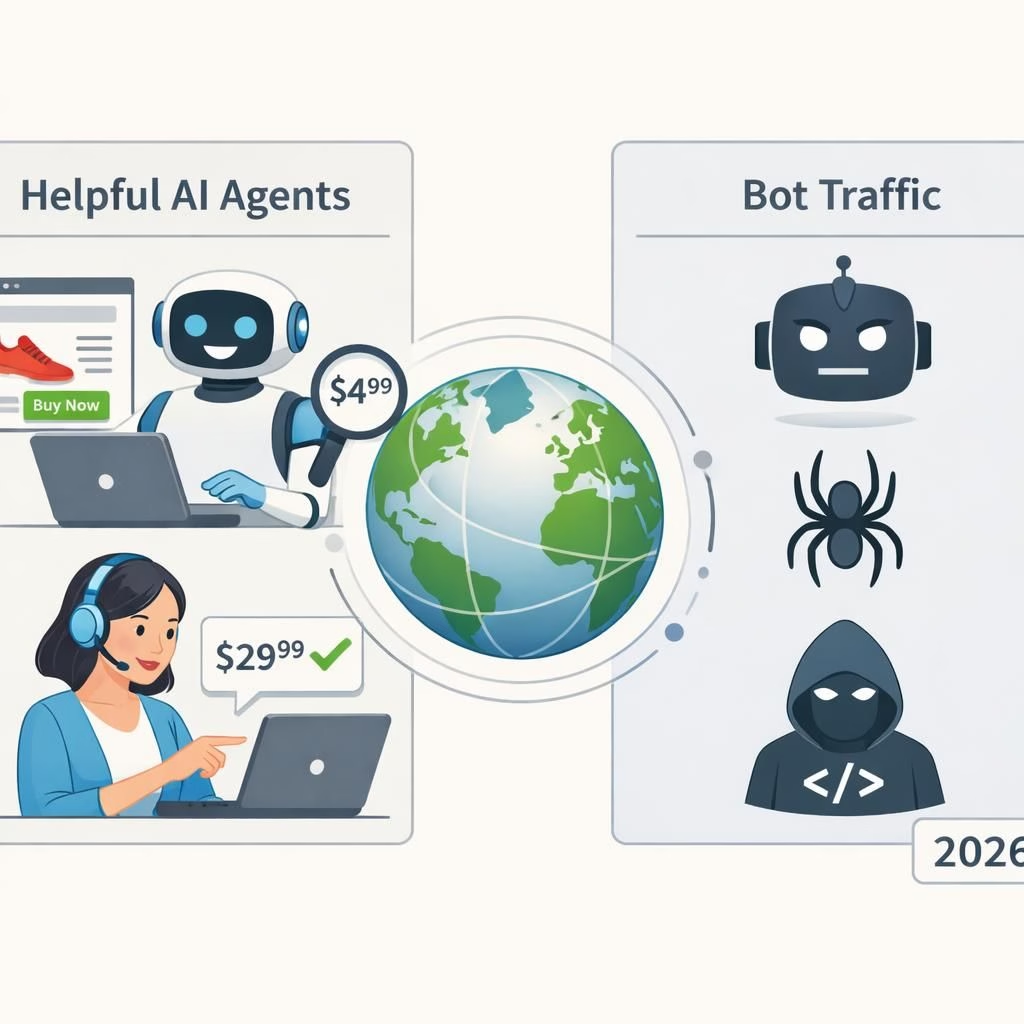
Welcome to a brighter, more purposeful internet era where AI-powered agents and bot traffic reshape how we browse, trust, and interact online. Cloudflare’s latest data offer a brisk snapshot of change: AI-powered agents now handle the majority of HTTP requests in many regions, while humans remain the late-night philosophers who still spend real time online. The crossover happened faster than anyone predicted, and yes, the data are messy enough to be entertaining, but the direction is clear: the internet has crossed the line into a new era. We gain speed and convenience, but we preserve choice by designing guardrails and clear expectations around evolving assistant technologies.
To understand what this means, let’s anchor the numbers: automated traffic now accounts for 57.5% of HTTP requests across the internet, with human-generated traffic making up the remaining 42.5%. That split marks a dramatic shift in how many requests travel the web each second. The exact crossover date remains fuzzy because the data are a tad chaotic, but the trend is unmistakable: the online world has moved to the other side of a line we once believed would be drawn by human browsers alone.
AI-powered agents reshape the web reality in 2026
What counts as an AI-powered agent, exactly, and why does this matter? In practice, these agents are not your stereotypical bots chasing metadata. They are designed to perform multi-step tasks with human-like thoroughness. They read product pages, check prices, compare flights, research purchases, order meals, and even handle customer service interactions. They browse in a way that feels deliberate and human—clicking a link here, scrolling there, pausing to consider a page before moving on. In short, these agents are stepping in to streamline routines that used to require a person, a browser, and a spreadsheet full of notes.
Cloudflare identifies these visitors as verified bots and signed agents, categories that help distinguish genuine user intent from the kinds of automation that often muddle dashboards. This clarity matters because it enables better fraud detection, better user experiences, and better decision-making for businesses that want hands-free efficiency without losing control of the customer journey. The takeaway is practical: AI-powered agents can handle repetitive, multi-step tasks so humans can focus on strategy, empathy, and creative problem-solving. The future isn’t about replacing people; it’s about amplifying what they can do when the routine drudgery is offloaded to capable automation.
From a user experience perspective, the rise of AI-powered agents promises faster decisions, smoother checkout flows, and more accurate price comparisons. For developers and operators, it means rethinking how sites are structured, how content is surfaced, and how signals from these agents are interpreted. The best outcomes come from transparent design choices—clear expectations for when a task is being automated, what data is used, and how users can intervene if needed. The space for clever UX innovation is enormous, especially as agents become better at anticipating user needs and reducing friction in the buying and support processes.
bot traffic and the brave new web reality
On the flip side, the term bot traffic still conjures up concerns, even as it evolves. Traditional bots were mostly about indexing, spam, or mischief. Today, the line between legitimate automation and noisy traffic blurs, but the goal remains: separate helpful helpers from invasive intruders. bot traffic in 2026 shows up not as a single, clumsy wave but as a spectrum, with some automated agents acting on behalf of users and others unintentionally or deliberately filling bandwidth without value. For security and performance teams, that means tuning policy rules, improving CAPTCHAs where appropriate, and building signals that distinguish a helpful, signed agent from a rogue or misconfigured crawler. The result is a more resilient internet that can gracefully differentiate between service-minded automation and nuisance volume.
Regionally, the data reveal curious patterns. Gibraltar leads the pack with about 92.1% bot traffic in data-centre-heavy contexts, a reminder that infrastructure density matters as much as intent. Singapore and Iran both show elevated levels, around 76.4%, which points to how local infrastructure, hosting, and regional traffic shapes influence. The takeaway is not alarm but context: different places will see different mixes of AI-powered agents and bot traffic, driven by data-centre footprints, policy environments, and the design choices of local service providers. It’s a practical nudge toward tailored security and performance strategies rather than one-size-fits-all solutions.
Meanwhile, humans still dominate time spent online. Streaming, social apps, and long-form reading keep people engaged in ways that volume-based metrics can’t fully capture. AI-powered agents, however, are generating a growing share of web requests, accelerating the pace at which pages load and tasks complete. The contrast isn’t about winners or losers; it’s about modalities. People buy, learn, and connect at human pace, while AI-powered agents accelerate the backend choreography that makes those moments possible. The result is a web that feels both more capable and more nuanced, where humans drive meaning and automation handles the heavy lifting behind the scenes.
The broader implication for 2026 is both technical and cultural. On the technical side, sites must optimize for agent-based navigation to maintain accessibility and performance. On the cultural side, businesses should communicate clearly about when an assistant is helping and when a user is actively steering a process. That clarity helps preserve trust in the relationship between humans and machines, even as the graph of automation continues to bend toward more capable, user-friendly experiences.
To tie this together with practical advice: monitor shifts in bot traffic patterns by region, design pages that support multi-step flows without sacrificing speed, and ensure that users can easily audit or interrupt automated actions if they choose. Security teams, too, should update risk models to reflect the realities of agent-driven browsing, because the best defense remains context and transparency. In other words, embrace the convenience of AI-powered agents while staying vigilant about who is behind the keyboard, and why.
As we track AI-powered agents and bot traffic shifts, we gain a clearer map of where the web is headed. The 2026 landscape is not a doom loop but a runway: technologies that can read, decide, and act continue to move forward, but human oversight remains essential for trust and accountability. The era of smarter automation is here, and the best outcomes come from a healthy balance of speed, quality, and human judgment.
Original article: Cloudflare blog on agentic traffic and bot traffic. Thank you to Cloudflare for the original material that inspired this exploration. We’re grateful for the work that made these insights possible.
Conclusion: the rise of AI-powered agents is a practical evolution, not a wholesale replacement of humans. The smart path forward is to combine fast automation with clear user controls and visible ethics. In the next section, you’ll find concrete steps to apply these ideas to real websites and apps.
Practical steps for AI-powered agents and bot traffic
- Map user journeys and identify multi-step flows that AI-powered agents can accelerate while preserving manual controls for critical decisions.
- Design pages with fast, frictionless paths to conversion, and implement progressive disclosure so automation stays helpful, not overwhelming.
- Publish clear signals that show when an action is automated and which data are used, enabling easy user audit and interruption if needed.
- Audit automation with privacy in mind: minimize data collection, set retention rules, and provide user-friendly deletion options.
FAQ: AI-powered agents and bot traffic
- What are AI-powered agents?
They are automated tools that can perform multi-step tasks across websites and apps, often acting on behalf of users to speed up routine tasks. - Why does bot traffic matter for sites?
Because it affects performance, security, and the accuracy of analytics. Proper distinction helps you tailor defenses and UX without blocking legitimate assistance. - How can I protect user trust?
Be transparent about automated actions, provide opt-out options, and maintain clear controls for users to intervene when needed. - What should security teams monitor?
Shifts in regional patterns, the emergence of signed agents, and signals that distinguish helpful automation from rogue crawlers.
References
- Times of India: Cloudflare CEO warns about bot traffic problem
- Cloudflare blog on agentic traffic and bot traffic