

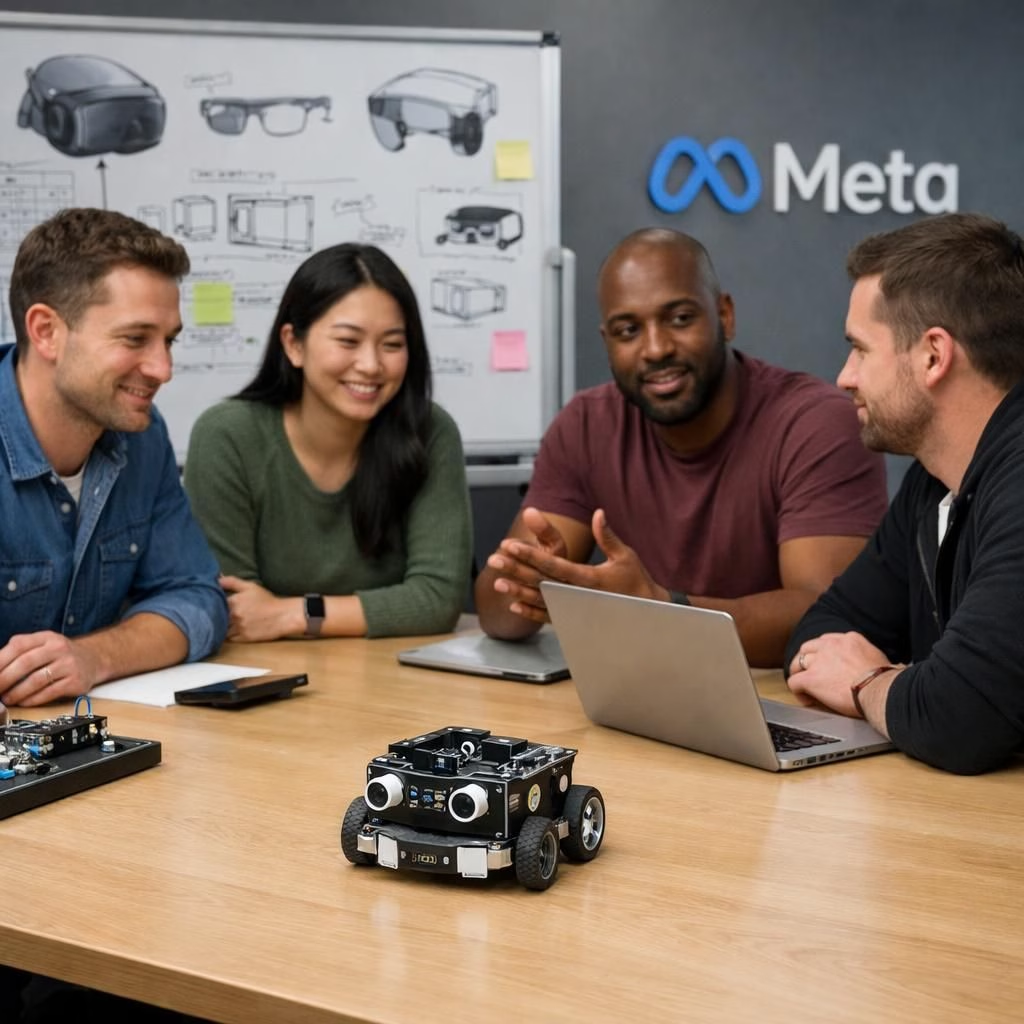
In 2026, Meta is quietly nudging its future toward AI devices and the [Tag B](https://www.geekyopinions.com/tag/hardware) that will power them. The company is assembling a dedicated [Tag B](https://www.geekyopinions.com/tag/hardware) team under its high-profile AI division, MSL, which emerged last year under Alexandr Wang’s leadership. The mood? Optimistic tinkering meets bold bets, with more prototypes on the drawing board than a weekend hackathon and fewer caffeine-fueled tears than a typical startup pivot.
AI devices and hardware: Meta’s 2026 push
The new effort is part of MSL’s expansion beyond glasses and VR. The [Tag B](https://www.geekyopinions.com/tag/hardware) team will be led by Rui Xu, a veteran engineer who previously headed [Tag B](https://www.geekyopinions.com/tag/hardware) at Dreamer, the AI agent startup Meta acqui-hired last month. Xu’s background spans operations leadership at K-Scale, work on smart devices at ByteDance, and stints at Xiaomi, Lenovo, and Tencent. Nat Friedman, who leads products and applied research at MSL, had previously invested in K-Scale through his AI Grant program, reinforcing the cross-pollination that Meta wants in its AI devices and [Tag B](https://www.geekyopinions.com/tag/hardware) strategy. The message is clear: the company is serious about turning AI devices and [Tag B](https://www.geekyopinions.com/tag/hardware) into a cohesive, practical portfolio rather than a one-off gadget.
AI devices roadmap
Reality Labs personnel have started transitioning to MSL to prototype the new division’s software using Reality Labs [Tag B](https://www.geekyopinions.com/tag/hardware). The two teams will reportedly work closely, sharing code, experiments, and the occasional coffee-fueled epiphany. This collaboration signals Meta’s intent to move beyond wearables into a broader family of AI devices and integrated [Tag B](https://www.geekyopinions.com/tag/hardware) platforms. The vibe is hopeful, and the engineering chatter suggests a path that blends curiosity with disciplined product thinking.
hardware fundamentals
Across the tech landscape, the race to ship AI-native devices is heating up. OpenAI, the ChatGPT creator, acquired former Apple designer Jony Ive’s [Tag B](https://www.geekyopinions.com/tag/hardware) startup IO to accelerate its [Tag B](https://www.geekyopinions.com/tag/hardware) ambitions, and rumors persist about Apple developing an AI-powered personal device, potentially an AI Pin the size of an AirTag with cameras, multiple mics, and a tiny speaker. Meta’s push under MSL fits a broader ecosystem play: build a personal agent that lives across a constellation of peripherals, from smart glasses to compact wearables, all coordinated by robust software and privacy-minded [Tag B](https://www.geekyopinions.com/tag/hardware).
Alexandr Wang, MSL’s chief, teased a future where your personal agent isn’t tied to a single gadget but travels with you across devices. In a podcast earlier this year, he said your agent should be on a constellation of peripherals, always on, able to see what you see and hear what you hear, and ready to help in ways today’s devices cannot. That vision drives both the [Tag B](https://www.geekyopinions.com/tag/hardware) and software decisions at MSL: sensor arrays, secure compute, energy efficiency, and a respectful approach to user data. It’s not about a single gadget; it’s about an ecosystem that feels natural and genuinely helpful when used every day.
In practical terms, Meta aims to deliver a [Tag B](https://www.geekyopinions.com/tag/hardware) stack that supports AI-powered software across devices while remaining mindful of privacy, interoperability, and user experience. The plan is to balance innovation with reliability: prototypes that are easy to use, easy to secure, and easy to repair if something goes delightfully wrong. The result could be a portfolio that feels cohesive—like a well-choreographed band where [Tag B](https://www.geekyopinions.com/tag/hardware) and software play in harmony rather than stepping on each other’s toes.
Where this could lead for users and developers
If this plan comes together, users may experience AI devices that blend into daily life as seamlessly as smartphones once did—smarter, calmer, and less distracting. Imagine a personal agent that learns routines, anticipates needs, and protects privacy by design, all without turning your home into a data breach risk averted only by luck. For developers, the [Tag B](https://www.geekyopinions.com/tag/hardware) tilt means new sensors, new interfaces, and fresh opportunities to extend AI capabilities beyond screens and speakers. It also raises important questions about data usage, device interoperability, and how quickly edge AI can handle ever-more capable models without draining batteries.
Of course, ambitious [Tag B](https://www.geekyopinions.com/tag/hardware) programs come with challenges: supply chains, manufacturing scale, and the never-ending dance between feature richness and battery life. Yet the upside is a more practical AI story—one where Meta’s [Tag B](https://www.geekyopinions.com/tag/hardware) decisions support real-world AI devices that feel more helpful than magical. With thoughtful design and clear user value, the AI devices and [Tag B](https://www.geekyopinions.com/tag/hardware) strategy could become a defining chapter of Meta’s consumer tech journey in 2026 and beyond.
Bottom line: the AI devices and [Tag B](https://www.geekyopinions.com/tag/hardware) push at MSL signals a thoughtful pivot toward an integrated, user-forward AI ecosystem. It isn’t about chasing a single gadget; it’s about enabling a reliable, privacy-conscious personal assistant across a network of devices that work together.
What are your thoughts on how Meta might shape AI devices and the [Tag B](https://www.geekyopinions.com/tag/hardware) that power daily life? Share them in the comments below to join the conversation. And a big thank you to Business Insider for the original article that sparked this analysis: Original Business Insider article.