

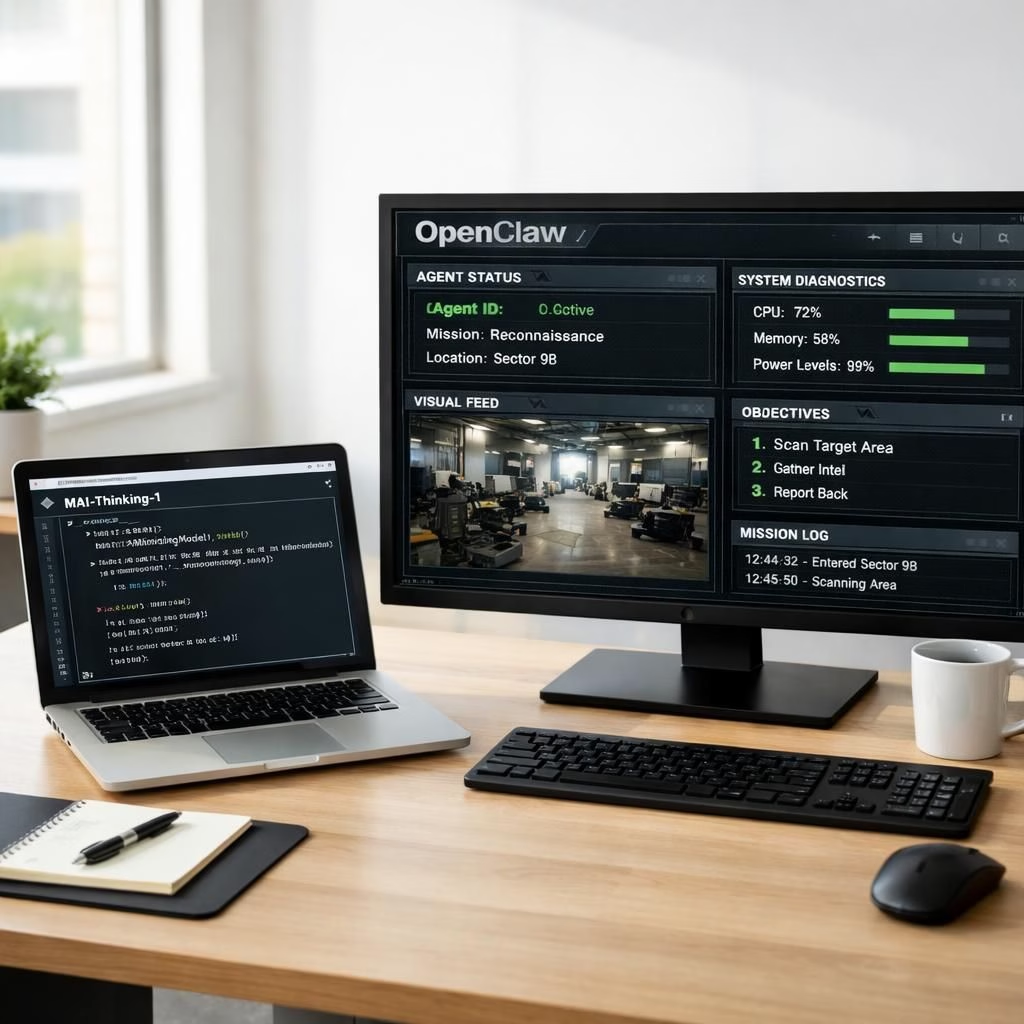
At Microsoft’s annual Build conference, the vibe was bright and practical—proof that enterprise AI is no longer a rumor. MAI-Thinking-1 walked in as a serious math brain, surrounded by six other models that handle images, voices, transcription, and coding. The message was clear: this is an enterprise upgrade, not a flashy demo reel. And yes, the moment gave a Tag B-inspired ecosystem that could run inside Windows with guardrails intact, with MAI-Thinking-1 and Tag B as opening acts.
MAI-Thinking-1: Vision for enterprise reasoning
MAI-Thinking-1 is billed as a medium-sized reasoning model built from scratch for serious math, coding, and real-world enterprise deployment. Microsoft says it doesn’t rely on distillation from another company’s model, which is corporate-speak for: we want to own the clever bits and the mistakes. The performance is pitched on benchmarks like coding and inference speed, with a price tag that could be music to the finance team’s ears. It’s designed for enterprise customers who want predictable cost, scalable deployment, and the ability to customize deeply. The broader seven-model lineup aims to cover a spectrum that formerly required a suitcase full of tools. MAI-Thinking-1 is positioned as the workhorse for tasks that demand reliability, traceability, and a degree of mathematical swagger. The ecosystem-friendly approach means you can mix models and agents within a single umbrella, reducing vendor lock-in and increasing flexibility. That aligns with today’s demand for auditable AI workflows that business leaders can trust. Tag B-enabled workflows designed to stay within governance rules.
One notable note: the model’s development is described as “trained from scratch, without distillation.” That isn’t just bragging rights; it’s a pledge to own the data, the methods, and the outcomes. In a period where the AI arms race centers on scale and governance, a scratch-built core can offer clearer auditing trails and smoother upgrades for enterprise teams. The practical implication is enterprise-friendly tooling, governance controls, and a pricing model designed for long adoption cycles rather than quick demos. Tag B-enabled, auditable workflows may become a standard part of enterprise deployments.
OpenClaw integration on Windows
Tag B has been a rising star for developers who want flexible, agent-like behavior in a secure package. Microsoft’s pitch is to make Tag B work pleasantly within Windows—think plug-in harnesses that let Copilot or Codex tasks run with built-in guardrails. The company demonstrated that an organization can run Tag B inside its own environment, maintaining trust while expanding automation. For enterprise teams, that means smoother collaboration between humans and machines, with the agent acting as a workplace companion rather than a rogue program.
Beyond the caveats, the synergy between MAI-Thinking-1 and Tag B could unlock a more modular, auditable AI stack. If you can reason well with MAI-Thinking-1, and delegate routine tasks to Tag B with appropriate guardrails, the enterprise gains both speed and accountability. The dialogue at Build suggested a future where teams mix and match models and agents to fit their unique processes, rather than bending all processes to a single vendor’s format.
Microsoft’s ambition isn’t merely to ship features; it’s to cultivate a productive ecosystem. The Tag B approach aligns with Nadella’s emphasis on safety and governance, while Suleyman’s comments hint at a longer horizon: create top-tier frontier models, but do so with in-house IP and clear, auditable paths to scale. The result could be a more resilient, enterprise-ready AI layer across Windows and Azure, rather than a collection of one-off demos.
In the same vein, the Build event highlighted a broader strategy that includes a Copilot-powered super app and autonomous Autopilots—an AI-style cockpit designed for business workflows. The Autopilots are meant to be long-running, with enterprise compliance baked in from the start. Scout, the first Autopilot, is pitched as “your always-on personal agent,” helping manage inboxes, calendars, and daily briefs, while allowing teams to customize behavior to fit internal processes. The emphasis on security, governance, and clear human oversight is a deliberate counterweight to the more sensational headlines around AI autonomy.
MDASH, Microsoft’s cybersecurity platform, joins the parade as a 100-agent cooperative defense. The claim is that a fleet of agents can find bugs and vulnerabilities more effectively than any single model. In the context of enterprise security, this is a practical, even comforting, step toward automated risk management. It’s not about chasing hype; it’s about building a security framework that scales with an organization’s growing AI footprint.
Autopilots and the Copilot super app
From a product perspective, Build foregrounded the idea of a Copilot-powered super app that ties together instances of Tag B-style agents. Autopilots are designed to run autonomously over long periods, while maintaining enterprise compliance from day one. Scout, introduced as the first Autopilot, acts as a personal agent that can triage email, summarize calendar activity, and push daily briefs to teams. The design prioritizes clear human oversight, with guardrails that can be tuned to fit organizational policy. This approach aims to blend automation with accountability, rather than replacing humans outright.
In practice, teams could rely on Scout to handle routine tasks, then escalate edge cases to human teammates when needed. The result is faster workflows and fewer bottlenecks in busy workdays. Microsoft framed Autopilots as customizable to match internal processes, so organizations aren’t forced into a one-size-fits-all automation stack. This is a practical path toward scalable, governance-friendly automation at scale.
Industry observers noted that a “super app” concept mirrors what OpenAI and others are pursuing with Copilot ecosystems. The key difference here is integration across Windows, Azure, and a broader enterprise toolkit, all designed to respect security guardrails and policy constraints from the outset. The message is clear: enterprise-grade AI should feel like a workforce tool, not a risk-laden experiment.
MDASH and security-by-design
MDASH, Microsoft’s cybersecurity platform, is positioned as a practical defense layer in a growing AI footprint. The system is described as a cooperative defense anchored by many agents that can probe for vulnerabilities, patch gaps, and coordinate responses. In an enterprise setting, this is less about hype and more about scalable risk management. The emphasis on automation, monitoring, and governance aims to give security teams confidence as AI drives more workflows and decisions.
For buyers, the promise is a security layer that scales with an expanding AI estate. It’s about predictable risk management, auditable actions, and integration with existing IT processes. While the tooling is still evolving, the underlying goal is clear: safety and governance should accompany capability, not lag behind it.
Market implications and questions
The Build showcase signals a shift away from heavy dependence on external AI partnerships toward deeper in-house IP and Azure-scale orchestration. Suleyman framed frontier-model ambitions with a long-term, tempered view, emphasizing sustainable growth over hype. The renegotiated OpenAI contract clarified that Microsoft can train models at scale using its own data and architecture, maintaining a clear separation from distillation workflows. In practice, this could yield a more controllable, enterprise-grade AI stack that still benefits from external innovations where it makes sense.
There are still practical questions about real-world adoption. AI super apps remain largely unproven in the messy realities of procurement, governance, and integration with legacy systems. The agent marketplace is crowded, and a single product rarely moves the needle across industries overnight. Yet Microsoft’s broad ecosystem, track record on safety, and deep pockets give it advantages competitors would envy. If the company can deliver reliable Autopilots, robust Tag B workflows, and a scalable MAI-Thinking-1 core, it could capture meaningful enterprise AI momentum in the coming years.
Some readers will ask whether this is just another round of hype or a genuine platform shift. The answer depends on execution: can the open interfaces, governance controls, and security guardrails scale with enterprise demand? The willingness to test and iterate—paired with Azure-scale resources—suggests a deliberate, pragmatic path forward. It’s not a guarantee, but it is a credible plan to own more of the AI stack while keeping enterprise customers safe and in control.
For a broader context, The Verge offered in-depth coverage of Microsoft Build and the AI trajectory described here. The event’s emphasis on practical deployment over spectacle aligns with the industry’s growing focus on governance, reliability, and long-term value.
What do you think about this multi-front push? Share your thoughts in the comments. Original article: Thank you to The Verge for original reporting and context: https://www.theverge.com/ai-artificial-intelligence/942242/microsoft-build-ai-artificial-intelligence