

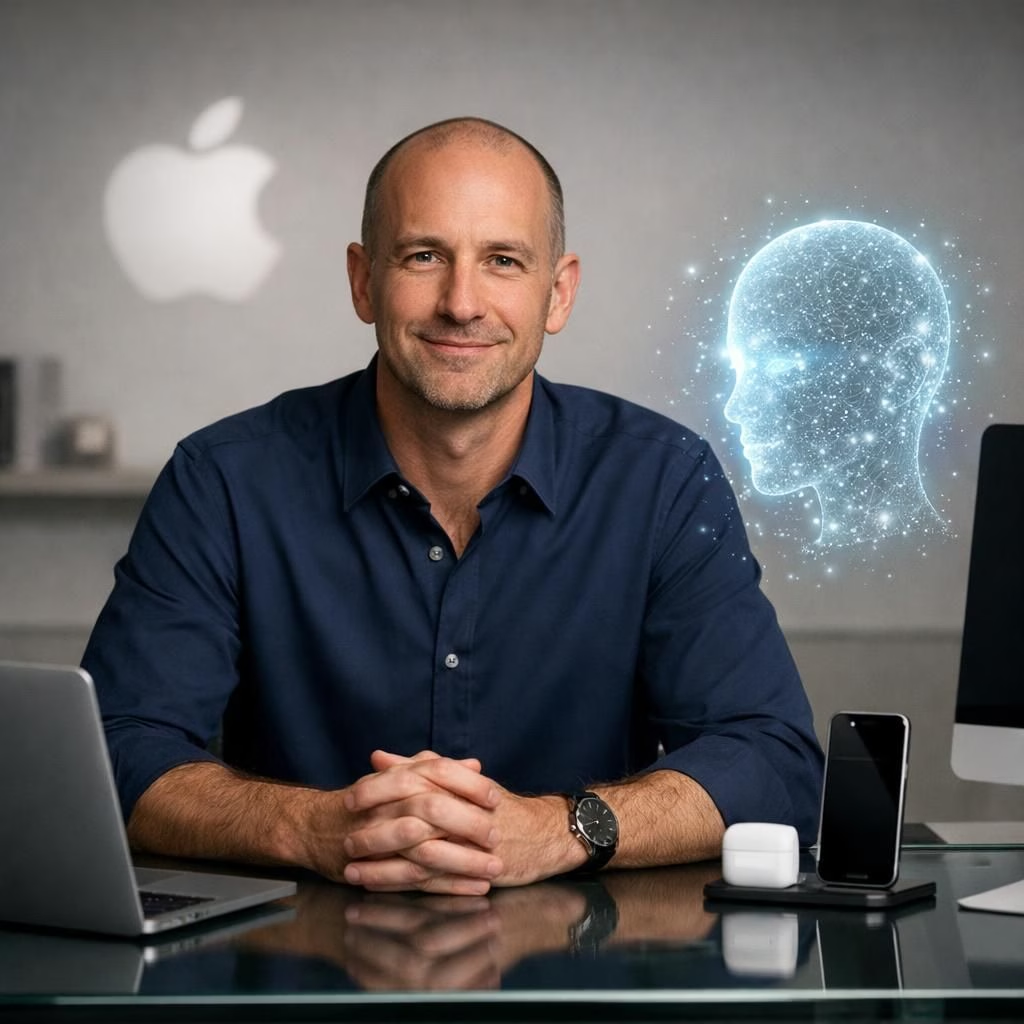
AI and Apple enter a new era as John Ternus steps up to lead, blending hardware rigor with AI ambitions in 2026 for the iPhone and beyond.
Apple announced that Tim Cook will stay on as executive chairman, and Ternus will assume the CEO role on September 1, 2026. Cook built a fortress of supply chain excellence that helped Apple compound value by trillions, and now he passes the keyboard to an insider who helped shape the company’s hardware backbone. This is less a changing of the guard and more a careful rebalancing of the empire, with AI quietly nudging the roadmap from behind the curtains.
Ternus joined Apple in 2001 and has quietly steered some of the firm’s most consequential hardware moves. He helped revive the Mac, nudging it back into conversations with PCs and revving up product cadence. He has kept a low public profile, but his fingerprints are on iPads, AirPods, and the big hardware bets that power the Apple ecosystem. In a world where AI is rewriting expectations, his appointment signals a belief that hardware leadership remains essential to delivering AI-powered experiences that feel truly Apple.
AI-First Apple Strategy
Under Apple aims to fuse AI into the hardware stack rather than rely on off-the-shelf software tricks. The Gemini deal with Alphabet aims to sharpen Siri and bring AI capability into daily tasks, but the company remains intent on on-device processing, privacy, and a cohesive user experience. Apple’s real goal is a credible AI story that is durable, private, and tightly integrated with the devices people already love. The challenge is to balance AI ambition with the Apple design ethos: simplicity, reliability, and long battery life.
Analysts note that creating an AI agent inside iOS and macOS that truly feels like a personal assistant is harder than it looks. The market is crowded with flashy demos, but Apple wants an AI that respects user privacy, runs on-device when possible, and never feels chopped together. The path forward emphasizes on-device AI acceleration, energy efficiency, and a seamless handoff between device and service. In practice, that means smarter on-device chips, smarter sensors, and software that makes AI feel like magic rather than a noisy add-on.
Public discourse already paints a picture: can Apple keep the magic intact while ramping up AI capabilities? The company has long prized a tight hardware-software loop. Apple’s era could solidify that loop with a sharper focus on AI-enabled hardware features, such as improved camera AI, smarter battery management, and privacy-preserving AI tasks that stay on the device whenever possible. Apple will likely emphasize user control, transparent AI prompts, and a refined assistant that respects user boundaries while offering useful help.
Apple Hardware and AI Journey
The leadership transition suggests a broader hardware push beyond the familiar iPhone family. Observers expect momentum on foldables, AR glasses, VR devices, and perhaps AI-centric accessories that pair neatly with on-device silicon. Gil Luria of D.A. Davidson hints at a balanced portfolio: new devices that showcase AI-powered prowess without sacrificing the tactile pleasures of Apple’s classic hardware — a combination that could help Apple regain momentum in a crowded field.
Nvidia remains a constant competitor in AI chips and computing power, pushing Apple to craft its own competitive path through silicon design. The company’s ongoing investments in chip architecture, power efficiency, and specialized accelerators play directly into how well future hardware can run AI workloads.
Cook’s tenure widened Apple’s reach by mastering supply chains and scaling production efficiently. Apple shares declined about 0.5% after regular trading hours when the news was announced, after being up about 1% during regular trading. The stock has soared 20-fold since Cook took over as CEO in August 2011. Apple, 65, was recruited by Jobs from Compaq at a time when that firm was riding high on the 1990s PC boom and Jobs was working to rescue Apple from the brink of insolvency. He made his early reputation at Apple by building out its sprawling supply chain with contract manufacturers in China, a model that became the envy of Corporate America because it kept expensive factory operations and product inventories largely off Apple’s books while maximizing profits. Apple’s decades of investments in China helped fuel that nation’s rise as the world’s workshop, a phenomenon that even Cook has found hard to shift away from. Despite opening assembly operations in India and Vietnam, Apple still sources many key parts and subsystems from China, and Cook has not yet been able to present a “Made in USA” iPhone to U.S. President Donald Trump, despite hundreds of billions of dollars of investment in Apple’s U.S. supply chain partners. Cook, who presented a custom golden plaque to Trump last year, will continue to engage with policymakers, the company said. Over his tenure, Cook became a celebrity CEO in his own right. He was the first Fortune 500 CEO to come out as gay in 2014 and took public stances on issues such as workplace diversity and corporate sustainability. Separately, Apple said that Johny Srouji, who has overseen Apple’s custom chip and sensor designs, has been named chief hardware officer. Srouji will continue to oversee that group, along with the hardware engineering group that Ternus once led, which will now be overseen by Tom Merieb.
As Apple navigates the AI era, public perception matters as much as quarterly results. Nvidia’s chips, OpenAI’s rapid progress, and a flood of AI-enabled devices have shifted investor expectations. Yet Apple’s brand remains a magnet for consumer trust. The real test will be how well the company blends AI innovations with its renowned hardware design, elegant software, and enduring privacy commitments. If Ternus can align AI ambitions with the hardware roadmap, Apple could reinforce its position as a premium, trusted innovator in a fast-changing landscape.
In the longer arc, the leadership team’s choices will shape how AI sits at the center of the user experience. The emphasis on on-device AI, privacy-by-default, and a disciplined hardware strategy could define a decade more of Apple products that feel magical yet grounded in reliable engineering. The combination of AI agility and hardware craftsmanship may become Apple’s signature move, a way to outpace rivals while keeping the product experience distinctly Apple.
If you enjoy conversations about AI and hardware, share your thoughts in the comments below. How do you see Apple balancing AI integration with its legendary hardware design in 2026 and beyond?
Original article: https://example.com/original-article — Thank you for the original source material.
Practical steps for users
- On-device AI improves battery life on Apple devices.
- Smart imaging features on Apple cameras use privacy-friendly AI.
- Smarter sensors in Apple hardware enable contextual awareness without data leaving the device.
- Seamless handoffs between Apple hardware features and software services.
FAQ
-
Q: What does this leadership change mean for Apple‘s AI strategy?
A: It signals a continued emphasis on on-device AI and hardware-led integration, prioritizing a smooth user experience and privacy. -
Q: Will there be new hardware beyond the iPhone?
A: The outlook points to momentum in foldables, AR/VR devices, and AI-focused accessories that complement on-device silicon from Apple. -
Q: How will privacy be preserved with more AI on devices?
A: On-device processing, strict prompts, and transparent controls aim to keep data handling within the user’s control.
Further reading
- For leadership news, visit the Apple Newsroom.
- Explore Nvidia AI computing for context on AI hardware advances.