

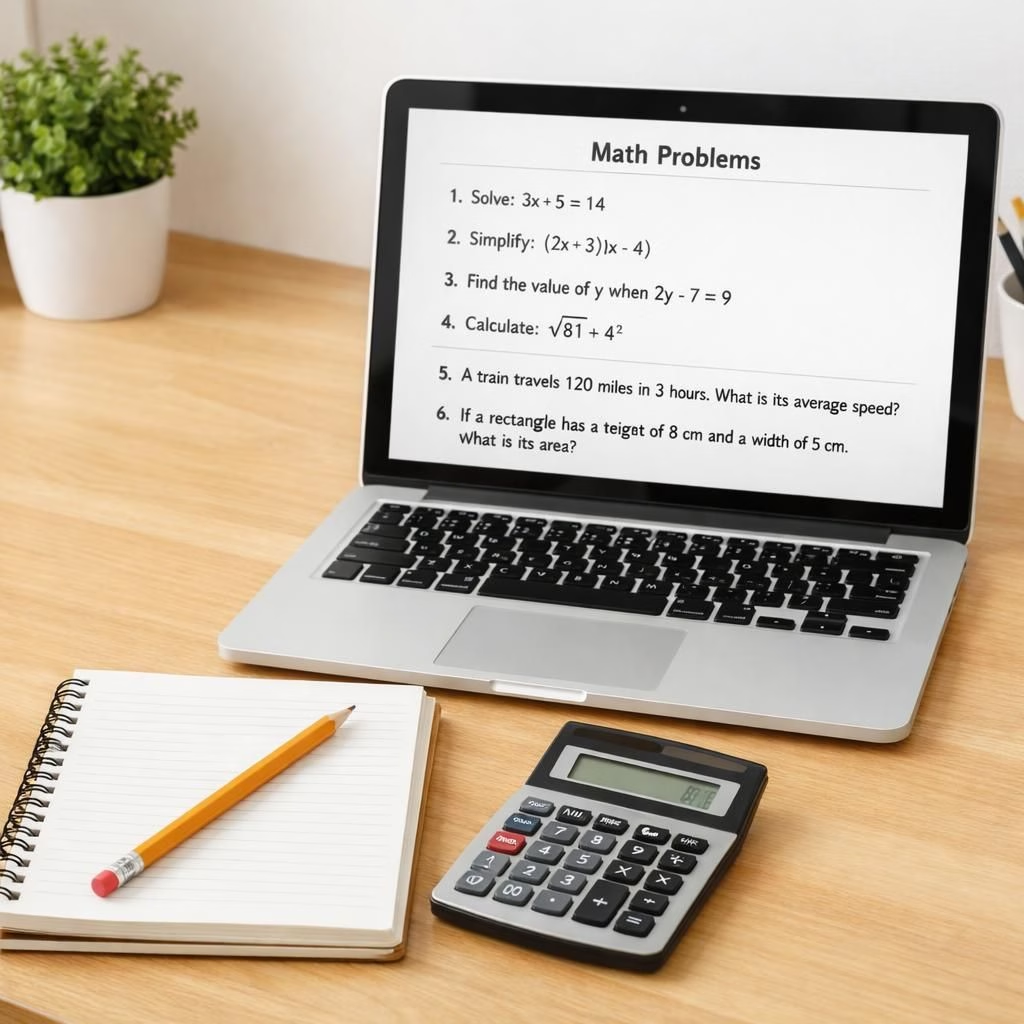
Welcome to the world’s largest collection of Olympiad math problems now open to everyone. Yes, you, the weekend solver with a coffee-stained notebook, can dive into challenges that used to sit behind institutional gates. This is Olympiad problems in public, offering real competition material with an open-access license that invites reuse. The result is a shared toolkit where curiosity becomes skill, and every problem carries a citation-friendly trail. Welcome to a new era where math meets the common room, and Olympiad challenges arrive with a friendly nudge toward clear reasoning.
math and Olympiad: Why Open Access Matters
The collection is not a toy box. It is a carefully curated feed of problems ranging from friendly warm-ups to nerve-wracking classics. For teachers, students, and curious citizens alike, the archive elevates learning from a coffee-break whim to structured practice. In 2026, open access matters more than ever, because knowledge should travel without tolls or gatekeepers. The math you find here is real competition material, yet the access is real-time and real-world.
In practical terms, you can browse topics, select by difficulty, and remix problems for short class sessions. The Olympiad flavor remains intact, but the barrier between solver and solver dissolves. The result is more discussion, more doodles on the margins, and more “aha” moments that feel earned rather than handed to you on a silver problem sheet.
math Opportunities for Olympiad Training for All Learners
Accessibility changes the math ecosystem. It invites high school students, undergraduates, and curious professionals to train like Olympiad veterans without needing a library card. The material is organized so beginners can find friendly starting points while seasoned solvers hunt for trickier twists. You don’t need a sponsor or a professor to start; you only need curiosity, a timer, and perhaps a lucky pencil.
The platform behind the release promises quality, not chaos. It offers curated problems with solutions or hints, enabling iterative learning. You can chase patterns in number theory, geometry, combinatorics, and algebra, or simply test a few proofs to see if your brain still accepts proof by contradiction as a challenge. The math here is robust, the Olympiad lineage is clear, and the path from novice to competitor is visible and navigable.
math Visualization and Practical Tips for Using This Olympiad Resource
To maximize impact, treat the collection like a gym for your brain. Start with warm-ups to wake up your problem-solving muscles. Then mix in mid-level challenges to test your resilience and flexibility. When you hit a tough problem, step back, sketch a diagram, or translate the statement into your own words. This is where math becomes a story, and the Olympiad theme provides a plot twist you can actually follow.
Organize your study by topic: number theory, geometry, combinatorics, algebra. Create a personal notes system, track which problem types still give you trouble, and circle the ones you mastered. The beauty of open access is that you can reuse problems in new combinations, annotate your solutions, and watch your own progress unfold—quite satisfying when you see a tough idea click on the page.
Educators can use this resource to structure short, repeatable classroom sessions. A 20-minute problem sprint can stand in for a lecture, giving students a taste of challenge with a safety net of hints. Over time, this builds confidence, precision, and a healthy respect for rigorous reasoning. The math is stirring, and the Olympiad perspective remains gentle enough not to scare away beginners.
math Bias, Quality, and Community in a Big Olympiad Catalog
No catalog is perfect, but openness invites correction and contribution. The community can point out ambiguities, propose clarifications, and share alternate solutions. This collaborative spirit keeps the math clean and the Olympiad lineage honest. Expect lively discourse, a few friendly debates, and a few lighthearted memes about squares and triangles.
As with any collection of problems, pacing matters. Don’t sprint through 200 problems in a day. Instead, pace yourself, savor the small wins, and let your understanding settle before moving forward. The goal is not to memorize answers but to sharpen thinking. The keyboard will soon feel like a partner in problem solving, not a bystander.
Beyond personal growth, the release benefits schools and communities that may lack rich math libraries. With open access, librarians and teachers can curate local practice sets, tailor them to curricula, and deepen math culture at the school level. The net effect is an ecosystem where curiosity is free to roam and the solver is in the driver’s seat, not a passive passenger.
In short, this is more than a repository. It is a movement toward inclusive, rigorous, adventurous math education. The scale is impressive, the intent honorable, and the opportunity accessible. Whether you’re chasing a competition berth, preparing for a national exam, or simply proving to yourself that you still enjoy a good puzzle, the collection invites you to press on with enthusiasm.
We’d love to hear your personal take on this open-access turn in Olympiad-style problem solving. Do you use it for self-study, tutoring, or classroom integration? Share examples of problems that challenged you and how you conquered them. Tell us what you’d like to see next in this growing catalog.
Special thanks to Phys.org for the original article and the inspiration that led to this write-up. Original article: Phys.org.
We invite you to share your thoughts in the comments. If you found this recap useful or funny, pass it along to friends who love numbers and puzzles.
Frequently asked questions
-
What is the benefit of open access for Olympiad-style problems?
Open access lowers barriers to practice, lets teachers tailor sets, and encourages collaborative problem solving beyond traditional classrooms. -
Who can use this collection?
Anyone with curiosity—students, teachers, self-learners, and professionals looking to sharpen logical reasoning. -
How should I pace my practice?
Start with short warm-ups, progress to mid-level challenges, and revisit tricky problems after a break. Regular, repeated exposure builds fluency without burnout. -
How do I track progress?
Keep a simple log: problem type, difficulty, what helped, and what to revisit. Annotation and reflection reinforce learning and show growth over time.
References
- Original article: Phys.org
- Math Olympiad overview: MAA – Olympiads
- Open access explained: Open access (Wikipedia)
- Mathematics Olympiad (overview): Mathematics Olympiad (Wikipedia)