

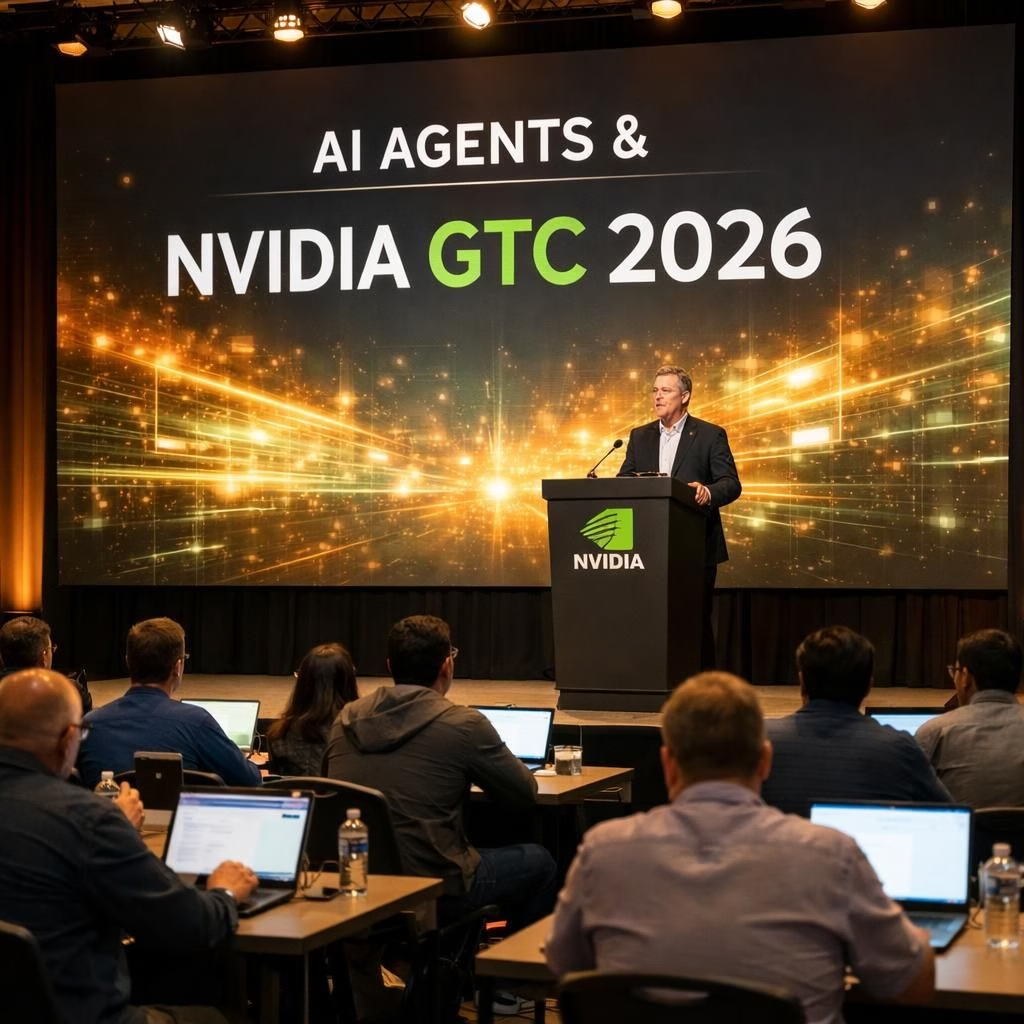
AI Agents and NVIDIA GTC 2026 are not just buzzwords; they signal silicon learning to optimize data centers. San Jose hosts the four-day spectacle, where Jensen Huang will step onto the SAP Center stage to deliver a keynote about practical AI progress. The mood is buoyant, the chips are fast, and the vibe remains pragmatic—an energy you won’t find in a sterile press release.
AI Agents at NVIDIA GTC 2026: The Hardware-Humor Hybrid
The keynote and demos center on concrete hardware progress, not buzzwords in a spreadsheet. Nvidia’s lineup this year leans into new AI inference capabilities and faster chips that can run models without overheating. In December 2025, Nvidia agreed to pay $20 billion to Groq to license its inference hardware and recruit talent—the largest tech purchase Nvidia has made to date, underscoring a practical bet: inference speed matters and cost matters more at scale. Now rumors point to a new chip that threads Groq’s inference tech into CUDA, promising speed with less drama.
Analysts expect Nvidia to reveal servers that fuse Groq’s ultra-fast inference engines with Nvidia’s networking stack, delivering a compelling performance-per-dollar package. The goal is faster AI workloads without forcing customers to overhaul their entire data-center fabric.
NVIDIA GTC 2026 Spotlight: AI Agents in Smart Hardware
Beyond chips, chatter centers on smarter hardware in the stack. Nvidia’s Vera Rubin GPUs are planned to ship in the second half of 2026, offering better performance per watt and a scalable roadmap. The company teased Feynman GPUs with a plan to bring them to market in the next couple of years. If previews hold, these chips will power nimble AI systems and impressive demos on stage.
On the software side, Nvidia pushes CUDA as the backbone of acceleration. Industry chatter suggests integrating Groq’s inference with CUDA, delivering a smoother path from model development to production. The goal is to keep developers in a familiar landscape while adding Groq’s speed. The result could be faster model iteration and cheaper AI services—an outcome many enterprise buyers crave as they scale from pilot to production.
Chip equipment and packaging rounds out the hardware story. Nvidia reportedly committed $2 billion each to Lumentum and Coherent, laser makers that connect chips in data centers. The idea is co-packaged optics that speed up chip-to-chip connections with less energy waste. Expect data centers that hum with efficiency and stay cooler under heavy inference.
Open Platforms, Safety, and NemoClaw
NemoClaw is pitched as an enterprise-grade open platform for AI Agents designed to rival OpenClaw. Nvidia reportedly plans NemoClaw with enterprise-grade security, privacy protections, and scalable task automation. It is hardware-agnostic and deeply integrated with Nvidia’s NeMo framework, the Nemotron model series, and Inference Microservices. If true, NemoClaw could help teams deploy AI Agents more confidently in real-world settings—bridging the gap between research ideas and production systems. For teams chasing AI Agents and NVIDIA GTC 2026 innovations, NemoClaw aims to deliver enterprise-grade security and scalable automation.
Crucially, NemoClaw’s design emphasizes modularity and security, so businesses can run multiple AI Agents across devices while keeping data flow under control. The platform’s enterprise focus could reduce risk while preserving the flexibility customers expect from a cutting-edge AI stack. And yes, it’s reasonable to wonder if such a platform becomes the backbone of customer service, industrial automation, or edge deployments soon. This is all central to the AI Agents narrative at NVIDIA GTC 2026.
Physical AI, Robotics, and a Little Star-Wars Neon
GTC has always flirted with physical AI, and this year looks ready to deliver more than hype. Onstage moments previously featured a Star Wars–style robot powered by a physics engine called Newton, a Disney and Google DeepMind collaboration. Expect similar demos, with robotics and real-world control taking a larger role. Analysts predict physical AI could become a multitrillion-dollar industry, given the right blend of hardware acceleration, robust software, and human-friendly interfaces.
Huang will highlight how the hardware-software stack supports smarter AI Agents that function in dynamic environments—industrial floors, warehouses, and consumer devices. The aim is to show that the future of AI is not just brainy algorithms; it’s a practical, field-tested ecosystem that runs smoothly and humorously, even when the projector hiccups.
Meanwhile, Nvidia’s strategy remains clear: push inference, not just training, and keep the AI ecosystem rich enough to reward developers and customers who invest in it. The plan is to funnel profits back into the AI ecosystem so the entire stack scales responsibly. If the market grows as expected, NVIDIA’s 2026 roadmap could help the company maintain leadership while inviting competitors to innovate rather than imitate. It’s a big show, but it reminds us that tech progress can be serious and delightfully practical at once.
For the home viewers and on-site attendees, the energy is upbeat and pragmatic. The people are excited, the engineers are building, and the buyers are plotting procurement with a careful sense of humor. If you’re watching from afar, you’ll feel the same energy in the coverage—the focus on products, partnerships, and the real-world impact of AI on jobs, cost, and everyday life. It’s a pivotal week for hardware, software, and the people who turn ideas into production—an encouraging sign for 2026 and beyond.
Thank you to the original article for the inspiration and the factual backbone.
We invite you to share your thoughts below and tell us what you’re most excited—or most curious—about for AI Agents and NVIDIA GTC 2026. Your perspective helps shape the conversation and sharpens our sense of humor about the next wave of computing.
External Reading
References
Original source: https://indianexpress.com/article/technology/artificial-intelligence/nvidia-gtc-2026-what-to-expect-jensen-huang-keynote-10584907/