

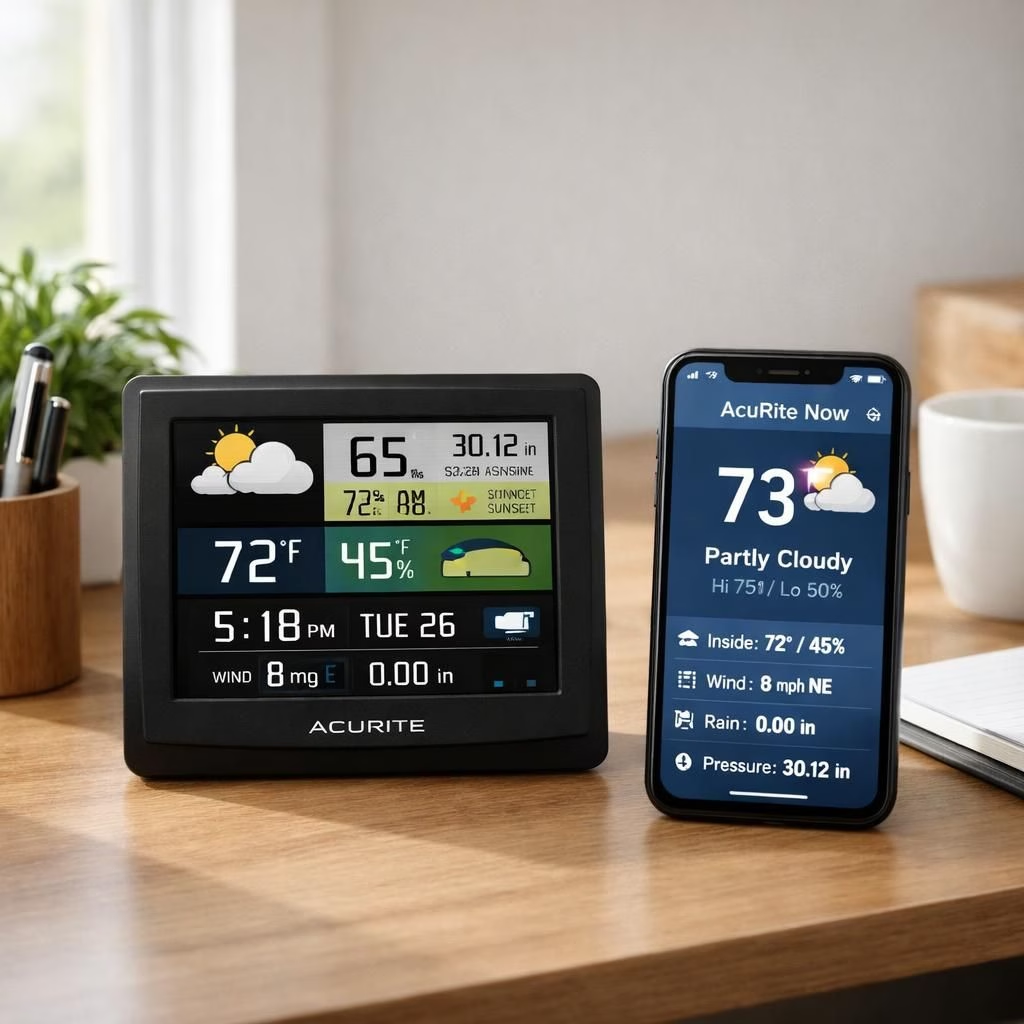
In 2026, AcuRite and AcuRite Now share a weather-loving reputation for stubborn yet lovable gadgets. This friendly tour examines the shift from My AcuRite to AcuRite Now with a sunny, practical eye—and yes, a dash of humor, because devices deserve personality too.
For many long-time users, the big news is real: the My AcuRite app is winding down, and the move to AcuRite Now is being nudged across the finish line with a May 30, 2026 deadline. AcuRite, the weather-monitoring company behind devices such as weather stations, indoor thermometers, and rain gauges, will make AcuRite Now the official control hub for all devices and sensors households rely on. The company first launched AcuRite Now in June 2025 to support a new weather station—the AcuRite Optimus—yet millions of users still preferred the My AcuRite interface. Now the two-app era ends, and the one-app era begins, with a practical focus on consistency and scale.
AcuRite Now: A Unifying Move That Still Feels Like a Leap
The consolidation is not just a branding refresh. It promises fewer compatibility quirks and a clearer upgrade path for future features. AcuRite Now is designed to work with thousands of products within Tuya’s SmartLife IoT ecosystem, including third-party fans, thermostats, light bulbs, plugs, cameras, and even motorized blinds. That wide integration brings convenience, but it also invites a bolder question: will the new app keep things simple for casual users while offering room to grow for power users?
Some long-time customers have voiced concerns about losing the old My AcuRite capabilities, such as renaming multiple sensors at once or more flexible data views. An active thread of user feedback notes that the old interface offered on-screen sensor organization that some fear AcuRite Now will need time to replicate. Still, the push toward a single, up-to-date app could reduce maintenance costs, streamline bug fixes, and lay groundwork for more future-proof features. In other words, a practical step forward that also invites a few spicy memes along the way.
AcuRite: The Data Saga, UI, and the Big Shift
Historically, My AcuRite allowed some users to view data with particular ease and share data with Weather Underground, a real-time weather service. AcuRite Now also supports sharing, but with a subscription twist. The new model includes AcuRite Now+ options that add storage and access to more historical data. The change has been polarizing: some see it as a necessary modernization; others worry about losing the simplicity that made the old app approachable. The official stance is that the shift helps consolidate code, reduce technical debt, and unlock room for desktop-style features that are still on the roadmap. In practice, you may notice a few layout changes, some screens showing less data at a glance, and a learning curve as the new UI finds its footing. The company has also acknowledged ambitions to add sensor-organization tools and multi-sensor renaming in the future, though those enhancements are currently labeled as “soon.”
From a user experience lens, the 365-day storage in AcuRite Now+ is a meaningful upgrade over the 30-day window on the older plan. It lets hobbyists and analysts track seasonal trends over longer periods. The trade-off is the subscription cost, starting modestly but potentially adding up for households with multiple devices. Yet the move also aligns with industry realities: cloud-based storage, ongoing server maintenance, and the ability to monetize value-added features without compromising the core device control. In other words, better data continuity and the chance to unlock more insights, provided you opt in.
AcuRite Now+: Subscription Twists, Data, and Practical Takeaways
The subscription model—AcuRite Now+—offers more than just extended history. It also includes data storage beyond the basic plan and the potential for premium capabilities that could empower advanced users to build longer-running analytics or feed more robust dashboards. For those who rely on Weather Underground sharing, the feature remains part of the ecosystem, now positioned as a premium option. Critics have pointed to the price and the sense that some features that used to be free may become paid add-ons. Proponents respond that a paid tier can fund ongoing development, better reliability, and faster feature delivery. The net effect is a cautious optimism: a streamlined platform with room to evolve, balanced against the understandable wish for continuity and simplicity.
On the design front, some Reddit discussions have framed AcuRite Now as a departure from the clean, focused feel that My AcuRite offered. The newer interface has drawn reactions ranging from “looks like a bad joke” to “it’s growing into its own.” The reality is likely somewhere in between: the new interface may not yet match every quirk of the old one, but it is a platform built to accommodate new devices, new data types, and new ways to share insights through the ecosystem. The shift also creates a clearer path for ongoing updates, which could yield faster bug fixes and more coherent compatibility across all AcuRite devices, third-party integrations, and newer sensors.
Ars Technica and other outlets have acknowledged the change and reached out for comment, with responses typically framed around a long-term roadmap rather than a sudden overhaul. The goal, in practice, is to simplify maintenance and improve scalability. If done well, users will eventually experience fewer app-crash moments, more consistent data streams, and a unified interface that makes it easier to compare sensor readings across devices and time spans. The price of admission may be a learning curve and a modest subscription, but the payoff could be a more reliable, future-ready weather- and data-monitoring setup for the average household.
In summary, the AcuRite Now shift represents a pragmatic evolution: consolidate two apps into one, lean into a broader IoT ecosystem, and monetize with optional premium features that provide real value for power users. The practical benefits include a unified data view, longer history storage, and potential feature upgrades. The potential drawbacks involve a transition period for users who relied on older functionalities, plus the need to decide whether the added subscription costs deliver enough incremental value for your situation. As with many tech transitions, the outcome will depend on how well the new app balances simplicity for casual users with depth for analytics-minded fans.
If you’re weighing the switch, here are quick takeaways: (1) expect a more uniform control surface across devices; (2) anticipate longer data history with Now+; (3) be aware of potential feature gating behind a subscription; (4) watch for upcoming desktop-like features that may improve organization and renaming capabilities; and (5) give the new app a fair chance before judging it too harshly—updates may close early gaps and reveal nice surprises.
For those who prefer a hands-on approach, try exploring the current AcuRite Now layout with one or two devices first. Note what data you access most and how you like to view it. If you’ve already made the jump, share your experiences—what works, what doesn’t, and what you’d like to see next. Your feedback helps shape the roadmap, even if it’s a gentle roast that ends in a helpful suggestion.
Original article attribution: Ars Technica. Thank you for the thoughtful reporting and context used to shape this post.
Have you already switched to AcuRite Now? Share your experience in the comments and join the conversation.
Practical steps for transitioning
- Test AcuRite Now with a couple of devices first to see how the layout feels for your most-used sensors.
- Review how you view data and consider enabling longer history storage if you opt for AcuRite Now+.
- Plan for any feature changes, such as sensor renaming or on-screen organization, and provide feedback to the developer channel as you explore.
References
Original source: Ars Technica.
Frequently asked questions
- Will I lose access to my data if I switch to AcuRite Now?
In practice, you’ll migrate to a unified view. Expect changes in how data is displayed, with the option for longer storage under AcuRite Now+ if you choose that tier. - Is the Now+ subscription mandatory?
No. It’s optional and designed to unlock longer history and premium features. Casual users can continue with the basic plan, though they may miss some extensions. - Can I still share data with Weather Underground?
Yes, sharing remains possible, but certain sharing features may be gated behind the Now+ tier. This is part of the broader shift to a paid model that funds ongoing improvements. - What if I don’t like the new UI?
Feedback channels are active. Many users report a learning curve, but updates and clarifications aim to improve organization and device compatibility over time.