

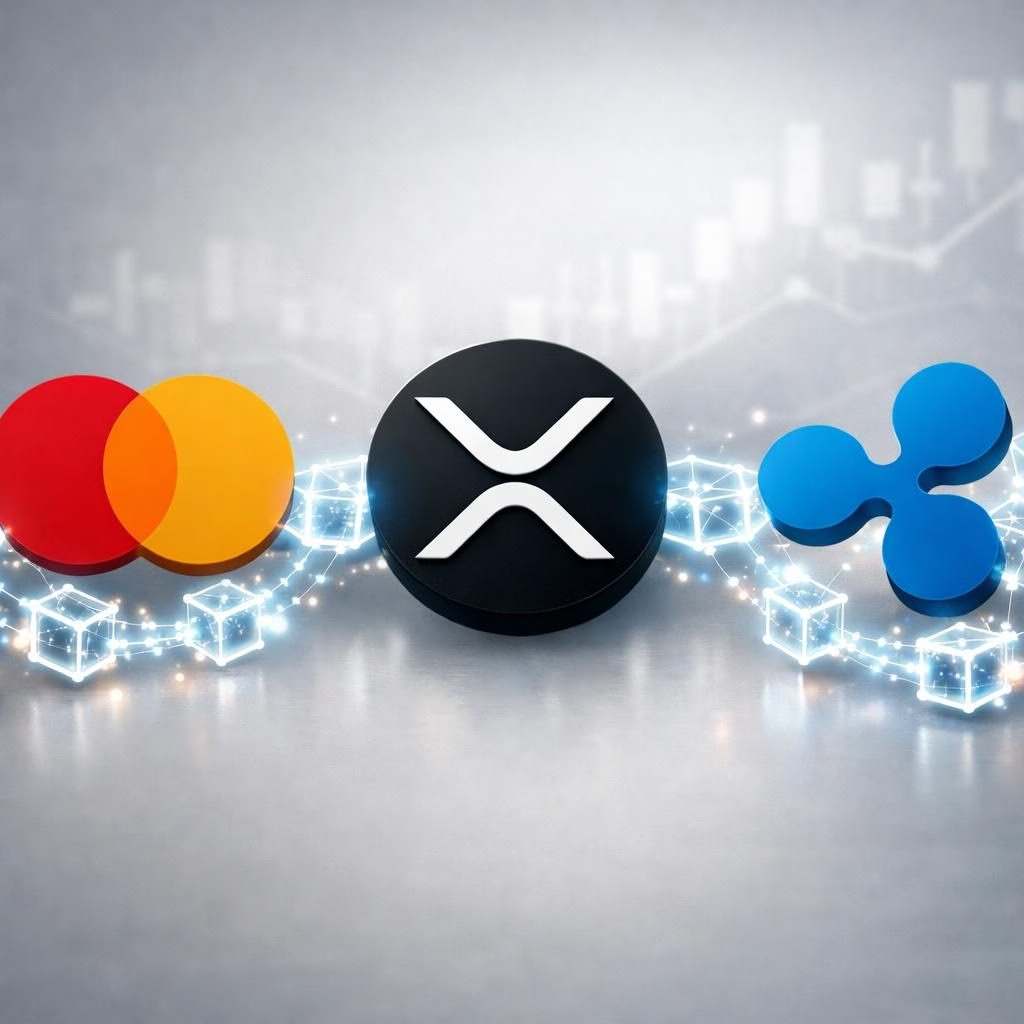
XRP fans are smiling again as Mastercard quietly tests Ripple’s cross-border payments lattice. The buzz isn’t wishful thinking; Blockchain-enabled money movement is transitioning from theory to practice. In plain terms, this could mean cheaper, faster, and more auditable transfers across borders.
XRP Blockchain: What Mastercard Ripple Collab Could Mean
Mastercard’s Crypto Partner Program now lists more than 85 partners, from Binance to PayPal, with Ripple in the mix. The practical aim: plug XRP into Mastercard’s global payments infrastructure—spanning 200+ countries—and reduce friction in trade corridors. Expect smoother cross-border transfers, faster B2B settlements, and more reliable instant payouts. This is not crypto theater; it’s a real-world rollout that tests how Blockchain-enabled rails can coexist with trusted brands. In this setup, XRP emerges as a real-world asset, not a speculative meme, capable of anchoring liquidity and improving settlement times across corridors that once relied on clunky legacy systems. The emphasis remains pragmatic: compatibility, risk controls, and clear governance help XRP move from hype to habit.
Blockchain and XRP: RLUSD, Cross-Border Growth, and Practical Implications
The stablecoin story is quietly becoming the backbone of global payments. In 2025, analysts estimate about $33 trillion in stablecoin transactions, illustrating genuine use rather than hype. Transaction volume rose 72% year over year, while global user adoption jumped 146% across 106 countries.
Nigeria’s remittance economy shows digital dollars blending with everyday money, while Turkey’s volatility fuels demand for dollar-pegged tokens in daily trade. The UAE’s institutional settlements are accelerating via on-chain rails that connect local operations to global networks. Ripple’s RLUSD sits inside this expanding liquidity layer, giving the XRP ecosystem a direct on-ramp to global settlement. As stablecoins become a universal settlement layer, networks that offer robust on-chain infrastructure could become the default rails for business and consumer payments. The result is a more connected world where XRP-based settlement can reach corners of the globe that once felt out of reach. In this narrative, Blockchain is not merely a buzzword; it’s a reliable, auditable plumbing that keeps wallets and ledgers in sync.
Beyond hype, the data points to a shift: cross-border B2B payments grew 733% to about $226 billion in transaction flows as stablecoins mature from trading tools into essential payment rails. This isn’t insurance against risk; it’s a blueprint for resilience. Ripple’s RLUSD adds another layer of computation and reliability, turning on-chain settlements into practical daily operations for treasury teams. For developers, this is a prompt to design interoperable APIs, clearer settlement timelines, and better analytics for liquidity management. For investors, it signals a longer horizon where XRP could serve as a stable anchor in volatile times, not merely as a speculative ticker. And for end users, the promise is simpler fees, faster transfers, and improved traceability—the kind of improvements that make you smile even when the network is congested with regional holidays.
What does this mean for the average reader? It means you might soon see XRP-powered payments show up in more places, from international invoices to cross-border customer payouts. It also underscores the importance of robust compliance tooling, transparent governance, and real-world testing that moves beyond white papers. In short: the XRP narrative is turning into a practical blueprint for how Blockchain-powered payments can scale, while RLUSD and related stablecoins serve as the default liquidity layer that keeps things moving smoothly.
If you enjoy this kind of analysis, share your thoughts in the comments below. I’m curious how you see XRP shaping cross-border finance in the coming years, and what questions linger as RLUSD expands.
Original article: A heartfelt thank you to the authors of the source piece for their thorough reporting on Mastercard, Ripple, XRP, and the evolving payments landscape. Your work provided a solid foundation for this exploration. Read the original article here: https://www.tradingview.com/news/newsbtc:b878359d0094b:0-xrp-back-in-the-spotlight-as-mastercard-explores-ripple-technology/
Practical steps for adopting XRP-based cross-border payments
- Assess your cross-border needs and map them to XRP-enabled rails.
- Establish clear compliance, KYC, and governance controls before pilots.
- Develop interoperable APIs to manage liquidity, settlement timelines, and traceability.
- Partner with banks and fintechs to run small-scale experiments before full-scale rollouts.
FAQ
- What is RLUSD?
- RLUSD refers to Ripple’s approach to using a USD-backed digital asset within its on-chain settlement ecosystem, aiming to improve liquidity and settlement speed.
- Is XRP guaranteed to be a settlement standard?
- No. Its role depends on regulatory clarity, liquidity, and broad adoption by institutions and businesses.
- Will this replace existing payment rails?
- Likely to be complementary at first. Institutions may use XRP- or RLUSD-enabled rails to reduce friction while maintaining legacy systems where needed.
References
- Original source: TradingView article on XRP, Mastercard and Ripple
- Swift: Cross-border payments overview
- IMF: Stablecoins and the future of global payments
- Federal Reserve: Digital currencies and payment systems