

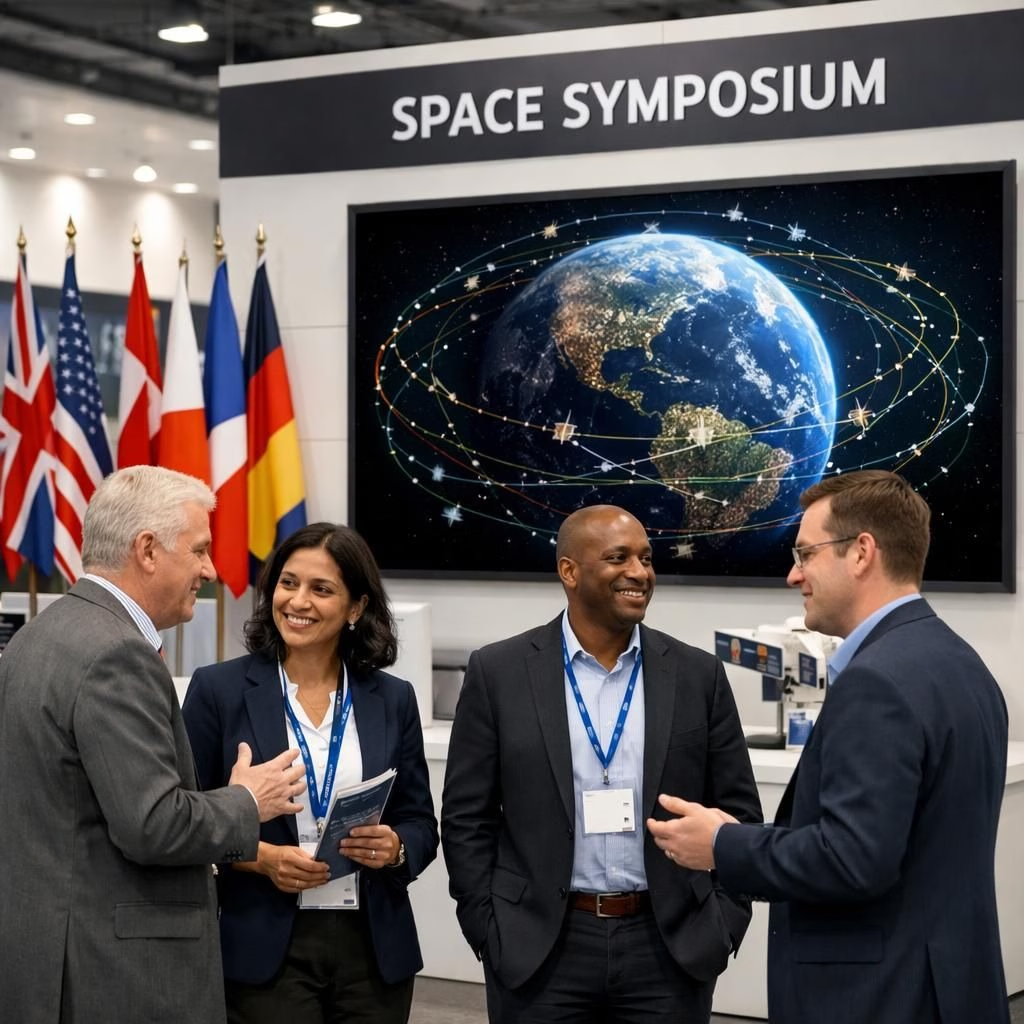
Space Security and International Collaboration illuminate the agenda at this year’s Space Symposium, where global teams join the U.S. Space Force to push orbital safety and smarter software. The tone is upbeat with a pragmatic edge: optimism lives alongside laser focus on real-world challenges. In 2026, the vibe is less about rival flags and more about shared goals, shared data, and a shared belief that better tools make space safer for everyone.
Space Security in Practice: Real-Time Orbit Safety
Out of 343 total exhibitors, 51 are international, underscoring the growing collaboration shaping space operations.
The international presence is visible everywhere — flags, uniforms, and even simulators that recreate the feeling of a near-Earth environment.
One standout participant is Space Map, a South Korean company working directly with the U.S. Space Force.
Their mission goes beyond collaboration: they build software platforms to solve decision‑making problems, including mapping satellite routes and preventing collisions in crowded orbits.
When necessary, they can outline maneuver options to avoid an incident.
The TAP Lab accelerates these efforts by bringing together software developers, engineers, and policymakers to prototype and deploy solutions quickly.
The lab has grown to about 400 individual players, many of them foreign partners, and that mix is the point: more minds, more angles, more robust tools.
This is a clear example of International Collaboration in action.
The conversation in the hallways keeps a practical tone.
Space Security in practice means better data standards, shared interfaces, and clearer threat assessments.
Space becomes more contested and complex, so sharing knowledge, strengthening alliances, and staying ahead matters—while staying mindful not to turn this into a fireworks show.
You can’t always predict what will happen when people collaborate, but the early results have been positive.
The partnership has personal resonance for leaders like Kim, who notes a duty to contribute to the global community, not just the United States.
The takeaway is straightforward: a more connected ecosystem raises the bar for everyone, and no single actor holds all the keys to safe, reliable space operations.
This is the heart of Space Security that keeps programs practical and focused.
International Collaboration in Action: Shared Knowledge, Shared Risk
International Collaboration shows up at every booth and briefing.
The goal is to shift from competitive secrecy to transparent, shared risk management.
When partners share satellite-tracking data, software interfaces, and even best practices for collision avoidance, the trajectory of space operations improves for all.
The Space Map example illustrates how real-time data fusion can reduce uncertainty and speed decision-making.
The TAP Lab model helps cross-border teams test ideas in a controlled environment, with feedback loops that turn rough prototypes into deployable tools.
And it’s not all dry tech talk: the exhibits celebrate the creativity behind mission planning, the art of balancing national security concerns with collaborative exploration, and the humanity behind the people who build these systems.
The net effect is a stronger, more resilient space ecosystem that benefits scientists, industry, and the public alike. This is a powerful illustration of International Collaboration at work.
For industry watchers, the alliance signals a shift toward open innovation with guardrails.
Space agencies and private partners recognize that International Collaboration does not erase risk; it distributes it and spreads responsibility.
The result can be more adaptable networks, better supply chains for space hardware, and faster responses to near-term threats.
It also signals that national security and civilian science are not separate tracks, but intersecting lanes that keep pace in a fast-moving domain.
As a result, companies gain access to a broader talent pool, more diverse perspectives, and a shared vision: safer space, smarter systems, and smarter decisions that come from diverse inputs.
Space Security remains the anchor here, guiding practical outcomes.
From a viewer’s perspective, this is more than a trade show.
It’s a living demonstration that International Collaboration is a practical strategy, not a glossy theory.
The exhibits show concrete outcomes: software toolkits, simulation environments, and collaborative programs that connect public and private sectors across borders.
The Space Security focus centers on collision avoidance, orbital debris management, and reliable data pipelines.
The International Collaboration focus is about people: the engineers from Seoul, the researchers from Europe, the policy experts from North America, all learning to speak a shared technical language and to trust one another with sensitive information in a controlled, responsible way.
As attendees reflect on the day, the takeaway is clear: global teamwork is a force multiplier in space.
The more we share, the more robust our systems become.
When international partners contribute to tools that map trajectories or predict anomalies, the result is less guesswork and more confidence.
And yes, the talk about space is serious, but the vibe remains approachable.
People ask questions, swap anecdotes, and sketch dashboards on napkins in the lobby, then return to the booth with better insights and clearer roadmaps.
In closing, Space Security and International Collaboration are not jargon; they are ongoing practices that make space safer and more productive. The latest demonstrations show that the best defense comes from a network of capable, cooperative actors who value data, transparency, and practical results. The future belongs to teams that blend technical skill with cross-border trust, and Space Symposium 2026 is a bright example of that blend.
Original article: KOAA News5. Thank you to KOAA for the original coverage and material that informed this rewrite.
Have thoughts to share? Please leave your comments below and join the conversation about how Space Security and International Collaboration shape our near-term future.
Practical Takeaways for Space Security and International Collaboration
- Adopt shared data standards and interoperable interfaces to reduce friction across agencies and industry.
- Invest in joint training and simulated exercises that mirror real-world orbit risks.
- Define clear risk distribution and incident-response plans to accelerate coordinated action.
- Support programs like the TAP Lab to turn prototypes into deployable tools quickly.
Frequently Asked Questions
- What is Space Security? It refers to measures that protect assets and operations in space, including collision avoidance and debris management.
- What does International Collaboration mean in space? It means cross-border cooperation on data, software, and missions to improve safety and efficiency.
- Why is collaboration important? Shared knowledge reduces risk and speeds problem-solving in a complex, contested domain.
- How does the TAP Lab fit in? It’s an innovation hub that fosters rapid prototyping of software solutions with diverse partners.
References
External Sources
- NASA – space safety and traffic management resources.
- U.S. Space Force – official updates on space operations and partnerships.
- Space Foundation – coverage and context for the Space Symposium.