

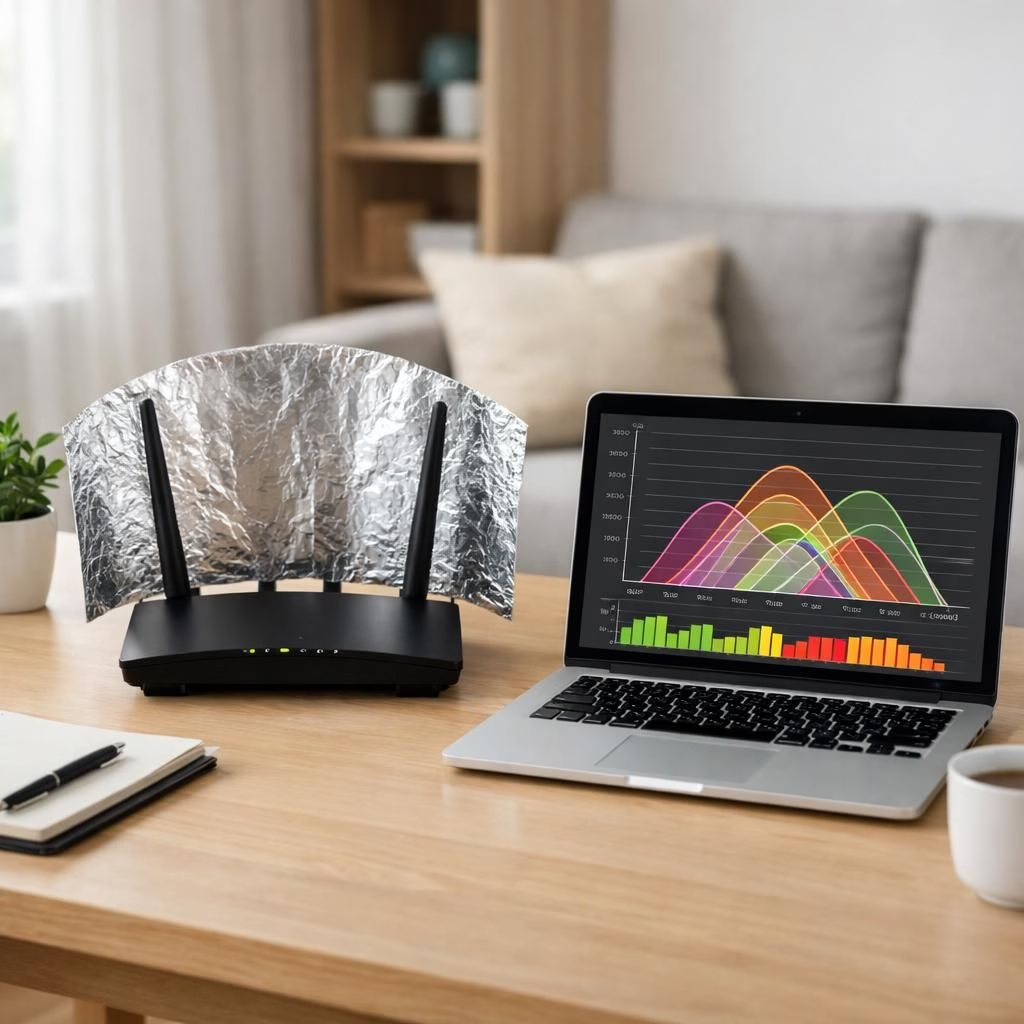
In 2026, a fascinating idea about a Wi-Fi Foil Reflector grabbed attention from homeowners and tech nerds alike. The core truth is simple and surprisingly hopeful: a curved piece of metal can redirect radio waves, giving you a directional lift without creating extra power. This isn’t a miracle; it’s the same physics that makes a flashlight reflector focus light. The Dartmouth work, though, proved that with the right shape and setup, you can nudge Wi‑Fi signals toward a chosen corner of your living space. It’s a small, receipts-friendly tweak that can feel grand when you’re hunting for a weak signal in a single room.
The lab version of the story is what fans of this trick should remember. In 2017, Dartmouth researchers measured real gains using a carefully designed, 3D‑printed plastic form covered in aluminum foil. The form was nothing like a crumpled sheet of kitchen foil; it was a precise curve, engineered to refract signals in a specific direction. The team reported a boost of up to about 50 percent in the targeted direction. They also observed a reduction of about 6 dB in directions the reflector was meant to weaken. That drop—roughly 75 percent less signal in those zones—helps keep the rest of the home from being overwhelmed by a single hot spot. The key takeaway: this is a directional hack, not a fix for every problem in your house.
Two important players shaped the narrative. Xia Zhou, an assistant professor at Dartmouth, led the project. Her team used a common consumer router, the Netgear R700, a dual‑band device that transmits on 2.4 GHz and 5 GHz. They placed reflectors near the antennas and measured the impact across rooms. The results, while compelling in the lab, come with big caveats for real homes. The Dartmouth method hinges on a carefully tuned curve, a room layout, and a willingness to adopt a more science‑fair approach to home networking. Home tests with a hand‑bent sheet of foil typically report more modest gains, usually in the 10 to 20 percent range, and with less consistency than the lab setup.
Wi-Fi Dead Zones and the Foil Reflector Concept
What does that mean for everyday Wi‑Fi? It’s not a universal power boost; you’re choosing a direction. In practice, a simple Foil Reflector behind the router can tilt signal toward the room you care about. The signal in front of the reflector strengthens while the signal behind it weakens, which makes this a directional hack rather than a broad improvement. If you’re seeking wide‑band coverage, a mesh system or a router with beamforming remains the smarter bet.
Experts outside the Dartmouth team largely agree on the core physics. They also remind us to respect regulatory boundaries. In the United States, the Federal Communications Commission limits how much power a router can emit in any direction. A passive reflector doesn’t create extra watts; it concentrates what’s already there. This means tinkering is mostly at your own risk, and you should avoid pushing the setup into a regulatory gray area. The concern isn’t a dramatic enforcement action, but potential interference with other licensed services. Proceed with curiosity, not bravado.
Foil Reflector: Design, Use, and Realistic Expectations
A practical recipe is simple but requires care. Unplug the router first. Snap a piece of aluminum foil roughly 8 by 12 inches. Curve it gently. Place it behind the antennas without wrapping the device. Plug the router back in and point the curved foil toward the room you want to improve. If you overdo it and wrap the whole unit, you’ll trap heat, shorten the router’s life, and achieve the opposite of your goal. Think of the foil as a partial reflector, not a full blanket.
One common misstep is trying to fix structural problems with foil. Thick concrete walls, metal ducts, and massive appliances can block Wi‑Fi regardless of what you bend behind the router. Start by moving the router to a more central location. If you still have a dead zone, a targeted reflector may help. For many people, the best path to better Wi‑Fi remains repositioning, upgrading to a modern router with beamforming, or adding a mesh network. The lab found impressive directional gains; the home user often finds more modest, location‑dependent improvements. The lesson is clear: use the foil reflector as a smart add‑on, not a substitute for good placement or a robust network.
From a design perspective, the Dartmouth team introduced a concept with real value. The WiPrint software they discussed was designed to calculate the best curve for the reflector based on a room’s layout. The idea was to democratize access to a well‑tuned reflector, making it easier for ordinary people to shape their own coverage. Unfortunately, the code release never fully materialized for broad public use. That gap underscores a familiar pattern: lab findings often outpace DIY adoption, not because the science is wrong, but because packaging and distribution take time—and users crave plug‑and‑play solutions. For now, the practical takeaway is to treat the lab as a guide, not a guarantee.
What has persisted since the 2017 study is a sense that home Wi‑Fi is more fickle than many users admit. A well‑placed router remains a powerful tool. A single reflector can help when a single room is stubborn, but it cannot compensate for a whole‑home design flaw. The most reliable improvements still come from a stronger hardware foundation, better placement, and, when needed, a modern mesh or router with beamforming features. The juxtaposition of a lab success and a home‑grown quick fix offers a wholesome reminder: science can inform DIY, but it rarely eliminates the need for good planning and sensible expectations.
In 2026, we can appreciate the idea with a smile. The concept of a low‑cost reflector is elegant. It demonstrates that technology is not just about power; it’s about direction. It’s a reminder that sometimes the simplest shapes—foil and curves—can teach us about a very modern problem: how to move signals where we want them without turning our homes into RF landscapes of interference.
Original reporting and inspiration: thanks to TechCrunch for coverage of Dartmouth’s WiPrint project and to Dartmouth researchers for the lab work. You can read the TechCrunch coverage here: TechCrunch. This tribute acknowledges the original material and the open curiosity that drives DIY tech exploration.
Have you tried any DIY Wi‑Fi tweaks at home? Share your thoughts in the comments and tell us what happened. Your experiences help others decide whether to chase the next clever hack or to invest in a more robust network solution.
Thank you for reading and special thanks to the original reporting by TechCrunch and Dartmouth for the foundational work in this area.
Practical tips and quick references
- Keep the reflector as a partial, not full, shield to avoid overheating the router.
- Test in small steps: compare signal in the problem room with and without the reflector installed.
- Be mindful of interference with neighbors’ networks and any local regulations.
FAQ
-
Does a Foil Reflector truly boost my total Wi‑Fi power?
No. It concentrates existing energy into a narrower forward beam, improving signal in one direction while reducing it elsewhere. You still have the same total output from the router.
-
Should I try this at home?
Only if you’re curious and comfortable with a low‑risk experiment. Avoid wrapping the router, and stay within regulatory guidelines to prevent neighboring interference.
-
What works better for whole‑home improvement?
Repositioning the router, upgrading to a modern router with beamforming, or adding a mesh system typically yields broader, more reliable gains.
-
Is there a safe DIY path beyond the foil trick?
Yes. Consider centralized placement, higher‑quality antennas, or a mesh network that provides uniform coverage without local hotspots.
-
Where can I read more?
External sources like the FCC’s guidance on transmitter power and general tech coverage from TechCrunch offer helpful context about limits and lab results. See also Popular Science for reader‑friendly physics explanations.
References
- Original source linkback
- TechCrunch coverage
- FCC guidance on transmitter power
- Popular Science: physics of reflectors