

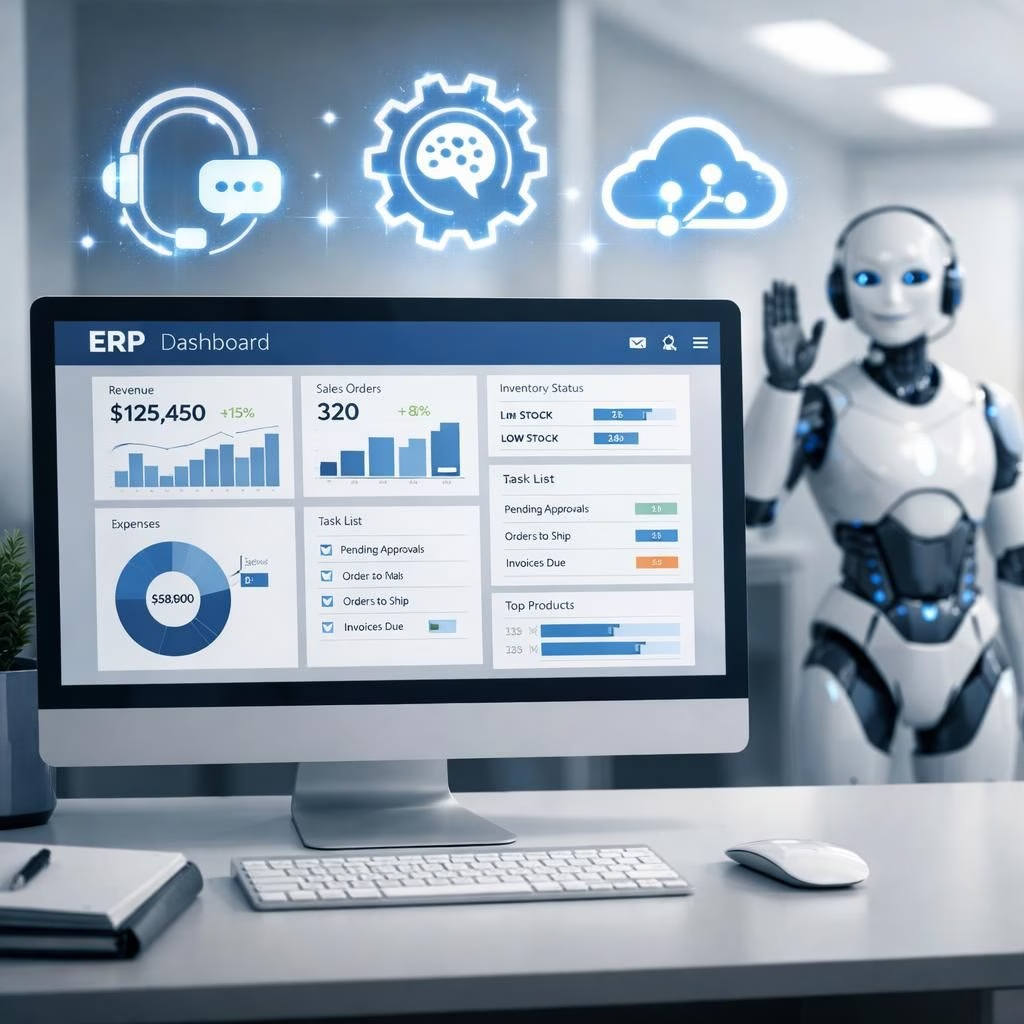
In Nashville this week, Epicor unveiled an ambitious agentic AI stack built on its Prism platform and paired with a bold 90-day cloud deployment program to accelerate ERP cloud migrations for manufacturers, distributors, and retailers. The aim is generous and practical: embed AI in ERP agents into ERP workflows — finance, supply chain, and customer service — to automate tasks, coordinate actions, and turn the daily grind into a smoother, smarter routine. This is not a sci-fi fantasy; it is tangible AI in ERP that helps business teams stay ahead. And while Epicor leans into ERP AI, Google I/O 2026 signals a broader AI era that touches Search, personal assistants, and more. AI in ERP is no longer a niche feature; it is a core capability with real world impact.
AI in ERP: Epicor shows the agentic stack in action
Epicor is serious about making AI practical for everyday users. The agentic AI stack sits atop Prism and is designed to live inside ERP workflows. In finance, the system can flag anomalies, approve routine invoices, and route exceptions to human teams with minimal friction. AI in ERP helps reduce errors and speeds routine decisions. In the supply chain, it suggests optimal reorder points, tracks shipments, and nudges suppliers when scorecards dip. In customer service, AI agents answer repetitive questions, create tickets, and escalate only when human insight is truly needed. The 90-day cloud deployment pledge acts as a fast track coach, offering hands-on guidance, best practices, and a structured path from on-premises to cloud comfort. SMBs especially benefit from this blend of capability and coaching—education, coaching, handholding, and yes, perhaps a bourbon toast after a successful go-live to celebrate the learning curve. AI in ERP becomes not just a tool, but a guided journey toward higher productivity and smarter decisions.
As with any large tech shift, Epicor understands that SMBs face a learning cliff. The promise is a gradual climb: start with the low-hanging fruit, measure what moves the needle, and expand step by step. The vendor argues that deployments should feel like a smart upgrade rather than a marathon sprint. The result is a manageable path to leverage AI in ERP and a foundation for broader digital transformation. Expect SMBs to begin with forecasting improvements, workflow automation, and tighter controls, then layer in more AI-driven capabilities as comfort grows.
Google I/O 2026: Gemini Spark and a smarter Search
If you thought the AI train had stopped at your ERP system, Google I/O 2026 proves the journey continues with a full onboard upgrade of Search and a fresh personal AI assistant called Gemini Spark. Gemini Spark is pitched as a personal 24/7 agent that can manage your digital life for about $100. It will monitor Gmail, tackle complex multi-app workflows, and handle routine tasks while you focus on strategic work. The broader shift is Google turning Search from a pure information tool into a proactive, conversational, multi-modal experience that blends text, images, video, and live data. The AI behind Search will offer layered, context-aware responses and proactive recommendations, acting as a dynamic companion when you hunt for information online. This is the biggest overhaul of Google Search in nearly three decades, and it redefines how AI interacts with everyday inquiries and business workflows. Google I/O 2026 is not just a product update; it is a wholesale rethinking of how users stay informed and act on data.
The magnitude of Google I/O 2026 is a reminder that keeping up with AI is a team sport. Large platforms release capabilities in waves, and the response often requires focusing on a few high-leverage moves rather than chasing every shiny feature. If you manage an SMB, your best bet is to identify the practical AI in ERP and the proactive assistant options that align with your current priorities. Start with email triage, forecasting, and basic automation, then consider deeper integrations with AI in ERP to connect the dots between planning and execution. The goal isn’t to chase all bells and whistles but to harvest the low hanging fruits that drive real outcomes for your business.
AI in ERP meets SMB realities: devices, robots, and forecasting
Meanwhile, tech headlines keep arriving with a mix of hardware and software refinements. Zac Bowden from Windows Central covered Microsoft’s Surface Laptop 8 and Surface Pro 12, emphasizing AI performance, security, and business-centric design. These devices bring sharper displays, longer battery life, and improved AI processing to the hands of business users who need reliability and speed for daily tasks. The products stay in the premium tier, with a focus on enterprise-grade features rather than mere consumer polish. It is a reminder that AI is not just software; it lives across devices, workflows, and the people who use them every day. AI in ERP conversations become more tangible when you can pair a robust laptop or tablet with your ERP cloud migration and AI agent deployments.
Elsewhere, Boston Dynamics showcased Atlas lifting up to 100 pounds with proprioception — a form of internal body awareness that helps the robot balance and adapt to changing loads. The idea is straightforward: future factories depend on machines that understand their own strengths and limits, so they can lend a hand with heavy tasks without constant human guidance. While most SMBs won’t buy Atlas tomorrow, the message matters: AI and robotics together will shoulder repetitive, dangerous, or precision-heavy tasks, letting humans focus on strategy, coaching, and complex decisions. The story is not about instant robot farms; it is about smarter processes and safer, more efficient operations over time.
On the forecasting front, many CFOs still run reforecasting as a repetitive, open-loop exercise — rebuilding forecasts from scratch every month or quarter. Here is a practical tip: install the Closed-Loop CFO Skill Stack in Claude.ai. The CFO Skill Stack includes a CFO Brain for analysis, a memory layer that tracks recurring patterns, and an Audit Trail to document decisions. With Claude Projects, you upload financial datasets and forecasting models, prompt for analyses, and update forecasts automatically. The result is faster, smarter forecasting that reduces guesswork and strengthens your financial reasoning. This approach illustrates a core truth: AI in ERP and AI in finance can collaborate for better outcomes, not just fancy toys. AI in ERP is about learning, not just automating tasks.
The point is clear: there is no shortage of exciting AI developments, and SMBs are uniquely positioned to benefit if they approach them with curiosity and discipline. The key is to pick a few tools that truly move the needle and scale thoughtfully, rather than trying to swallow the entire AI menu at once. If your team can gain a reliable forecast, automations that save time, and a better handle on supplier performance, you have already unlocked a measurable advantage. AI in ERP and related AI updates can become a steady, practical advantage that compounds over time.
Have a technology story that small business owners should know about? Share it with me on X at @genemarks. Let’s keep the conversation going and help more SMBs ride the AI wave with confidence. AI in ERP and Google I/O 2026 are not just headlines; they are directions for smarter, kinder, more productive business practices.
Original article: Modern Distribution Management articles summarize Epicor’s Insights conference and the broader AI landscape for SMBs. Thanks to the team behind the original material for the thoughtful coverage that inspired this rewrite.
Practical sounds and talking points for SMBs
- Start with a single, measurable objective where AI in ERP can move the needle, such as forecasting accuracy or order fulfillment speed.
- Leverage a guided 90-day migration plan to cloud and AI adoption, with defined milestones and coaching support.
- Build simple automations around forecasting and supplier performance, then scale to more complex workflows as comfort grows.
- Invest in user training and governance to ensure responsible AI use and fast adoption.
Getting started with AI in ERP: a practical checklist
- Choose one high-impact area (forecasting, cash flow, or customer service) to pilot the agentic AI stack.
- Set a 90-day timeline for cloud migration and measurable success metrics.
- Match AI capabilities with existing ERP processes to avoid over-engineering new workflows.
- Provide hands-on coaching and regular check-ins to collect feedback and adjust quickly.
FAQ
-
What is the agentic AI stack in ERP?
It refers to AI agents embedded inside ERP workflows to automate tasks, coordinate actions, and support decision-making within finance, supply chain, and service functions.
-
Why is the 90-day cloud deployment pledge important?
It provides a structured, time-bound path to cloud adoption that reduces risk, accelerates learning, and helps SMBs realize value quickly.
-
Will Google I/O 2026 change how I search for business information?
Yes. The update moves Search toward proactive, multi-modal, conversational experiences, which can streamline information gathering and decision support for SMBs. Google I/O 2026 is a key part of that shift.
Conclusion
Epicor’s agentic AI stack and Google’s I/O 2026 era together illustrate a practical, evolving path for SMBs. The focus is on useful, measurable improvements—forecasting accuracy, automation of repetitive tasks, and smarter decision-making—delivered with guided support to ease the learning curve. For SMBs, the takeaway is clear: start small with high-impact uses, adopt cloud-enabled AI thoughtfully, and scale as confidence grows. The result can be tangible gains in productivity, profitability, and resilience.