

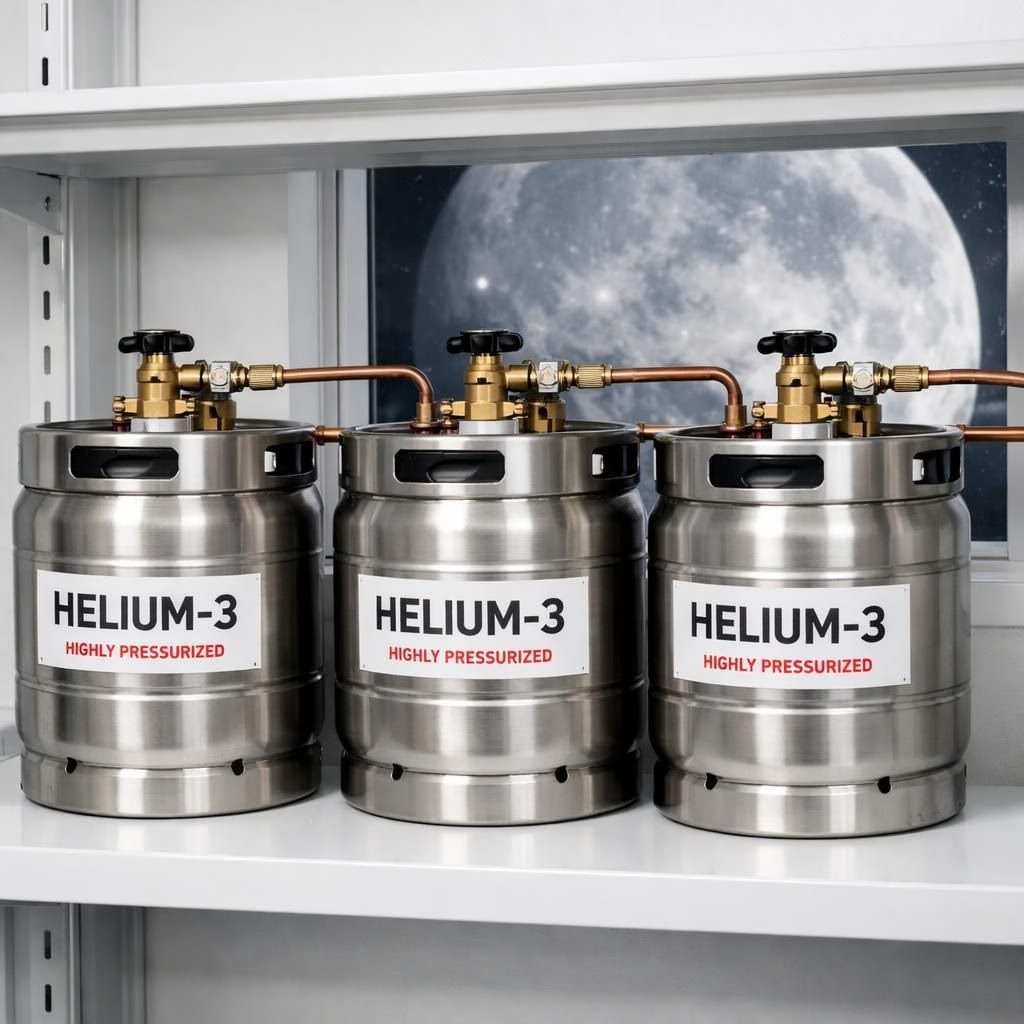
In a locked Lancaster lab, helium-3 sits in a neat row of metal kegs, not beer, but a rare treasure. This setup ties lunar-mining to helium-3 in a surprisingly tidy way.
helium-3 and lunar-mining: a practical overview
Helium-3 is an isotope that acts like a shy celebrity at ultra-cold parties. In physics labs, helium-3 helps researchers reach millikelvin temperatures when paired with helium-4. Dilution refrigeration uses helium-3 to chill qubits, which helps quantum computers run more reliably. The Moon becomes part of the conversation because regolith could hold helium-3 in useful amounts.
helium-3 and lunar-mining: a space-economy tease
The link from lab gas to lunar-mining isn’t far-fetched. If helium-3 proves workable for cooling or fusion, it could spark a broader quantum and space economy. On Earth, production from tritium decay is tightly controlled, and Apollo-era samples hint at lunar presence, though the picture remains uncertain. The big question is how to measure and extract it without turning the Moon into a quarry.
quantum-computing cooling in the lunar-mining context
Quantum computers need extreme cooling. Helium-3 enables ultralow temperatures for qubits, and dilution refrigeration relies on a controlled separation of helium-3 from helium-4. The gas can be reused, making it a long-term resource for experiments. If lunar-mining grows, a steady helium-3 supply could underpin a broader quantum economy.
Some teams test equipment on parabolic flights to simulate lunar gravity on the way to a Moon mission. Interlune in Seattle and Astrotech in the US are part of this story, pursuing lunar-mining concepts that would mine regolith and ship helium-3 back to Earth. The economics are tricky—the energy needed to process regolith is enormous, and the exact lunar concentrations remain uncertain.
Meanwhile, researchers are pursuing cooling methods that reduce dependence on helium-3. The University of Auckland and others explore robust routes for future devices, while Pulsar Helium looks at terrestrial deposits that could yield helium-3 in Minnesota. Peter Barry of Woods Hole notes Minnesota is more accessible than the Moon, though concentrations remain tiny.
Pulsar Helium, a company in Portugal, is looking at helium-3 deposits in Minnesota, suggesting that terrestrial extraction could be feasible in the not-so-distant future. Geochemist Peter Barry notes that drilling might recover helium-3, though concentrations are low; Minnesota is more accessible than the Moon.
Conclusion: Helium-3 remains a rare resource that ties frontier science to bold space ambitions. Whether lunar-mining becomes practical or not, the conversation is already reshaping how researchers think about cooling, energy, and the future of quantum computing.
Practical steps for researchers
- Define target temperature ranges and required helium-3 quantities for your experiments.
- Assess whether terrestrial helium-3 sources could meet demand or if lunar-mining is a longer-term option.
- Plan for long-term cryogenic infrastructure and maintenance costs, including handling and safety.
- Work with funding and policy teams to navigate export controls and procurement.
FAQ
- What is helium-3? An isotope of helium used in cryogenics for cooling quantum devices and in fusion research concepts.
- What is lunar-mining? The idea of extracting helium-3 from lunar regolith and transporting it to Earth, currently theoretical and costly.
- Are there alternatives to helium-3 cooling? Yes. Researchers are exploring other cooling methods and terrestrial helium-3 sources to reduce dependence on lunar material.
External sources
References
- BBC original article: https://www.bbc.com/news/articles/ce8jmg2e4kro