

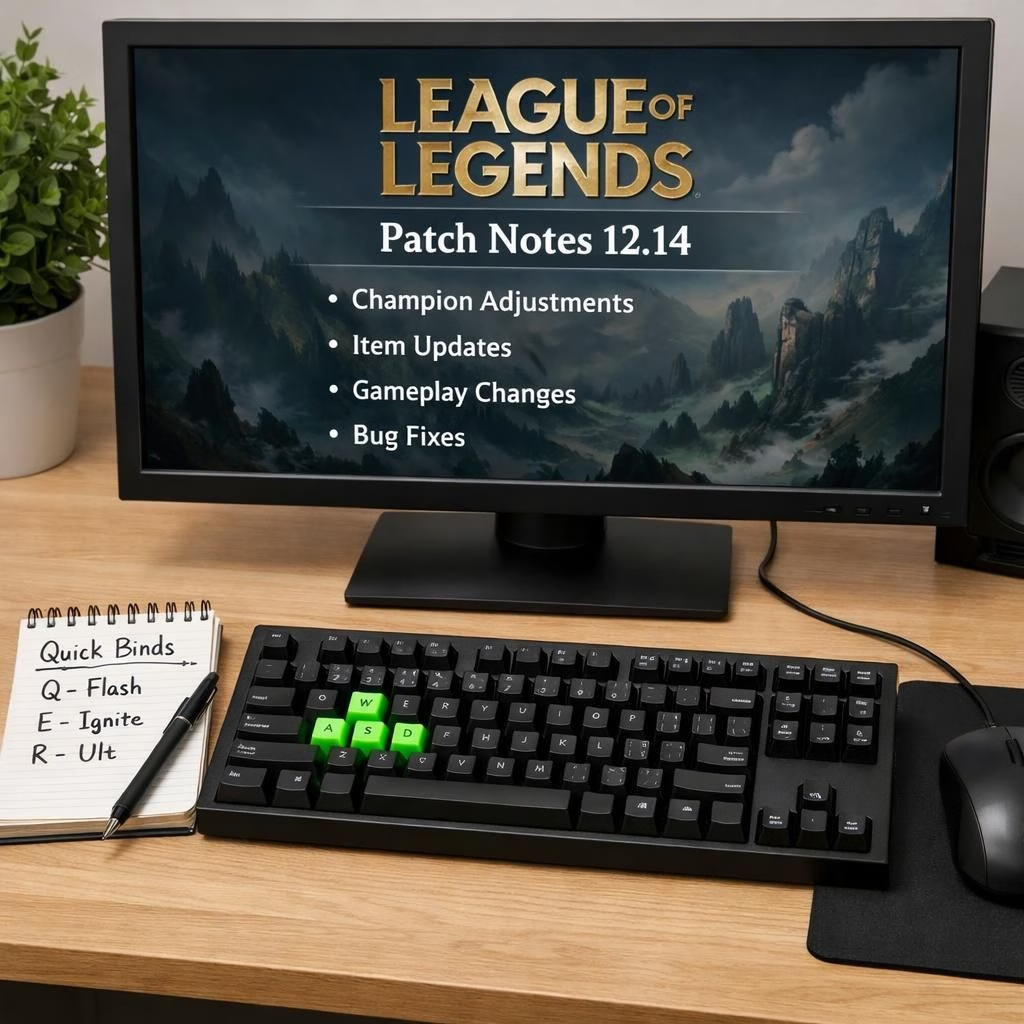
WASD and [Ranked](https://www.geekyopinions.com/tag/Ranked) are finally teammates in League of Legends patch 26.9, and the keyboard-wrangling crowd is buzzing with a mix of relief and mischief. This piece keeps things practical and positive, explaining how WASD controls land in the ladder, what to expect, and how to set up a clean mapping that minimizes finger gymnastics while maximizing clutch moments.
WASD in Ranked: A Player-Friendly Patch 26.9 Update
The big story this patch is simple: WASD input is no longer a gimmick for novelty accounts. Riot’s patch 26.9 brings tangible improvements to how movement and camera controls feel in the heat of games. In plain terms, WASD in [Ranked](https://www.geekyopinions.com/tag/Ranked) means more precise motion, smoother panning, and fewer accidental sprint toggles during a critical teamfight. The change is not a magic wand, but it is a signal: you can map your keyboard in ways that suit real-time decisions, not just theatre-lab experiments. What you gain is predictability. What you lose if you ignore it is unnecessary micro-stalls and a sprinkle of frustration from clutch moments slipping away because your keys argued with your intention.
The practical truth is this: WASD configurations are not a one-size-fits-all magic ritual. They are a toolbox. Some players prefer a traditional WASD layout with a guardrail on the movement keys, others lean toward a hybrid where movement touches a subset of your other bindings. Patch 26.9 doesn’t force a single approach; it invites players to experiment, to measure, and to adapt. The benefit is a player who can react faster to a sudden bit of danger in the river brush or a skirmish near the mid-lane wall. In short, WASD in Ranked 26.9 is about reducing the cognitive load at the moment of decision, not adding another layer of complexity.
From a technical angle, the patch clarifies compatibility for hotkey profiles and emphasizes consistency across games. If you’ve built a personal kinetic language around WASD and camera control, you’ll likely notice fewer confusing mid-fight hiccups. The goal is steady, repeatable input. If you can achieve that, your eye-hand coordination becomes the tool for the brain’s plan instead of your fingers fighting to catch up. For many players, that translates to more confident engages, cleaner disengages, and fewer moments where you wonder if you pressed that key or if the laptop just hiccuped.
That reliability is especially valuable for [Ranked](https://www.geekyopinions.com/tag/Ranked) players who need predictable input in chaotic teamfights. The change also sets expectations: a well-tuned WASD setup can reduce cognitive load and improve reaction time when a fight breaks out near the dragon pit or baron pit.
WASD for Ranked: Setup, Mappings, and Quick Wins in 2026
Let’s get practical. A solid WASD setup for ladder play starts with one rule: comfort first, speed second. If a binding setup causes fatigue after a few minutes, it’s not a win; it’s a loss you’re carrying into your next lane phase. Here are some actionable steps that consistently help players in ladder environments:
- Baseline mapping: Keep movement on WASD, but consider binding camera to keys that you naturally reach with your left hand (for example, Q/W/E for quick abilities or item checks). The aim is to minimize hand travel. You should feel the map in your muscles, not in your eyeballs scanning for keys.
- Centering and sensitivity: Calibrate your mouse and in-game sensitivity to avoid overshoot when you pan with the camera. A tiny change in sensitivity can save minutes across a dozen games, which in ladder translates into a small but meaningful win rate uptick.
- Ability shortcuts: Map a couple of abilities or summoner spells to near-gesture keys that stay close to your movement cluster. If you can press a spell without shifting your grip, you’ll react faster when the moment arrives.
- Consistency across modes: If you play flex, solo queue, and custom leagues, try to keep the same WASD-related patterns across modes. A consistent muscle memory helps you pace your actions under pressure.
- Test and measure: After a few practice sessions, compare your engage times and reaction windows before and after adopting a WASD-focused setup. Small gains add up in a grind-heavy mode like ladder.
To summarize the practical setup: keep WASD as your anchor, tune the camera with a lean on nearby keys, and reserve a couple of easily accessible options for critical abilities. This approach reduces the mental load during chaotic moments, letting you focus on map awareness and timing rather than fumbling with the keyboard. In practice, players who adopt this mindset report crisper engages and fewer misfires when the enemy squad converges on your lane. WASD becomes a steady compass rather than a noisy, unpredictable instrument in the heat of battle.
Beyond mechanics, WASD in Ranked invites players to rethink posture and desk ergonomics. A comfortable chair, a height-adjustable desk, and a clean mouse pad can influence in-game performance just as much as any binding tweak. The human element matters; if your body isn’t happy, your decisions won’t be sharp, no matter how clever your keyboard map looks on paper. A few mindful adjustments can translate into longer, more productive sessions with fewer cramps and fewer mental drops mid-fight—an underrated advantage in ladder where consecutive wins require both clarity and stamina.
Seasoned players often discover that WASD in Ranked is a gentle nudge toward better communication as well. When your hands move with confidence, you’re less likely to mislabel a target or misread a retreat path. That intangible confidence is contagious; teammates sense it and respond with more decisive calls. Patch 26.9 isn’t a revolution, but it is a thoughtful invitation to optimize your habits without sacrificing your fun. When you treat WASD as a trained tool rather than a random button, the whole game lightens up a notch.
As you experiment, keep notes on what works best for you and your champion pool. Some players thrive with a minimal binding approach; others crave extra macro shortcuts to accelerate decisions. The key is to test deliberately, measure outcomes, and adjust. The core truth remains simple: WASD in Ranked is about reliable input during critical moments, so you can play your best game when the stakes are highest.
Finally, if you want a quick win to start your learning curve, practice one controlled objective at a time. Move with WASD, keep your camera steady, and thread your binds to cover a single combination of actions—this builds a repeatable rhythm that translates into real-world results across multiple games.
For quick wins during practice, [Ranked](https://www.geekyopinions.com/tag/Ranked) players often benefit from focusing on a single combination at a time: move with WASD, control camera, then press the combo button. This creates a repeatable rhythm and helps you lock in muscle memory across sessions.
Original coverage and thanks to the sources that helped shape these ideas: Original article: WASD’s Ranked Release — a grateful nod to the authors for the inspiration and context.
I’d love to hear your thoughts and setups. What binding changes worked for you in patch 26.9, and how did WASD influence your ladder games this season? Share your experiences in the discussion below, and let’s help each other climb the ladder with smarter, simpler inputs.
Wasd Consistency Across Modes
Under consistent mappings, you’ll notice fewer mid-fight hesitations and more reliable escapes or engages. This WASD approach works best when you keep the same camera and movement language across Flex, Solo queue, and custom sessions.
Ranked Readiness: Posture and Ergonomics
Keep a comfortable setup: chair height, desk depth, and wrist support all influence response time and stamina over long sessions. A simple ergonomic tweak can help maintain sharp decision-making when the action spikes.
References
- Original source: League of Legends — WASD’s Ranked Release
- Patch 26.9 Notes — Riot Games
- Hotspawn: Patch 26.9 overview