

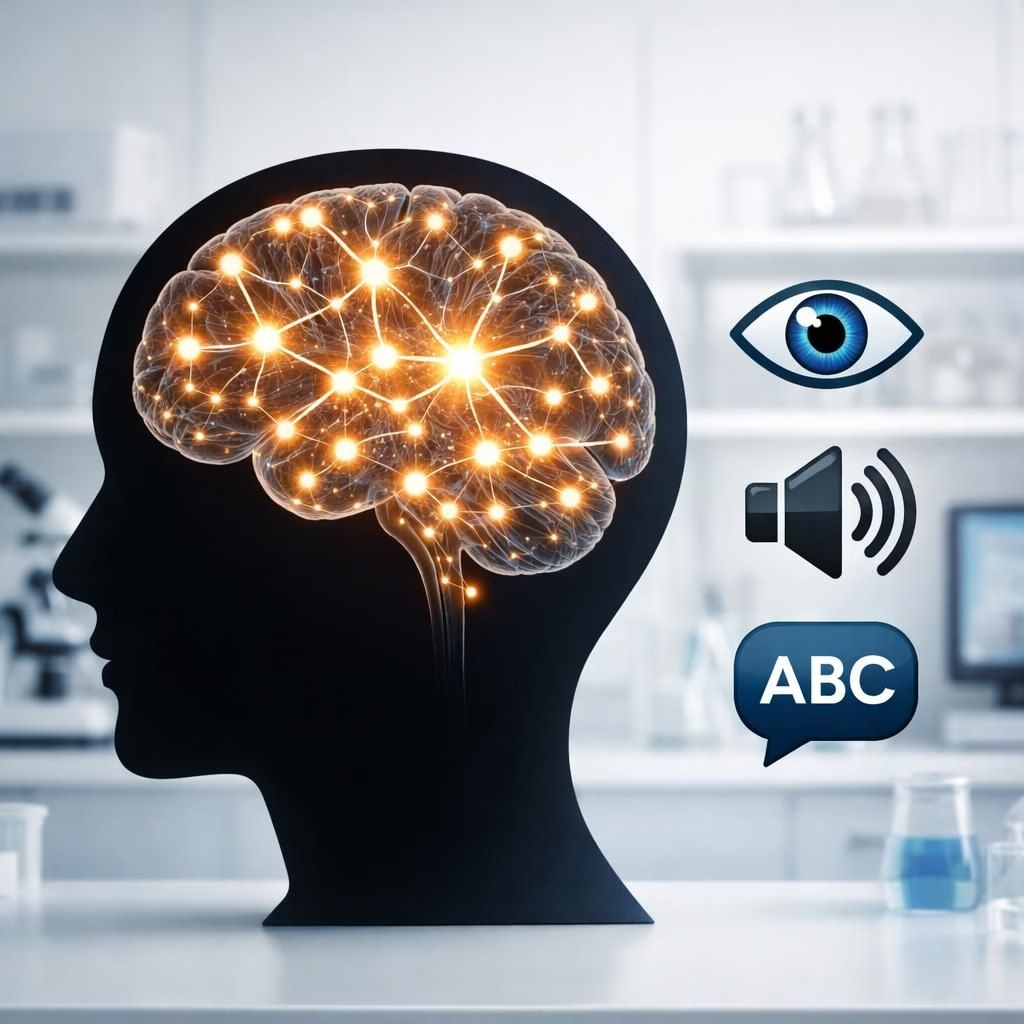
In 2026, TRIBEv2 and NeuroAI stand at the frontier of brain research, promising to mirror human brain activity in response to sight, sound, and language. This trio of capabilities — vision, audition, and language processing — isn’t just science fiction; it’s a pragmatic path toward faster, cheaper, and more reproducible experiments. TRIBEv2, short for the Trimodal Brain Encoder, is designed to be a digital mirror of real neural activity, translating sensory input into a computable footprint and then predicting which brain regions would light up under those stimuli. The aim is to accelerate honest, data-driven neuroscience, AI research, and healthcare by providing researchers with a reliable map to guide inquiry.
TRIBEv2 in Focus: A Practical Overview
TRIBEv2 follows a three-stage pipeline. First, sounds, visuals, and text are converted into numbers that a computer can crunch. This normalization lets the model compare different input types on an even playing field. Second, the system fuses this information, hunting for general patterns in how humans process multisensory information. Finally, the model predicts which areas of the brain are likely to activate when someone sees, hears, or reads something, linking those patterns to expected brain activity. It’s a robust, data-driven approach that leverages larger, more diverse datasets to improve prediction fidelity over earlier versions.
One of the big selling points is how TRIBEv2 handles noise. Real fMRI data is full of little interruptions: motion, scanner quirks, and unrelated signals. Instead of chasing raw signals, the model estimates a typical brain response for a given stimulus, which often lines up more closely with the average pattern than any single noisy scan. That may sound like a shortcut, but it’s a principled way to cope with imperfect data and a reminder that science advances by embracing imperfection rather than pretending it doesn’t exist.
Meta has released the TRIBEv2 paper, code, and model weights as open source, signaling a deliberate move to accelerate progress across three key domains: neuroscience, artificial intelligence, and healthcare. The openness invites researchers to test, remix, and validate, turning one model into a springboard for a spectrum of experiments. With TRIBEv2 and NeuroAI in the mix, laboratories can run virtual experiments at scale, compare outcomes across populations, and push toward studies that would have taken years in the past—while lowering costs and reducing the need for invasive data collection.
NeuroAI: Practical Pathways for Research and Care
NeuroAI, the broader idea Meta hints at with TRIBEv2, focuses on turning brain-relevant data into actionable knowledge. The emphasis is on a foundation that works across sight, sound, and language, so researchers aren’t forced to tailor a dozen bespoke models for each new experiment. By aligning a unified encoder with a scalable three-stage pipeline, NeuroAI aims to standardize how we map cognition to neural activity. This standardization isn’t boring; it’s the scaffolding that enables reproducibility across labs, devices, and populations. The practical payoff for clinicians and healthcare researchers is a faster route from a stimulus to a predicted brain response, which can inform diagnostics, treatment planning, and even the design of assistive technologies for people with neurological conditions.
Open source also means more eyes on the problem. With TRIBEv2‘s code and weights available, teams worldwide can verify results, test robustness, and push the model toward new domains like language therapy, sensory restoration, or cognitive training tools. The software life cycle becomes a community project rather than a single company’s lifting effort, a rare and welcome expansion in AI-enabled neuroscience.
Beyond the lab, NeuroAI has the potential to affect healthcare workflows by improving how we interpret brain signals during routine scans and by informing more personalized care plans. If researchers can predict typical responses more reliably, clinicians gain a faster, more consistent baseline for comparison, helping them spot meaningful deviations and tailor interventions accordingly. It’s not about replacing human judgment; it’s about complementing it with a robust, data-driven second pair of eyes that can be trusted under pressure.
As with any powerful tool, there are caveats. TRIBEv2 provides predictions, not perfect mirrors. Real brains are idiosyncratic, shaped by genetics, experience, and moment-to-moment context. The open-source release invites careful validation, diverse datasets, and ongoing refinement. The aim is not to claim a final victory but to create a durable platform that grows stronger as more researchers contribute, test, and critique. When you hear about breakthroughs like TRIBEv2 and NeuroAI, remember that progress in science often arrives through incremental improvements, repeated experiments, and a willingness to share both data and questions openly.
What’s exciting is not merely the prediction accuracy, but the potential for higher-level synthesis: combining predictions with real-world data to accelerate hypothesis testing, enable rapid prototyping of neurotechnologies, and foster a more iterative research culture. With broader participation, more data, and more minds engaged, TRIBEv2 and NeuroAI could help us unlock new knowledge about perception, language, and the brain’s capacity to adapt. This momentum makes science feel like a collaborative expedition rather than a solitary climb.
From the lab’s practical optics to a hopeful vision for future care, TRIBEv2 demonstrates how careful, creative engineering can illuminate the brain’s hidden maps. The combination of three input modalities, a robust encoding strategy, and an open-source stance makes the project both scientifically compelling and accessible to researchers who want to test ideas without reinventing the wheel. In short, TRIBEv2 is a framework for thinking about brain activity as something we can measure, model, and apply across disciplines. The NeuroAI ethos underpins an era in which neuroscience and AI aren’t separate silos but co-authors of a shared story about intelligence, perception, and healing.
As 2026 unfolds, the practical impact of TRIBEv2 and NeuroAI will rely on thoughtful experimentation, rigorous validation, and careful attention to ethics. The promise of faster experiments comes with a duty to protect privacy, avoid overstating capabilities, and ensure that the technology serves diverse communities. This work reminds us that science advances when ambition meets responsibility and when researchers openly share data, questions, and results. The result could be a more reliable science pipeline, a broader ecosystem of collaborators, and progress on tough brain questions that invites more people into the conversation.
Finally, the open-source TRIBEv2 release invites researchers and enthusiasts to engage. Try new input combinations, test across populations, and publish findings—then share what worked and what didn’t. The spirit of TRIBEv2 and NeuroAI is curiosity, transparency, and collective improvement. Please share your thoughts in the comments to keep the conversation alive and help refine this evolving approach to brain science.
Original article: Original source article on TRIBEv2 v2 and NeuroAI — Thank you for the thoughtful material that inspired this rewrite and for making the research accessible to a wider audience.
TRIBEv2 and NeuroAI: Shaping labs together
- Three-modality processing (sight, sound, language) is being integrated into a single, scalable workflow.
- Open-source access invites validation, replication, and extension across diverse datasets.
- Researchers can explore new applications in language therapy, sensory restoration, and cognitive training.
Getting started: a quick-start workflow
- Access the open-source TRIBEv2 resources and baseline datasets provided by Meta.
- Validate predictions on your own multisensory data, comparing model output with known brain responses.
- Publish findings, share insights, and contribute improvements back to the community.
Practical caveats and responsible use
Despite the promise, it is essential to recognize that TRIBEv2 provides predictions, not exact mirrors. Real brains vary with genetics, experience, and context. Open source work requires careful validation, diverse datasets, and ongoing refinement. The goal is a durable, collaborative platform that grows stronger as researchers contribute and critique.
Frequently asked questions
- What is TRIBEv2?
- TRIBEv2 is a Trimodal Brain Encoder designed to predict brain activity in response to sight, sound, and language, turning lab-scale data into scalable, computable predictions.
- What is NeuroAI?
- NeuroAI is the broader vision of unifying brain-activity modeling across modalities to improve reproducibility and collaboration in neuroscience and healthcare.
- How reliable are the predictions?
- The model emphasizes patterns and averages to cope with noisy data; predictions are a guide for hypothesis testing, not a definitive map of every brain’s response.
- How can I access the code and data?
- The TRIBEv2 release is open source, inviting researchers to download, validate, and extend the model with their own data.
- What about ethics and privacy?
- Open science should be paired with robust privacy protections, broad dataset diversity, and transparent reporting of limitations and risks.
Conclusion: a collaborative path forward
TRIBEv2 and NeuroAI illustrate a practical vision where brain science and AI work together. By standardizing across sight, sound, and language, and by embracing open collaboration, researchers can test hypotheses faster, reduce waste, and move toward therapies and technologies that help people with neurological conditions. The journey is ongoing, ethics-aware, and powered by a community of scientists ready to share their data, methods, and learnings.
References
- Original article on TRIBEv2 and NeuroAI: https://www.indiatoday.in/technology/news/story/meta-ai-predicts-how-humans-respond-to-sight-and-sound-is-superintelligence-next-2887899-2026-03-27
- National Institutes of Health (overview of brain imaging and fMRI): https://www.nih.gov
- Nature (brain imaging and cognitive science topics): https://www.nature.com