

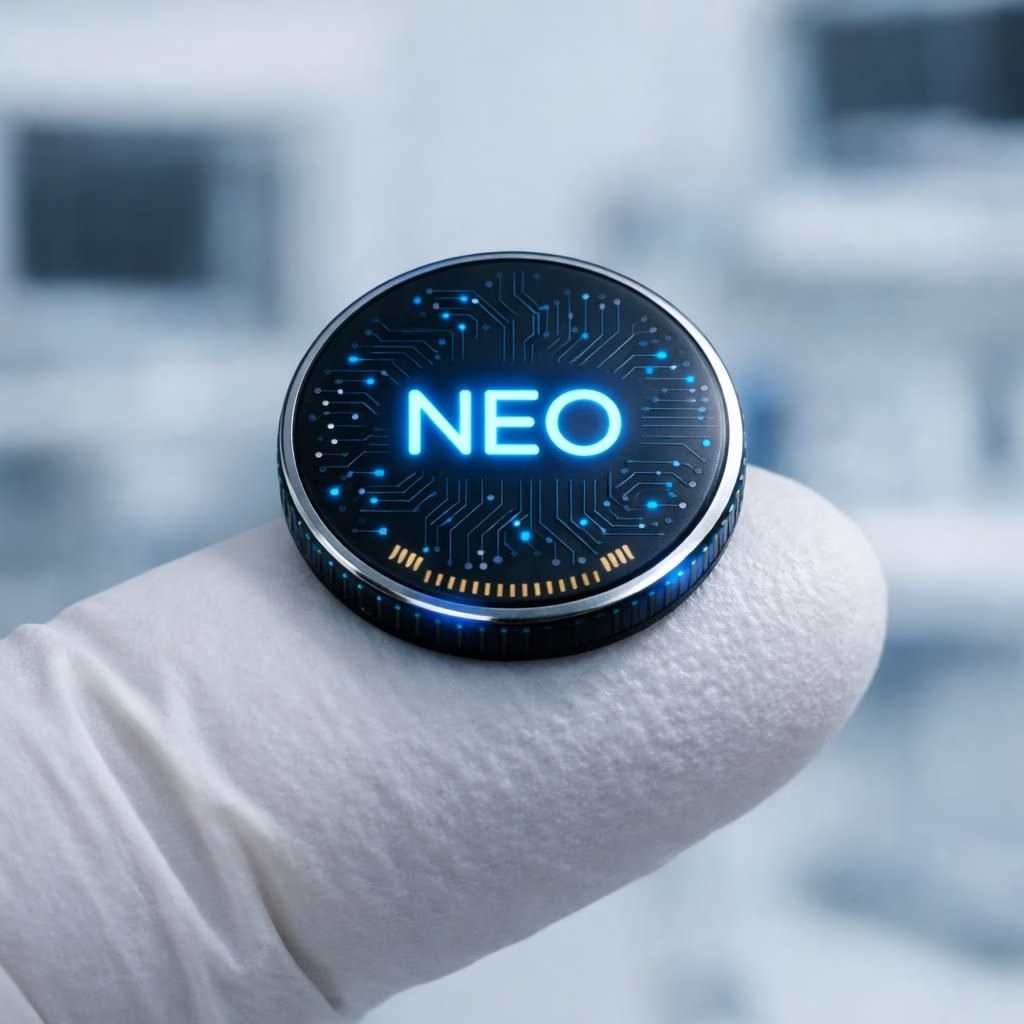
Welcome to the Brain-Computer Interface era, where Neuralink dreams collide with NEO realities and a very serious lab coat. In 2026, China moved from rumor to rollout, approving a coin-sized device called NEO for commercial use. This Brain-Computer Interface device aims to improve the nervous system in spinal cord injury cases, with a less invasive footprint than some earlier implants. Yes, we are finally past the stage of grandiose sci-fi posters and into real-world clinics. And yes, digital telepathy still has a long way to go, but the signals are getting louder and clearer.
Brain-Computer Interface vs Neuralink: NEO’s edge
NEO is a coin-sized implant that sits between the skull and the brain’s protective membranes, with eight tiny sensors pressed against the dura. The design emphasizes minimal invasiveness: fewer surgical risks, quicker recovery, and a straight line to large-scale clinical use in a state-run health system. Neuralink’s approach places electrodes directly into brain tissue to capture higher-resolution signals, making it more invasive but potentially richer data for tasks like thought-controlled typing or cursor movement, and eventually more ambitious goals like restoring sight. The contrast isn’t a political quarrel; it’s a regulatory and engineering choice about risk, payoff, and who pays the bill for safety tests. The NEO path signals that real-world rehab and assistive devices can arrive sooner when you favor practicality over a sci‑fi dream of perfect precision from day one. Brace for a future where several flavors of brain-computer interfaces coexist, each chosen for its own strengths and safety profile.
The NEO device cleared a regulatory route in China and is moving toward mass production for a state-run health system. That means supply chains, service models, and clinical workflows already exist in a way that a university lab can only dream of in the near term. Neuralink, meanwhile, remains under U.S. FDA review with human trials that began in 2024 and a smaller patient cohort. The regulatory friction here isn’t about virtue or vice; it’s about how quickly a system can validate safety at scale while balancing public trust. In short, one path prioritizes a controlled rollout for rehab, the other pursues broader, high-resolution capabilities that could power a wider range of applications in the future.
Neuralink and the Brain-Computer Interface path
From a technology and policy perspective, the two efforts illustrate complementary strategies. NEO’s sensors rest on the brain’s protective membranes, aiming to reduce surgical risk and shorten recovery time. This aligns with a public-health approach that prizes proven safety, reproducible results, and clear reimbursement pathways. Neuralink’s proposed approach pushes for denser data capture, which could unlock more nuanced control and sensory restoration options but requires careful handling of deeper brain tissue interfaces and stricter regulatory scrutiny. The result is a spectrum of options rather than a single winner in the race toward practical neurotech. The public message is hopeful: safer, more accessible implants can help people regain movement and motor function, while more invasive but potentially capable devices can push the envelope for complex neural signals. Both tracks push the same umbrella of goals—improved quality of life, restored independence, and better medical outcomes—just via different routes.
Clinical trials offer a window into reality versus hype. NEO has reported encouraging results from a cohort of 36 patients with spinal injuries, suggesting meaningful functional improvements with manageable safety concerns. Neuralink’s early human data in the U.S. has been more limited in scale but aims for higher detail in neural signals, which could translate into richer user experiences down the line. The regulatory landscape mirrors those aims: China’s approval for commercial use signals public-health confidence and a willingness to back scalable production, while the United States prioritizes rigorous, multi-phase validation to protect patients and data alike. Both stories remind us that innovation thrives when safety and efficacy are not afterthoughts but core design principles.
Beyond the lab, the promises and perils of brain-computer interfaces are worth a sober look. Advocates see digital telepathy and direct thought-to-action interfaces as the next leap in human-computer collaboration. Critics rightly flag privacy risks and the possibility of neural data being misused or stolen. Experts urge careful architectures for data security and transparent consent models. It’s not utopia or dystopia; it’s a careful, incremental journey with measurable milestones and ongoing scrutiny. As Dr. David Tuffley from Griffith University noted in a balanced take, brain implants are a promising, ethically complex frontier—one we should approach with both curiosity and caution, not with loud bravado or alarmist headlines.
Industry voices frame this as the cusp of a broader shift. Venture capitalists, researchers, and tech leaders see this as the moment when biology and software begin a long, cooperative tango. The vibe is optimistic but pragmatic: some users will benefit quickly from simpler, safer implants; others will push for higher-performance devices that demand more robust safeguards and regulatory finesse. Leaders across sectors are quietly negotiating standards for safety, privacy, and interoperability, because a future where devices from different providers work seamlessly with your nervous system requires careful, collaborative governance.
Neuralink’s regulatory journey and the Brain-Computer Interface path
Regulatory conversations aren’t funny, but they are foundational. In the U.S., Neuralink’s program is navigating a rigorous FDA process, with ongoing safety assessments and participant protections. The Chinese path for NEO emphasizes swift scale-up within a public-health framework, aiming for broad access and standardized care. Both routes reflect different regulatory cultures and healthcare ecosystems, yet both share a common denominator: patient safety comes first, but not at the expense of patient progress. If all goes well, 2026 could be remembered as a year when practical neurotech began to reach millions through well-regulated channels, rather than one-off research demonstrations.
For developers and policymakers alike, the lesson is clear: design choices matter. The hardware must balance invasiveness, reliability, and signal quality. The software stack must protect neural data while enabling meaningful control. The ecosystem around reimbursement, clinician training, and long-term monitoring must be lined up. In short, this isn’t merely a gadget story—it’s a healthcare system story, reimagined around a new class of interventions. And yes, the market will feature both safer, more accessible options and more ambitious devices that push the limits of what our brains can interface with technology to achieve.
As we watch 2026 unfold, there’s room for measured optimism. The Brain-Computer Interface space is no longer a rumor mill; it’s a patient-centered field with real clinical pilots, regulatory milestones, and ongoing safety dialogues. The balance of risk and reward will continue to shape which devices reach users first and how regulators view future innovations. If you’re rooting for progress with prudence, you’re in good company.
Would you share your thoughts in the comments? Tell us what you believe the next decade will bring for Brain-Computer Interface tech, and how you weigh safety against speed in medical innovation.
Linkback attribution: Thanks to the New York Post for the original reporting on the NEO chip and Neuralink comparisons. Source: New York Post.