

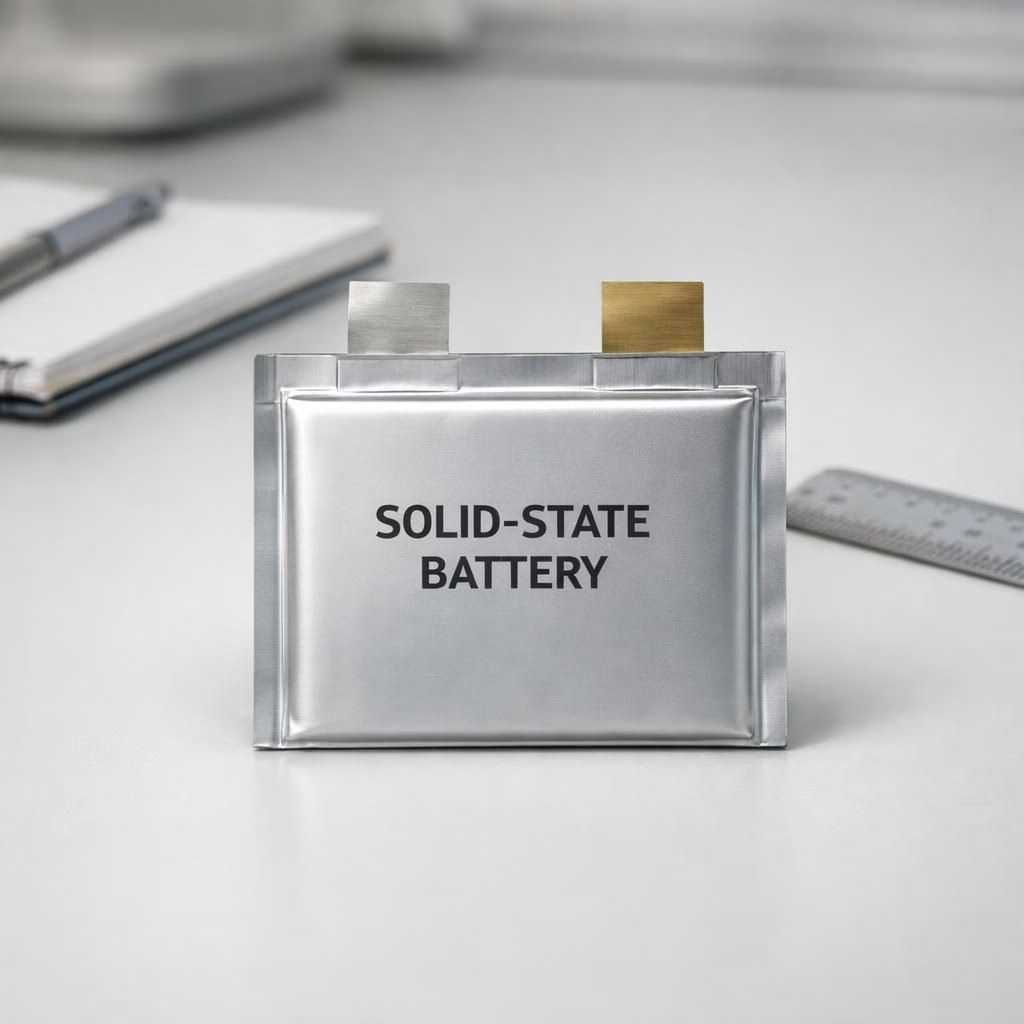
Solid-State Battery optimism meets Donut Labs reality
In this bright, breezy tour through the solid-state battery claims from Donut Labs, we aim to separate sparkle from substance in 2026. Donut Labs has staged a showy pitch that reads like a sci‑fi trailer—promises of cheap, readily available materials, ultra‑fast charging, and a lifespan measured in centuries. The idea of a truly solid-state battery could rewrite everything from smartphones to EVs, which is exactly why the spectacle has drawn a mixed chorus of believers, doubters, and everyone in between. The core truth persists: the science may be sound in theory, but the data trail is remarkably easy to misread, especially when the marketing theatrics (think I Donut Believe) steal the spotlight. This post sticks to what we can verify, what remains unclear, and why the Donut Labs saga has become a compelling case study in tech hype versus evidence.
Donut Labs and the Solid-State Battery marketing play
The Donut Labs campaign leans heavily on spectacle and cadence—weekly ’evidence drops,’ a branded site, and a narrative of clever risk-taking. The company launched I Donut Believe as a way to let fans peek behind the curtain, then framed each reveal as a strategic ploy in a longer game. The intention is clear: arouse curiosity, invite debate, and position Donut Labs as a fearless disruptor ready to ship storage and power now. For a technology story, that’s a bold, even entertaining strategy. The risk is that bluffing can erode trust when the data never quite aligns with the hype. In the world of solid-state battery research, trust is currency, and Donut Labs is spending it fast, sometimes with more flash than proof.
We see a recurring pattern: bold claims, a marketing-forward narrative, and limited access to the underlying tests. The cadence and style may be entertaining, but the core questions remain urgent. If a solid-state battery can truly deliver 400 Wh/kg with a 100,000‑cycle life and sub‑six‑minute full charges under realistic manufacturing conditions, those results should be reproducible under independent validation. Instead, what the public often gets are partial test results, selective summaries, and public-relations flourishes that invite a closer look rather than immediate acceptance.
VTT tests, transparency, and the solid-state battery evidence
One of the most scrutinized chapters in the Donut Labs story is the collaboration with VTT Finland, a government‑backed research organization. Donut Labs published multiple isolated tests over several weeks, each designed to showcase a particular feature of the battery. The big question remains: do these tests constitute transparent validation, and can they be reproduced by independent labs with the same materials and processes? The public record shows VTT performing independent charging and discharging trials, vacuum integrity checks, and cycling experiments. Yet the results have been interpreted in different ways by different sides, and some observers feel the published excerpts lack the holistic, end‑to‑end data set one would expect for a production-ready claim. It’s the classic trap of promising a holistic revolution while offering only slivers of the full data set.
In practical terms, VTT reported observations such as gas removal during manufacturing and vacuum integrity checks, along with a few cycles that demonstrate the cell’s resilience. But the same reports also describe swelling under certain conditions and performance degradation after repetitive cycling. Donut Labs touted these outcomes as proof of robustness, while critics argued that swelling and vacuum loss are red flags more consistent with a prototype than a commercial product. The tension between optimistic interpretation and cautious analysis is precisely why independent replication matters—and why Donut Labs’ data transparency becomes a pivotal factor in how the story will be judged in the long run.
What the testing saga teaches us about solid-state hype
Beyond the specifics of Donut Labs and the VTT reports, there’s a broader takeaway about the solid-state battery landscape. The industry is racing to move from “could be” to “is” on scalable production, real-world cost, and reliable lifetime. That transition requires open datasets, clearly defined metrics, and independent replication. Donut Labs’ strategy—releasing data in a staggered fashion while framing critics as biased—highlights a common tension in emerging tech: the line between bold storytelling and verifiable engineering. The more a company with grand claims withholds the core testing details, the more skepticism tends to grow. Conversely, a transparent data trail, even if imperfect, can convert doubt into constructive scrutiny and rapid improvement.
And yes, the dialogue continues to be lively online. You’ll find enthusiastic supporters, wary observers, and a healthy crowd of mid‑level engineers who want to see the numbers, see the blueprints, and see the full set of test results laid out in a reproducible format. The Donut Labs story is not just about one battery; it’s about how the tech community communicates breakthrough ideas, handles big promises, and negotiates the space between marketing and measurable progress. It’s a reminder that in a field as intricate as solid-state chemistry, a single glossy video cannot replace a robust, transparent, independent validation program.
Lehtimäki, the company’s leader, has been unapologetic about the newsroom drama. He has framed the discussion as a strategic chess match, teasing new generations of tests while acknowledging some estimates behind claims require more rigorous proof. The conversation with the public remains crucial: if a solid-state battery is truly ready for mass production, the signals should be clear, replicable, and timely. If the signals are muddled or selectively presented, the audience will rightly demand more clarity instead of more spectacle.
Looking ahead for the solid-state battery path
In the end, the Donut Labs episode is a valuable case study in how bold claims travel in the age of social media, marketing campaigns, and rapid prototyping. For enthusiasts, it’s a frontier worth watching; for engineers and investors, it is a reminder to demand robust data and reproducibility before cheering. The field itself benefits from high standards and transparent science, and the best way forward is to insist on the numbers, the methods, and the reproducible demonstrations that turn hype into dependable, scalable reality.
FAQ: solid-state battery hype, in plain terms
What would a 400 Wh/kg solid-state battery mean for EVs? It could cut weight and increase range, translating to more efficiency and lower cost per mile in real-world driving.
Why are independent tests important? They verify claims under controlled conditions, enabling apples-to-apples comparisons and reproducibility across labs.
What counts as credible evidence in this space? End-to-end data sets, clear test protocols, full charging/discharging cycles, packaging details, and independent replication.
What should companies share openly? Basic specs (weight, size, energy density), complete test results, and access to raw data to enable review and replication.
Conclusion: a cautious takeaway for the solid-state battery frontier
Ambition in solid-state chemistry matters, but credibility matters more. Until Donut Labs and others provide a transparent, reproducible data trail with full end‑to‑end testing, the hype should be read with caution. The right path forward is a rigorous, open validation program that converts promise into dependable, scalable reality.
If you buy something through a link in this article, we may earn commission.
Original article: Thank you to the original authors for the material on Donut Labs and the solid-state battery saga.
We’d love to hear your take: what do you think about the solid-state battery promises from Donut Labs? Share your thoughts in the comments.