

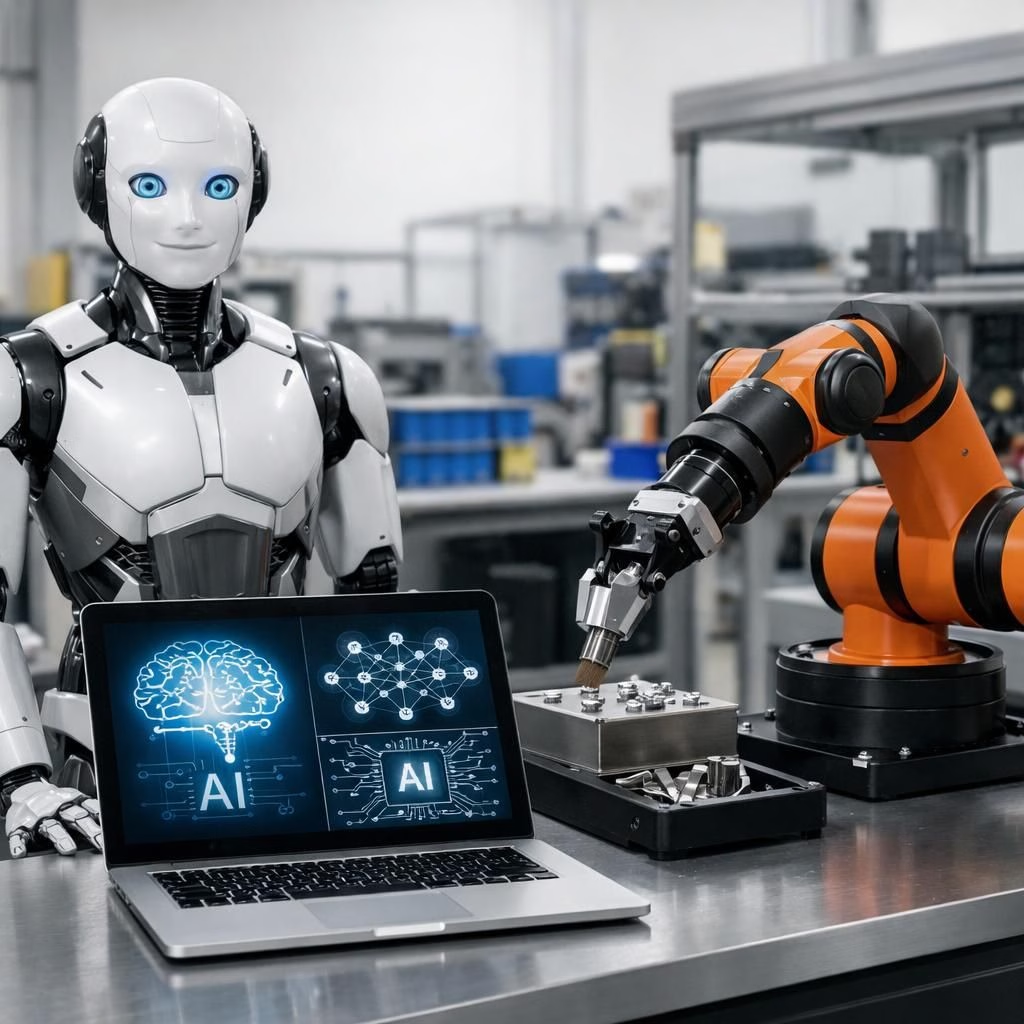
In 2026, Qualcomm rolled out a bold package of robotics and AI ambitions at the India AI Impact Summit 2026. It presented a cohesive end-to-end robotics suite designed to democratize physical AI in homes, factories, and large-scale operations. The buzz reflected real practicality: a modular system that deliberately threads hardware, software, and AI together across diverse form factors.
robotics and AI in action: Qualcomm’s end-to-end platform
The company described its Robotics System as a single stack that blends heterogeneous edge computing, mixed criticality, software platforms, and ML ops. The result is a platform to support robotics-driven household robots, industrial autonomous mobile robots, and humanoids. The architecture aims to shorten time-to-market and simplify development for manufacturers pursuing scale.
Shrestha Jain, Marketing Lead for Robots and Automotive at Qualcomm, highlighted a key point: the architecture supports a range of workloads with a common core. The platform uses an AI data flywheel to improve perception and decision-making over time. The goal is rapid iteration and reliable performance in real-world environments.
robotics-driven AI for homes, factories, and the industrial edge
Qualcomm introduced its first dedicated robotics processor, the Dragonwing IQ-10, aimed at powering advanced autonomous mobile robots and full-sized humanoids. Jain called this move Qualcomm’s entry into the premium tier of robotics computing. The IQ-10 runs perceptual workloads while the AI data flywheel keeps feeding learning loops, ensuring robots stay sharp on the shop floor and at home.
The hardware stack pairs with a software stack that handles perception, planning, and control. The system scales across form factors—from compact home bots to large industrial units—without sacrificing industrial-grade reliability. In high-automation settings, uptime becomes the norm, not the exception.
At the India AI Impact Summit, the event is framed around three Sutras: People, Planet and Progress. Organizers describe this as the first global AI gathering in the Global South. Prime Minister Narendra Modi opened the Expo, showcasing AI aimed at national priorities and global needs.
More than 20 heads of state and 60 ministers joined, with hundreds of global AI leaders mapping practical steps under the IndiaAI Mission and the Digital India initiative.
Practically, the platform holds promise for smart homes that learn routines, factories that optimize fleets, and campuses where robots collaborate with humans. The modular architecture supports a range of real-world use cases, easing integration for manufacturers and lowering the barrier to entry for new players in AI and robotics.
Here are takeaways for readers who follow tech deployments closely. First, the Dragonwing IQ-10 represents a credible step up in robotics computing, combining perceptual sensing with scalable software. Second, the AI data flywheel concept signals a push toward continuous improvement, not one-off machine configurations. Third, the emphasis on industrial reliability shows intent to keep robots running in demanding environments, which matters for long-term ROI.
For households, this means more capable service robots that can handle chores and assist family members. For factories, fleets of autonomous mobile robots can coordinate tasks, monitor safety, and reduce downtime. For researchers and startups, the modular architecture provides a blueprint for faster development and broader adoption of AI and robotics in real-world contexts.
As Qualcomm partners with India to accelerate digital transformation, the focus remains on tangible outcomes. The three Sutras remind us that progress should benefit people, protect the planet, and deliver lasting value. The push toward physical AI is less about sci-fi and more about practical, scalable systems that perform reliably in the wild.
Takeaways include staying informed about how AI data flywheels evolve, watching how the IQ-10 performs in diverse environments, and noting how modular design reduces risk for manufacturers exploring robotics and AI for the first time.
Finally, the summit highlighted a global trend: AI adoption is not a luxury but a practical tool that can be woven into everyday life. The combination of robotics and AI is moving from lab benches to real-world floors, with measurable benefits in efficiency, safety, and user experience. This is the kind of progress that deserves attention from engineers, policy makers, and curious readers alike.
Original article: Thank you to the original publisher for the material.
Have thoughts on AI robotics? Share them in the comments below.
FAQ
-
What is the Dragonwing IQ-10?
Qualcomm’s new robotics processor targets advanced autonomous mobile robots and full-sized humanoids with perceptual and control workloads.
-
How does the AI data flywheel work?
It feeds learning loops to improve perception, planning, and decision-making over time, helping systems adapt to changing environments.
-
What does this mean for homes vs. factories?
In homes, service robots may learn routines and assist tasks; in factories, fleets of autonomous robots can coordinate tasks and boost uptime.
-
Will this affect jobs?
Adoption tends to shift roles toward systems integration and supervision while automating repetitive tasks; new developer ecosystems can emerge around modular architectures.
Conclusion & next steps
The Qualcomm platform signals a practical path for robotics and AI to move from labs to everyday environments. For engineers and business leaders, the key is to watch how the modular stack performs across homes, campuses, and factories, while assessing the ROI from continuous improvement and reliable operation.
Further reading and references
- External coverage on robotics platforms and AI integration (credible tech outlets).
- Qualcomm-related robotics developments in industry press.