

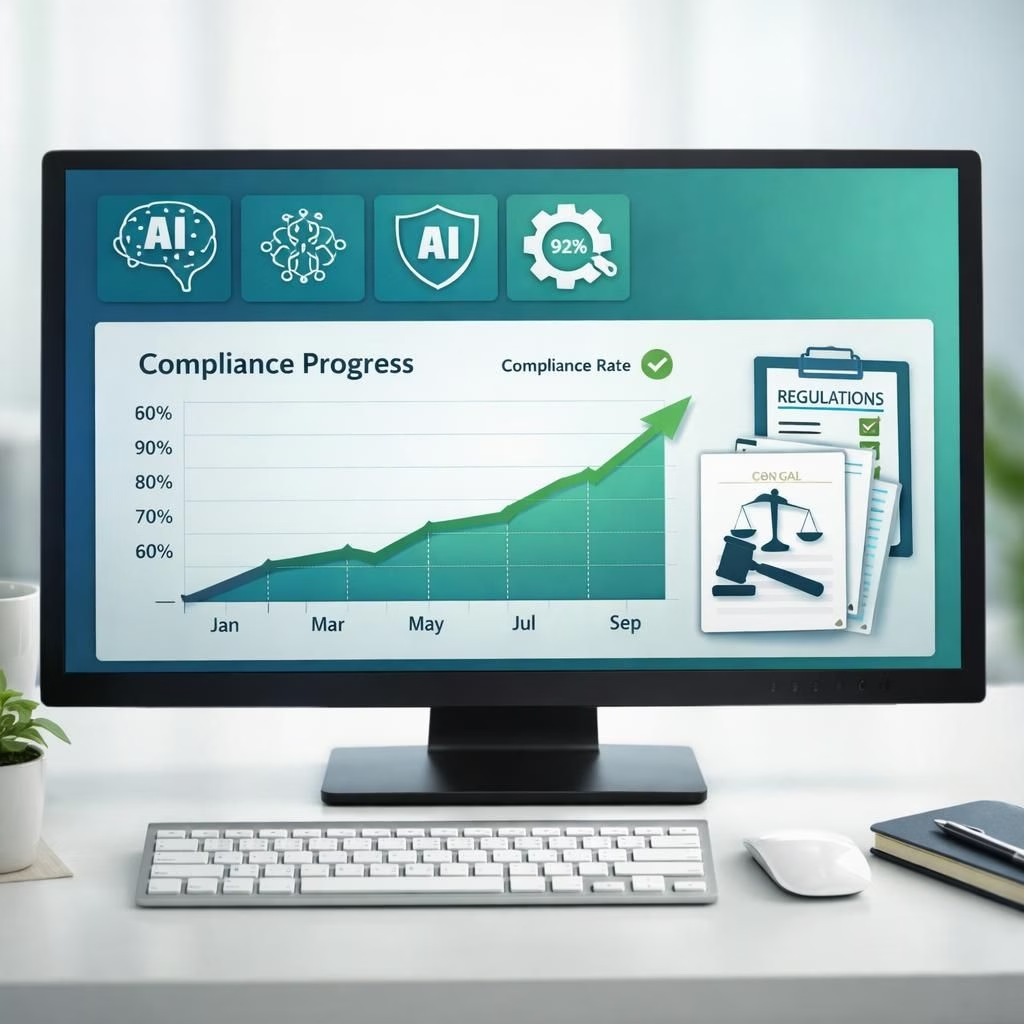
RegTech and ComplianceAutomation are no longer buzzwords; in 2026 they are quietly becoming the operating system for regulatory change. The pace of new rules lands daily, guidance expands, and compliant firms respond with a blend of grit and gadgetry.
To understand how organisations cope, AscentAI surveyed risk and compliance professionals across FinTechs, Tier 1 banks, regional banks, and investment firms in North America and Europe. The findings reveal a crossroads: rising demands collide with uneven readiness, yet AI sits in the wings as a potential star player.
Manual processes remain the dominant — and most painful — reality.
Despite years of digital transformation rhetoric, the survey found that 58% of respondents still operate at what AscentAI describes as a Basic or Dependent maturity level. In practical terms, compliance functions remain largely manual, spreadsheet-driven, or heavily reliant on outside counsel. Only 16% of organisations surveyed had reached an Advanced maturity level — characterised by highly automated, fully integrated compliance operations.
What makes those figures striking is the projected shift ahead: the advanced cohort is expected to more than double, reaching 35% within just 12 months. Among Tier 1 banks specifically, 67% anticipate reaching that level within the same timeframe — a signal that the largest institutions are betting heavily on automation.
When asked about their biggest day-to-day challenges around regulatory data management, the responses were remarkably consistent across seniority levels. Some 57% cited time-consuming manual processes as their primary pain point, 39% pointed to fragmented data and the absence of a single source of truth, and 30% admitted they lacked full confidence in whether they had everything they needed to stay compliant. From the C-suite to junior analysts, the frustrations were strikingly similar.
RegTech in 2026: Turning policy into practice
Regulatory bodies are increasingly formalising expectations around automation to manage compliance more efficiently. See the FCA’s guidance on RegTech and SupTech for context: FCA RegTech / SupTech.
Survey participants were asked to identify the most challenging steps in regulatory change management workflows. The results varied by geography and institution type. EMEA respondents and large institutions such as Tier 1 banks ranked operationalising regulatory changes within the business as their most difficult task. By contrast, regional banks and investment or broker-dealer firms found monitoring regulators for updates to be their steepest challenge.
This divergence reflects the different structural pressures these organisations face. Larger firms may have monitoring capabilities in place, but struggle to cascade rule changes effectively across complex, siloed organisations. Smaller institutions, meanwhile, may lack the dedicated resource to track the regulatory landscape with sufficient rigour.
ComplianceAutomation: High expectations, mixed verdicts
Artificial intelligence is generating significant interest across the compliance space, though opinion on its current state is divided. The survey found that 46% of respondents described AI for compliance as transformational technology with real potential. A further 41% acknowledged the value of AI in principle, but found existing market solutions underwhelming or unconvincing. Just 8% said they did not believe the hype at all — meaning 87% of respondents saw either current or future value in AI-powered compliance tools.
Whether that translates into investment is becoming clearer: 74% of respondents said they planned to invest in new compliance technology within the next 12 months. Adoption appetite was highest among FinTechs, with 90% planning to spend, followed by Tier 1 banks at 87% and regional banks at 80%. Given the survey’s findings on AI sentiment, RegTech tools powered by artificial intelligence are likely to feature prominently on procurement shortlists.
For many teams, adopting a plan around ComplianceAutomation is a key strategic priority this year.
The 2026 AscentAI Benchmark Survey is the first in a broader research series designed to track how compliance automation is evolving across the industry. Future instalments will explore topics like compliance maturity modelling, the cost of manual processes, monitoring challenges, data management at enterprise scale, and AI adoption trends. The full report, including cross-tabulated analysis by industry, geography, and seniority, is available to download now. Download the full report here.
Progress on ComplianceAutomation initiatives often speeds up regulatory change cycles.
Special thanks to FinTech Global for the original article. Linkback: 2026 AscentAI Benchmark Survey.
Practical steps to advance ComplianceAutomation
- Map data sources across the organisation and establish a single source of truth for regulatory data.
- Invest in automation platforms that integrate policy math, change tracking, and audit trails.
- Implement data governance and quality controls to reduce manual handoffs and errors.
- Set up cross-functional governance with clear ownership for regulatory changes and monitoring.
FAQ
- What is RegTech?
- RegTech refers to technologies that help financial services firms meet regulatory requirements more efficiently, through automation, data management, and analytics.
- How quickly are organisations moving toward advanced maturity?
- Survey data suggests a rapid rise, with the advanced maturity tier expected to grow notably in the near term, especially among Tier 1 banks.
- Is AI ready for compliance automation?
- The majority see potential now or soon, but real-world deployments vary by vendor and use case.
- What can smaller firms do to boost compliance readiness?
- Start with governance, data quality, and phased automation pilots guided by a clear strategy.
References
- Original FinTech Global article
- FCA RegTech & SupTech
- World Economic Forum on RegTech
- OECD RegTech overview