

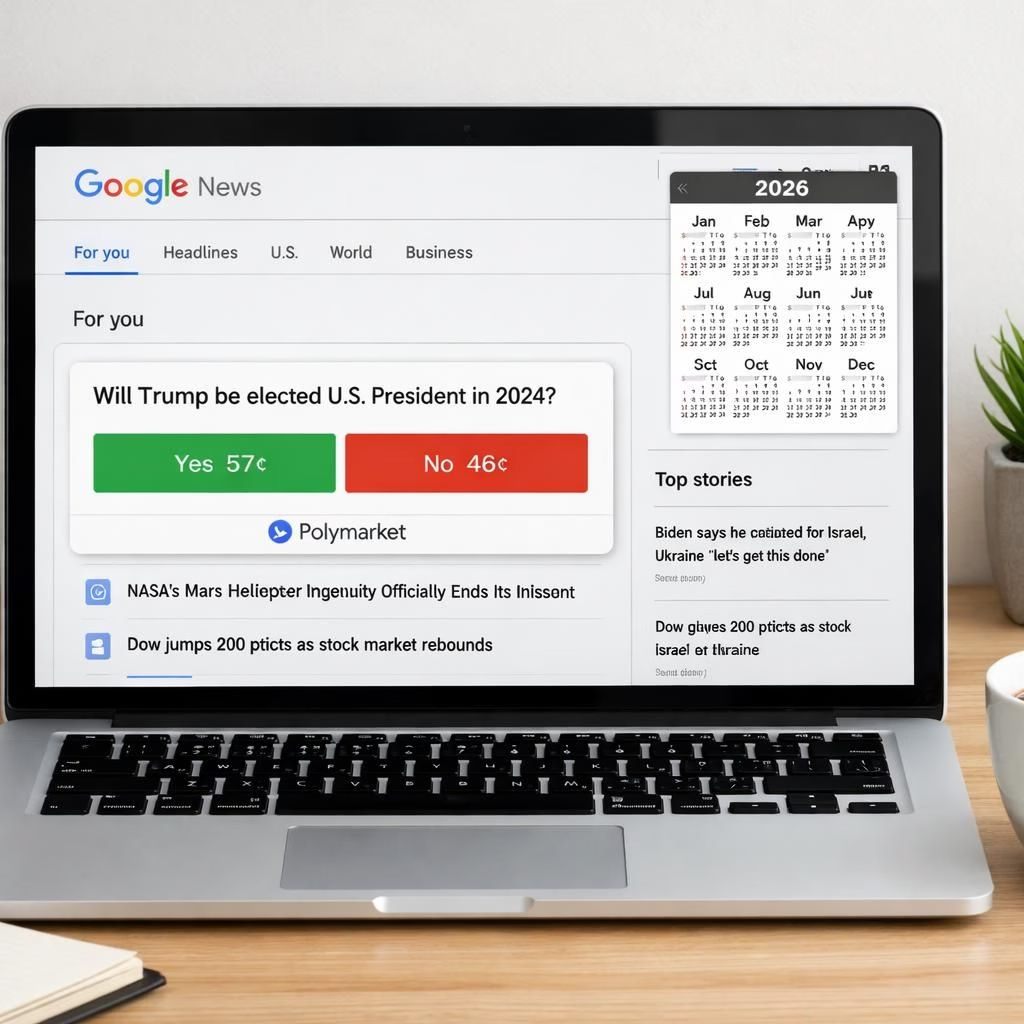
Polymarket briefly popped into the news landscape in 2026, a surprising cameo that shone a light on Prediction Markets in the wild world of mainstream media. The episode reminded us that software glitches can be witty, inconvenient, and educational. Google labeled the incident an error and said it has since been resolved. The moment felt like a backstage pass handed to a crowd not quite prepared for it, and yet the spectacle offered a useful nudge toward understanding how data moves into the public square.
In Google News, Polymarket listings appeared where they rarely belong: the personal For You feed, the homepage, and even as top results in searches. Some entries popped up alongside market chatter, with Bitcoin price references in the background. For a moment, the line between a betting option and a news item blurred, inviting readers to blink twice.
Polymarket and Prediction Markets: a curious glitch in the feed
What happened, exactly, reads like a cautionary but oddly comforting tech fable. A subset of Polymarket betting entries surfaced in Google News across multiple surfaces. The content appeared in user feeds and in search results in ways that felt more like a data feed than a newsroom, which understandably invited questions about context, sourcing, and editorial intent. The same glitch made other sources look normal by comparison, a reminder that not every algorithmic nudge is a signal and not every signal is a verified report. The incident was quickly identified as an error and resolved.
Polymarket itself is a platform built on real-time crowd sentiment and probabilities for real-world events. In practice, that means listing data that can resemble news updates if the surrounding framing is loose or inconsistent. Prediction Markets like Polymarket and its peers have long sparked debates about whether betting odds belong in the realm of news or in a separate data category. The episode intensified that debate but also clarified a path forward: better separation, clearer labeling, and stronger boundaries between editorial content and market data. The takeaway is not a verdict on the legitimacy of Prediction Markets data, but a call for clearer curation, especially when the data can influence readers who are short on time and long on curiosity.
Polymarket and Prediction Markets influence in today’s news ecosystem
The incident aligns with a broader push to surface Prediction Markets data alongside traditional news. Critics have argued that betting odds should not masquerade as news, and proponents say predictive data can enrich decision-making when properly contextualized. The debate isn’t about silencing data pools; it’s about ensuring readers can distinguish between editorial content and market-derived signals. In 2026, Google’s announcement of collaboration with Polymarket and Kalshi to weave prediction data into its finance ecosystem raised eyebrows about potential influence on search results and perceived credibility. At the same time, it’s unclear whether that partnership played any role in the mislisting, or if it was purely a separate technical slip that surfaced due to indexing patterns across Google surfaces.
From a practical standpoint, the episode shows how Prediction Markets work: crowdsourcing probabilities, rather than relying on formal reports, yielding a probabilistic snapshot of likely outcomes. That snapshot can be informative, but it can also be noisy. The signal quality depends on transparency, labeling, and reader expectations. For journalists, the lesson is simple: when you remix data streams, make the remix obvious—and be ready to correct misreads quickly. For readers, the takeaway is to treat Prediction Markets data as supplemental context, not as a substitute for primary reporting.
On the technology and media side, clarity matters. Prediction Markets can be powerful tools for forecasting, risk assessment, and trend spotting, but their presentation requires careful framing. If a listing looks like a news item, readers should be able to click through to a clear source that explains the boundaries between reporting and market data. If a source wants to use Polymarket or Kalshi as data partners, it should label those data streams explicitly, disclose the nature of the data, and show how it differs from traditional reporting. In that sense, 2026 is less a catastrophe and more a learning moment—a reminder that ambitious data ambitions require equally ambitious labeling and governance to keep readers oriented and informed.
For readers who want a practical checklist: verify the source, note the context, watch for labeling cues, and compare with traditional outlets when possible. Market data can illuminate uncertain futures, but it can also tilt perception if presented without proper safeguards. Prediction Markets are not going away, and neither is Google News. What changes is the need for explicit context, clear sourcing, and transparent separation between editorial content and market signals. The ecosystem will improve as editors and platforms adjust their interfaces, but the pace of improvement will depend on ongoing feedback from readers who first noticed the mislisting.
Original article and inspiration: The Verge (thank you for the original material) — we appreciate the thoughtful reporting that sparked this broader discussion on data, news, and markets.
Curious about your take: how do you differentiate market data from news in your daily scrolling? Share your thoughts in the comments below and join the conversation.