

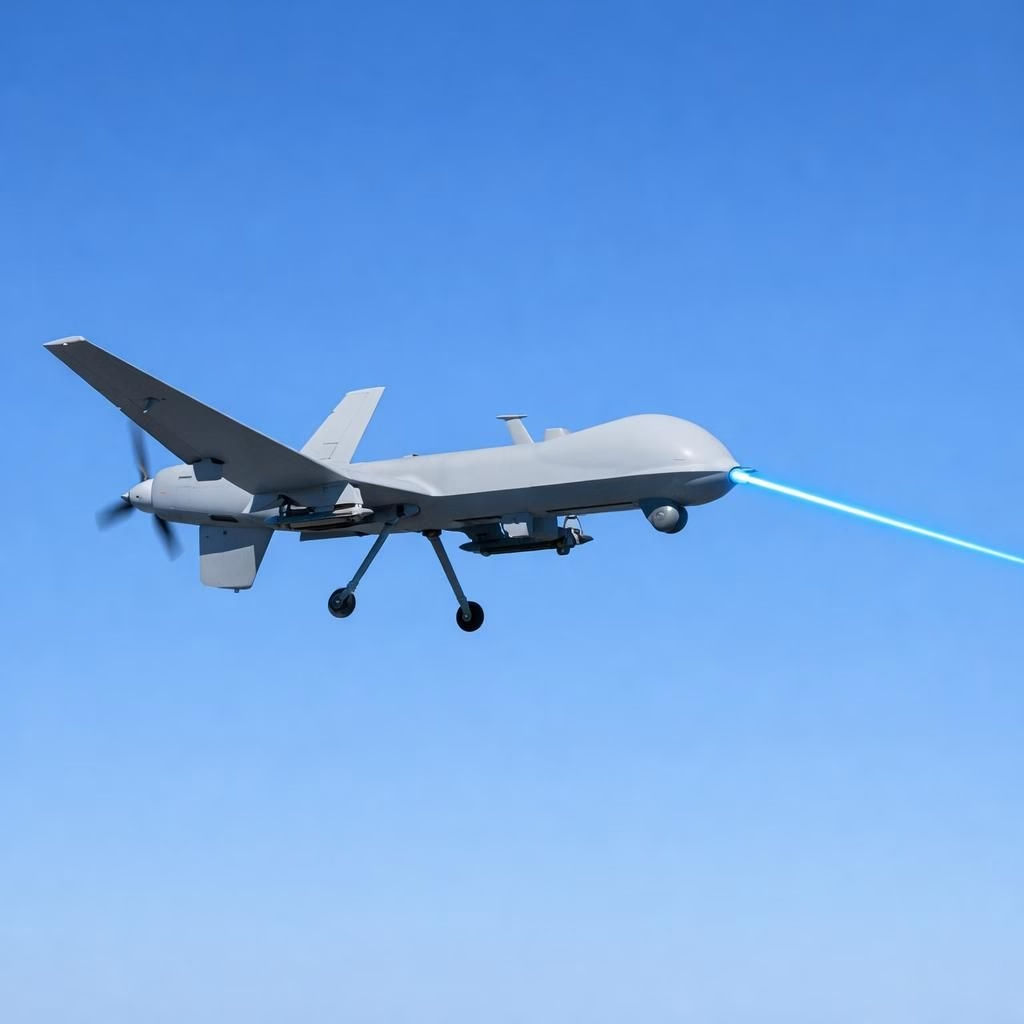
2026 finds the U.S. military flirting again with directed-energy ideas, this time aiming to bring airborne-lasers to the edge of the fight and to surprise potential threats above our skies. The Defense Department’s Missile Defense Agency signals a renewed push to field energy-based weapons on unmanned platforms while the budget line remains a mystery, a combo that defense readers love to analyze.
At a hearing of the House Armed Services Subcommittee on Strategic Forces, MDA director Lt. Gen. Heath Collins described an all-in stance on bringing directed-energy to the fight, specifically on drones for homeland defense against missiles and drones. The goal is clear: put the laser on a fast, nimble platform so the first shot happens at the edge of the battle, thinning the threat before it reaches the inner defense ring. The tone remains practical and hopeful, a reminder that bold ideas thrive when paired with accountable planning.
directed-energy push: edge-of-the-fight on drones
Collins did not name a laser model or a power rating, but his written remarks emphasize accelerating operational use of high-energy lasers on various platforms, adding a critical non-kinetic layer to the existing defense architecture. The approach favors testing, learning, and iterative upgrades over grand promises. In 2026, the plan prioritizes quick demonstrations that inform better decisions and different funding paths for directed-energy systems on unmanned assets, including airborne-lasers being a component of the plan.
Historically, flying lasers have a habit of entering the conversation and then stalling. The YAL-1 program on a Boeing 747 finally produced in-flight demonstrations, but affordability and technology hurdles doomed the project. The story teaches humility and discipline: the physics is real, the budget is stubborn, and the airframe imposes limits. The result is a smarter path, not a retreat from a bold idea—this is how big ideas get tested in the real world, with constraints in plain sight and a sense of humor about timelines.
airborne-lasers roadmap: lessons from history
Directed-energy concepts demand rigorous testing, predictable power budgets, and disciplined program management.
From the High Energy Liquid Laser Area Defense System to later experiments, the route has wiggled, not walked straight. The Low Power Laser Demonstrator offered early promise and then faded as power, cooling, and beam control posed stubborn problems. The modern claim remains enticing: lasers can be cheaper per shot and deliver a faster response than missiles, but the engineering remains intense. The dialogue centers on installing lasers on unmanned platforms with attention to weather, altitude, and energy management.
Recent advances in solid-state lasers have yielded more compact units with better efficiency. That progress makes a drone-ready laser more plausible, but the practical limits of atmospheric turbulence and airframe integration still loom large. The 2024–2026 window shows policymakers and engineers learning together, shaping a credible route while procurement details stay opaque for now. The emphasis stays on incremental learning and scalable demos rather than a single magic device.
Beyond hardware, a mature approach requires budget transparency, interoperability with existing defense layers, and safety for civilian airspace. If the energy weapon matures, the long-term cost curve could improve, complementing current interceptors rather than replacing them. If the dream stays just out of reach, the testing still yields valuable knowledge about physics, materials, and control systems. The takeaway is resilience and deliberate progress rather than fireworks and fantasy.
In short, the conversation blends optimism with a practical mindset. The MDA seems to favor a staged cadence: demonstrate, validate, and refine before large-scale fielding occurs. The public discourse benefits from balance—skepticism kept in check by curiosity about what directed-energy and airborne-lasers can actually deliver under real conditions. The 2026 outlook remains a work in progress, but the commitment to learning is unmistakable.
Have thoughts on how directed-energy and airborne-lasers fit into modern defense? Share your perspective in the comments below. Your input helps drive the conversation beyond the lab bench and budget slide.
Original article attribution: A sincere thank you to Breaking Defense for the original reporting that inspired this rewrite. Original article link: Breaking Defense: MDA directed-energy push.
Practical takeaways for policymakers
- Power and cooling: Directed-energy systems require robust power sources and thermal management on drones.
- Weather and beam control: Atmospheric turbulence can degrade performance; testing across conditions is essential.
- Safety and airspace: Clear safety protocols help protect civilian airspace during demonstrations.
- The role of airborne-lasers in layered defense should be assessed alongside existing interceptors.
FAQ
- What is directed-energy on drones? A focused power source used to defeat missiles and drones at the speed of light, with practical limits tied to weight, power, and weather.
- Will airborne-lasers replace missiles? Not in the near term; they are envisaged as a complementary, non-kinetic layer in a multi-layer defense.
- What timeline is realistic? Expect staged demonstrations, incremental upgrades, and ongoing risk management rather than a single breakthrough.