

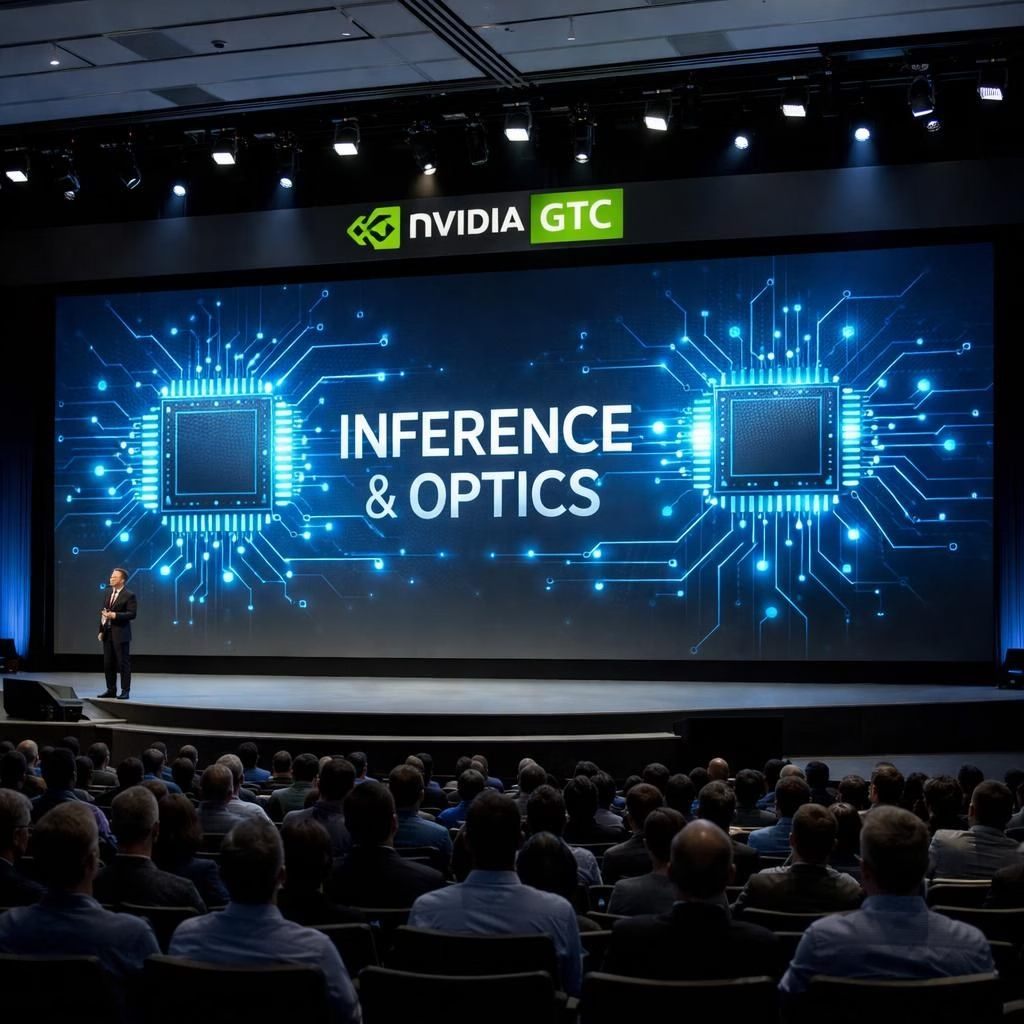
Jensen Huang will take the stage at Nvidia’s GTC to map the company’s next moves in AI hardware, software, and global partnerships. The event, long a compass for developers and investors alike, now doubles as a stacked portfolio review of the AI gold rush. Nvidia reported solid earnings that impressed analysts but barely moved the stock, underscoring a market with strong opinions but no fixed price target. Huang is expected to deliver a blend of pragmatic upgrades and audacious bets, pairing inference capabilities with CUDA strengths and new architecture ideas that promise greater efficiency and calmer operation. Expect updates on optics-driven data movement ideas to surface, potentially reducing latency and cooling the silicon in real deployments. We’ll also hear about memory strategies designed to ease long-standing bottlenecks. The story isn’t about a single gadget; it’s about a coordinated stack spanning software, systems, and a global network of partnerships. If OpenAI signs on as a customer and Groq tips surface, you can bet the crowd will notice.
inference-focused chips and OpenAI ties
On the chip front, the chatter centers on an inference-focused processor designed to optimize running trained models rather than training them. Nvidia has teased several new chips the world has never seen before, and a Wall Street Journal note hinted at Groq-derived tech powering this class. The goal would be to address inference memory pressure, possibly by leaning on high bandwidth memory (HBM) where memory density often bites, or by supplementing with SRAM for fast on-chip caches. Analysts like Sid Sheth say inference is a different game from training, with developers able to deploy finished models across cloud and edge with less reliance on CUDA-centric workflows. The question for investors becomes: can Nvidia extend its leadership in inference without surrendering the developer advantage that has defined its platform? As always, Nvidia’s tooling, partner ecosystem, and performance-per-watt math will be part of the narrative. Inference remains a signal of future demand for autonomous tasks and real-time decisions, not just a data-center routine. Coverage from Financial Times and Wall Street Journal has underscored similar themes about AI workloads and chip strategy.
optics and the copackaged future
The Rubin Ultra push is about more than horsepower; it rethinks how data travels inside a compute stack. optics-enabled interconnects and copackaged optical components could shrink latency, reduce energy use, and enable denser clusters. Nvidia has signed multiyear supply contracts with optical-component makers such as Coherent and Lumentum, signaling a strategic bet on light-based data movement. The optics approach also aims to build a resilient, future-proof supply chain amid silicon shortages and export controls. Meanwhile, talk of a forthcoming Feynman architecture suggests optics-driven interconnects would be central to large-scale AI infrastructure. Geopolitical considerations—export controls and cross-border tensions—shape licensing, shipping, and service for hardware across regions. Nvidia is likely to share Rubin’s power envelope, the plan to Rubin Ultra, and the path beyond, with cloud providers and government buyers in mind for the next-generation optical interconnects.
Beyond hardware, Nvidia continues to ride the wave of agentic AI and robotics. Analysts note that demand durability matters as much as growth pace, with several clouds and data centers expanding their AI footprints. The concept of autonomous software agents performing tasks across voice interfaces, video processing, and multimodal AI excites investors. At the same time, policy and geopolitics loom large. Export controls threaten supply lines, but Nvidia is turning this challenge into an advantage by diversifying its supplier base and deepening international partnerships. The result could be a broader, more resilient AI infrastructure built on optics-enabled interconnects and optics-driven memory pathways that keep costs predictable and performance high.
We close with a human note: the GTC stage is a gathering of engineers, executives, and curious onlookers who believe that smarter machines can help people. The themes to watch include durable demand for optics and inference-driven systems, a Rubin axis that leans into power and efficiency, and a future Feynman line that could mainstream light-based data movement. If you’re an investor, a developer, or a tech-curious reader, consider how hardware, software, and policy intersect to shape the AI era—one GPU at a time. Look for more agentic AI demonstrations, robotics milestones, and the export-controls drama that will influence where AI hardware ships in 2026 and beyond.
We welcome your thoughts and questions—share them in the comments below to keep the conversation lively and constructive.
Original article attribution and thanks: Special thanks to the original source material for providing insights that inspired this rewrite. You can read the original article here: Original Nvidia GTC preview article.
Practical takeaways for readers
- Monitor for inference-focused chip updates and how they affect real-world deployments.
- Watch how optics-enabled interconnects could change data center efficiency and cloud scaling.
- Consider how policy and geopolitics might shape where Nvidia ships hardware next year.
FAQ
- Q: Will Nvidia reveal a new chip at GTC?
- A: The company is expected to discuss potential inference-focused chips and the broader inference stack, though official product details may vary by announcement.
- Q: How important are optics for Nvidia’s roadmap?
- A: Very important. Copackaged optics could reduce latency and power, enabling larger AI clusters and more efficient infrastructure.
- Q: What about geopolitics? Could export controls affect plans?
- A: Export controls and cross-border tensions could influence licensing, manufacturing, and distribution strategies, making a resilient supply chain essential.