

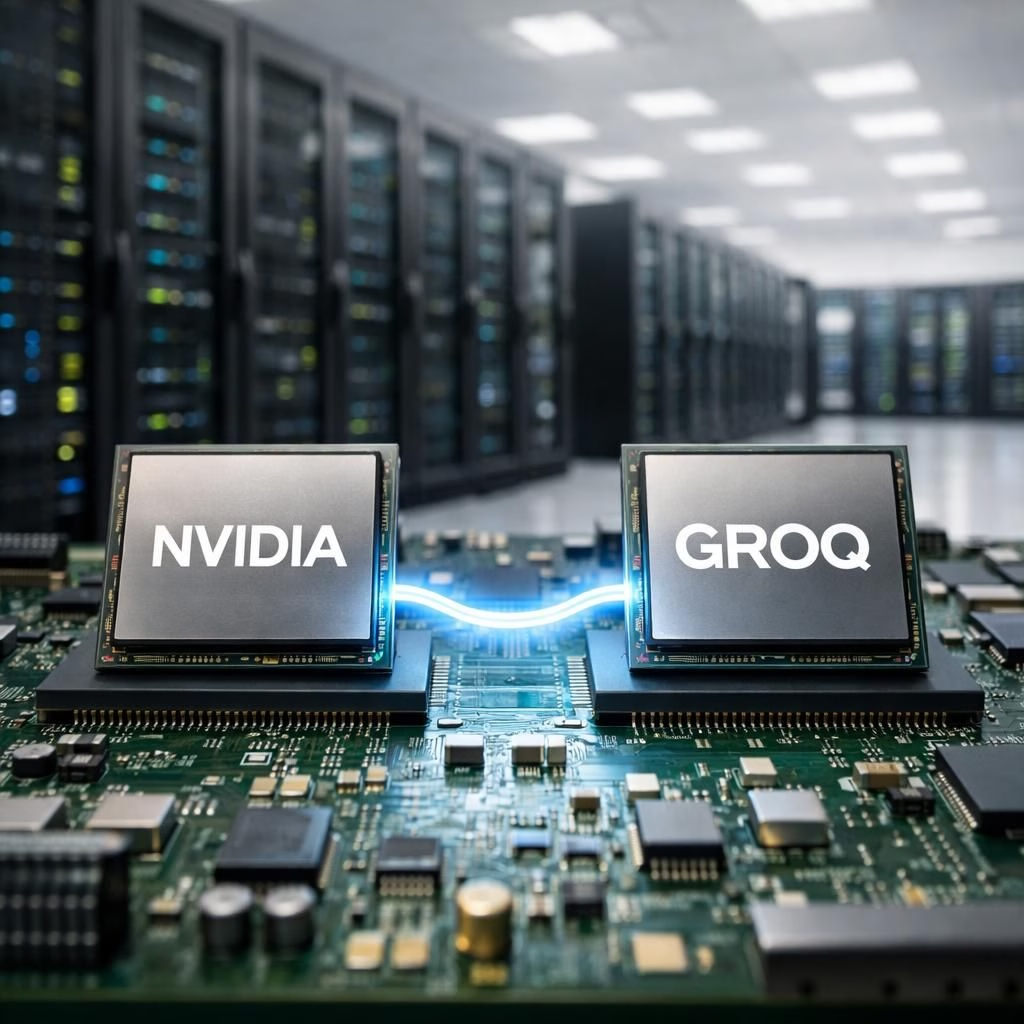
At Nvidia’s GTC 2026, Jensen Huang reframed the company’s chips as part of an evolving ecosystem. AI chips and inference were the stars, but the mood was pragmatic: a toolbox that keeps adapting. The San Jose arena pounded with energy, signaling that the world’s most valuable public company isn’t resting on laurels; it’s building alliances to stay ahead. The message was clear and energetic: you win by pairing strengths, not by insisting on a solo act, especially as workloads evolve in 2026.
AI chips: The evolving toolkit for 2026
Huang introduced a product that stitches Groq’s accelerators to Nvidia’s AI engines. The aim is straightforward and ambitious: when an AI task arrives, Nvidia’s AI chips handle the request while Groq’s accelerators accelerate the critical inflection point of inference. This isn’t a merger; it’s a carefully choreographed duet designed to push inference tasks—from code generation to image synthesis—toward faster results and lower per-inference costs. Analysts note that the collaboration helps Nvidia defend against rivals with their own inference-focused chips, and from nimble upstarts such as Cerebras. The takeaway is clear: AI chips are versatile, but the best outcomes come from partnerships that speed up inference without breaking the bank. In 2026, AI chips should be adaptable, and inference should be both quick and affordable for real-world teams.
Inference economics: speeding up inference with Groq
Speed and cost have become the true currencies in the AI hardware market. Google’s inference already shines at inference, while other players chase efficiency wins on the edge and in the cloud. Nvidia’s licensing deal with Groq—announced last December for a substantial sum—signals a deliberate pivot: combine Nvidia’s robust chips with Groq’s accelerators to maximize inference performance. The expectation is that faster inference will come with lower operating costs, a combination developers and operators crave as deployments scale. This isn’t about replacing Nvidia’s chips; it’s about expanding the toolkit so inference can scale with demand while budgets stay sane.
AI chips at deployment: real-world checks
Beyond the data center, AI chips must perform where development happens—on the cloud, at the edge, in labs. The Groq–Nvidia collaboration reads like a modular design: keep Nvidia’s inference-optimized cores in the mix for routine tasks, and add Groq’s accelerator for the heavy-lift moments. This approach lowers overprovisioning, makes deployments smoother, and encourages more experiments. For teams, that translates into faster prototypes, more iterations, and less panic when demand grows. The emphasis on efficient inference aligns with a broad industry push toward cheaper, faster AI results, a trend likely to persist through 2026 and beyond, as the math of cost and throughput finally lines up with real-world needs.
The broader narrative is that Nvidia isn’t dabbling in partnerships to appease critics; it is strategically expanding the thermal envelope of its chips. The company remains confident in its core lead—yet it accepts that the inference race won’t be won by a single product. By embracing Groq’s accelerators, Nvidia positions itself to deliver more sustained inference performance at a lower cost, a combination that matters when OpenAI, Meta, and countless research outfits push models of increasing complexity. It’s a pragmatic, optimistic plan that treats the hardware stack as a platform for faster, cheaper AI iteration rather than a fixed crown worn by one product.
In the broader market, this approach helps Nvidia protect its share while enabling customers to optimize how they allocate compute. The story isn’t just about chips; it’s about how teams can push the boundaries of what’s possible with inference workloads, without paying a premium for every incremental improvement. Inference isn’t just a phase; it’s the engine driving practical AI today, and Nvidia wants to keep it humming with competitive pace and cost discipline.
Practical steps for teams evaluating a Groq–Nvidia setup
- Identify workloads that bottleneck inference speed and cost.
- Run a staged pilot that pairs Nvidia cores with a Groq accelerator on representative tasks involving inference.
- Measure total cost of ownership and throughput per inference (units of work per dollar).
- Iterate on model types and batch sizes to find the optimal balance of speed and accuracy for your use case.
- Monitor energy usage and thermal headroom to avoid overprovisioning.
The move signals a pragmatic, platform-first vision: expand the hardware toolkit, tame costs, and keep inference humming across data centers and edge locations alike.
To readers: what are your thoughts on the AI chips and inference dynamic in 2026? Have you experimented with hybrid accelerator setups or any Groq-enabled workflows? Share your experiences in the comments below so others can learn from real-world deployments and budgets, and how you balance speed, cost, and reliability in your AI pipelines.
References: Nvidia GTC keynote coverage is cited in the original material. For deeper context, see the following: