

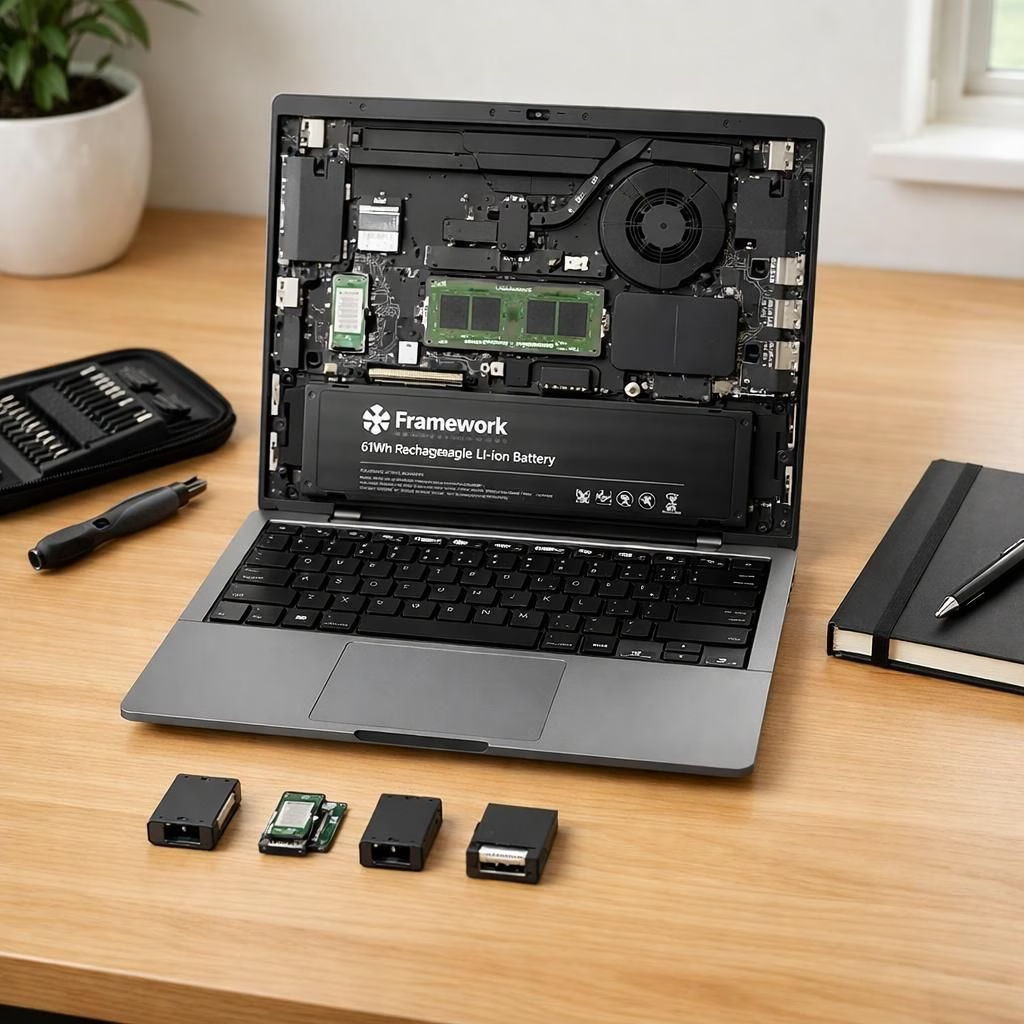
As the tech world pines for ever-smaller gadgets, the Framework Laptop Pro arrives with a defiant, framework-inspired ethos: repairable, modular, and delightfully non-disposable. It’s the kind of machine that makes you smile at the idea of swapping a RAM stick rather than an entire motherboard, and it stakes its claim on open hardware without shame. In this article, we explore what makes this laptop different, why Linux fans cheer, and how it nudges the industry toward kinder, more durable design. For readers who value a framework ethos in everyday tech, this is the kind of device worth considering.
Framework-Ready: A Laptop That Dares to Be Open
In practice, the Pro edition leans on a philosophy where the chassis opens like a tiny, well-behaved library. Tool-free access panels, clearly labeled modules, and a user-friendly teardown guide invite you to Upgrade Sunday without calling in a tech support squad. Yes, you can swap storage, memory, and wireless modules without wrecking your day. The idea is not to create a rugged showpiece but a reliable everyday tool that ages with your needs, rather than forcing you to trade in every two years; repairability helps reduce waste and aligns with a practical policy for people who like to upgrade their own machines.
For the framework ethos, this is more than a gimmick. It’s a statement that hardware should be readable, extendable, and respectful of your time. The keyboard remains comfortable, the keyboard’s feel is consistent, and the chassis is designed to handle a few scratches without confessing defeat. The modular approach means you aren’t stuck with one spec forever. If your storage needs shift from a few hundred gigabytes to terabytes after a year, you can accommodate that need without buying a whole new laptop. That’s the sort of long-term planning most manufacturers tease but rarely deliver, and it’s a breath of fresh air in 2026.
Laptop-Modularity: Linux, Open Hardware, and Honest Design
Let’s be clear: Linux users, developers, and tinkerers have often faced a laptop that pretends to be open but is mostly close-minded about firmware, drivers, and boot options. The Pro laptop from Framework flips the script. It boots with minimal proprietary baggage, offers documented firmware interfaces, and promises a more transparent upgrade path. You can install Linux distributions with less gnashing of teeth than you might expect, and you can tailor your setup without wrestling with a stubborn, Windows-first bootloader. This is not a marketing line; it’s a real difference that shows up when you run a distro with full-disk encryption, a modern compositor, and a kernel module you compiled yourself to support new hardware. The result is a laptop that behaves like a platform rather than a purchase you outgrow in a single quarterly cycle.
Two things stand out here: first, the attention to modularity means you won’t fear an accidental spill ruining a motherboard, since you can swap affected parts rather than the entire system. Second, the repairability makes the laptop less of a “luxury appliance” and more of a “workhorse you can lean on.” We’ve all grown weary of laptops that trade repairability for sleeker curves; Framework flips that equation by giving you practical options that remain beautiful in a quiet, understated way. The Pro edition doesn’t pretend to be a gaming monster, but it earns its keep by making maintenance straightforward, letting you keep a dependable laptop for the long haul. This is the laptop you’d recommend to a friend who hates waste and loves the idea of a device you can fix with a screwdriver and a smile.
The broader tech culture could learn from this approach: build devices that are easy to take apart, easy to upgrade, and easy to live with. Yes, the idea of a laptop that you can repair without taking out a loan sounds almost quaint in 2026, but that’s precisely why it’s compelling. The Framework Laptop Pro is a reminder that repairability, openness, and user autonomy aren’t relics from the age of CRTs; they’re practical tools for contemporary work, learning, and tinkering. If you’re someone who saves receipts, tracks component warranty cards, and occasionally prints out a manual just so you can feel in control, you’ll recognize the appeal instantly.
In short, this is a laptop designed for the real world: it’s upgradeable, serviceable, and thoughtful about how people actually use machines. It doesn’t pretend to solve every problem—batteries still wear out, ports occasionally misbehave, and software can be stubborn—but it offers a clearer path to resolution. If your goal is to avoid the wasteful cycle of buying a new device every couple of years, this is a model worth examining closely. It’s not a fantasy; it’s a practical statement about what modern hardware could look like, if we prioritised repairability as a feature rather than an afterthought.
Of course, no product exists in a vacuum. The Framework Laptop Pro sits in the tradition of open-hardware advocates who insist that you deserve to know what’s inside and how it all fits together. The design invites curiosity and experimentation, without turning the user into a certified engineer. If you’ve ever opened a laptop and found a gadget you could not identify, you’ll appreciate the deliberate, modular approach here. It’s a small revolution, but it’s the kind of incremental shift that changes how we think about devices in the long run.
Jaywalking between the worlds of Windows and Linux is rarely elegant. The Pro laptop, in keeping with its Linux leanings, makes it easier to choose your own desktop philosophy. It’s not about forcing a single path; it’s about offering options that respect your preferences and your time. In a year that promises more portable tech than ever, having a reliable, repairable, modular laptop is not simply a novelty—it’s a practical necessity for many power users who want to invest in something that won’t feel obsolete at the end of a motherboard’s warranty window.
So if you’re hunting for a laptop that treats software as a choice, hardware as a partner, and repairability as a feature rather than a marketing line, the Framework Laptop Pro deserves a closer look. It’s the sort of machine that asks you to dare to tinker, to prefer serviceable over disposable, and to value the kind of ownership that makes you feel accomplished when you replace a tiny module instead of tossing the whole thing.
Have thoughts? Share them in the comments below—we’d love to hear how you’d approach a modular laptop in 2026, what Linux distribution you’d pair with it, and what other open-hardware ideas you’d like to see scaled up across the industry.
Original article attribution: Special thanks to Gizmodo for the original reporting on Framework’s New Ultra-Repairable ‘Pro’ Laptop Lets You Ditch Windows Entirely. Read the original article here: Framework’s New Ultra-Repairable ‘Pro’ Laptop Lets You Ditch Windows Entirely.
Practical notes & quick-start
- Assess your typical workloads and confirm the storage and RAM you’ll need over the next 3–4 years.
- Plan upgrades with the modular framework in mind: consider which modules are most cost-efficient to swap as technology evolves.
- When dual-booting or installing Linux, ensure you have a current backup and a fallback plan for firmware updates.
FAQ
- Is Framework Laptop Pro truly Linux-friendly out of the box?
Yes. It ships with a minimal bootloader and documented firmware interfaces that make Linux installations smoother than many modern laptops. - Can I upgrade the RAM and storage myself?
Yes. The design emphasizes tool-free access to modules, allowing straightforward upgrades without professional help. - Is repairability worth the price premium?
That depends on your long-term plans. Over years, modular components can reduce waste and total cost of ownership, especially for power users who upgrade intentionally.