

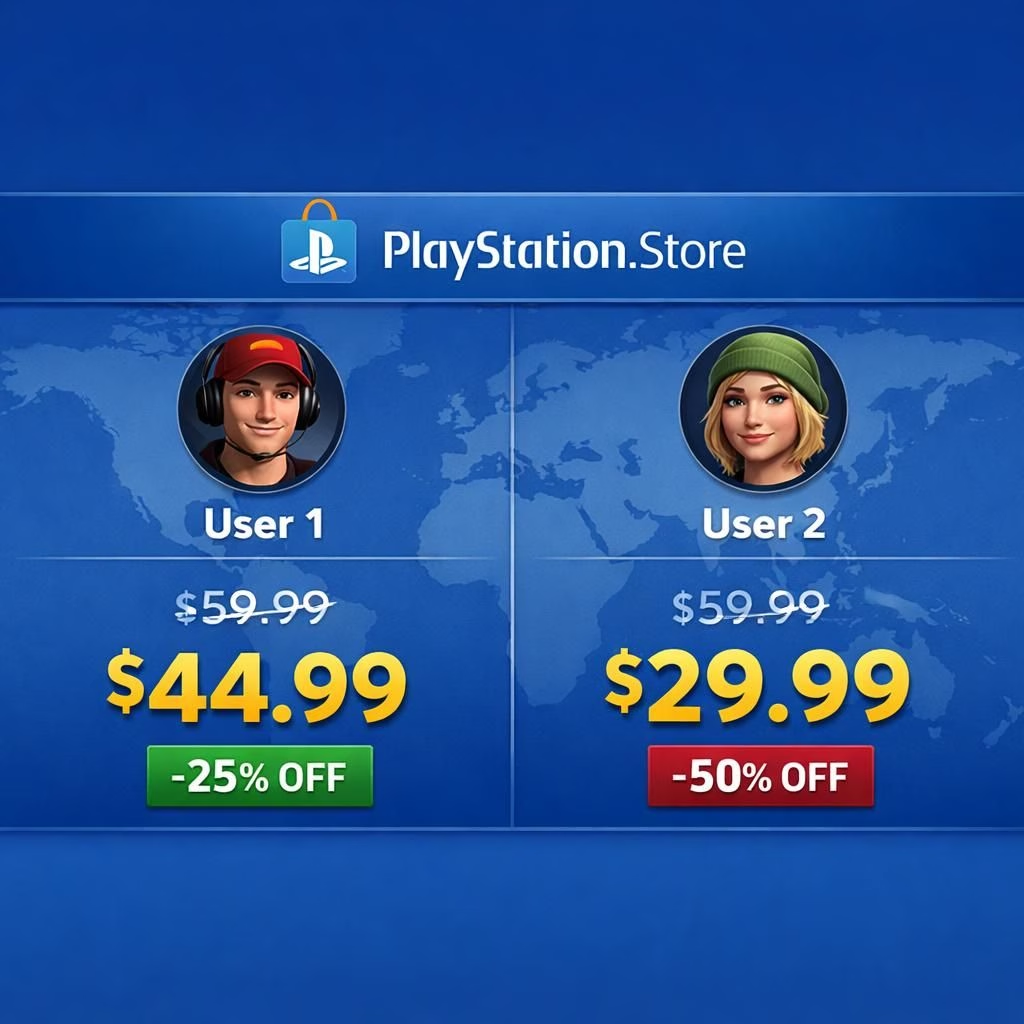
Welcome to the curious case of dynamic pricing on the PlayStation Store, as tracked by [PSprices](https://www.geekyopinions.com/tag/PSprices). The researchers at [PSprices](https://www.geekyopinions.com/tag/PSprices) spotted experiment markers in the PlayStation API, including IPT_PILOT and IPT_OPR_TESTING, and the tests span more than 150 games across 68 regions. For now, Sony appears to offer discounts to a subset of users, ranging from 5 to 17.5 percent, with the United States not part of this round. This is a controlled price experiment rather than a broad price hike.
dynamic pricing in the PlayStation Store: a PSprices case study
The notion of dynamic pricing is familiar, but the setting here is unusually public. [PSprices](https://www.geekyopinions.com/tag/PSprices) reports that the dynamic pricing experiment covers more than 150 games across 68 regions. The US is absent from this round, which keeps things interesting for shoppers who travel or shop with different accounts. In practice, selected players see discounts that feel like a secret doorway: 5 percent, 10 percent, or as much as 17.5 percent on titles such as Spider-Man 2, God of War, and Red Dead Redemption 2. The aim by [PSprices](https://www.geekyopinions.com/tag/PSprices) appears to be learning which discounts resonate and how price perception shifts as players explore the catalog. It is not a universal price change, but a targeted trial that should illuminate buyer behavior over time.
PSprices notes on A/B testing: who gets discounts and why
[PSprices](https://www.geekyopinions.com/tag/PSprices) tracks the A/B testing labels IPT_PILOT and IPT_OPR_TESTING to understand who receives discounts and how quickly the tests roll out. The A/B testing framework seems to grant discounts to a slice of users while others see different price points, creating a social experiment in plain sight. The practical effect: some neighbors may see different prices for the same game, a situation that could feel odd unless players know the conditions of the test. This is not a policy shift; it is a learning phase, and Sony has yet to offer a formal comment on the rollout as of 2026.
PSprices and A/B testing in the 68-region map
The regional footprint is a key feature here. Sixty-eight regions are involved, and the US remains out of sight for now. This geographic spread matters for players who cross borders or compare prices across accounts.
For the PlayStation Store, the outcome is less about universal savings and more about conducting a practical experiment. The discounts, though modest, can influence shopping behavior, encourage more frequent visits, and nudge players toward trying titles they might otherwise skip. In the larger picture, dynamic pricing becomes a data story about elasticity, perception, and the friction of price differences among friends who talk shop after a session of co-op missions. [PSprices](https://www.geekyopinions.com/tag/PSprices) frames the situation as a learning exercise, not a sweeping policy, and that nuance matters for players and industry watchers alike.
Two notable PSprices examples and what they illustrate
Consider a Civilization VII case where one player sees a 25 percent discount while another sees 10 percent. Such gaps highlight the lived reality of dynamic pricing: it can feel personal and uneven even when the intent is to optimize engagement. [PSprices](https://www.geekyopinions.com/tag/PSprices) notes this as an early-stage study rather than a definitive plan, and Sony has not issued a formal public statement yet. The pattern remains consistent: a measured experiment, a cautious approach, and a lot of data to collect before any public-facing policy emerges.
Meanwhile, blockbuster titles like Spider-Man 2, God of War, and Red Dead Redemption 2 appear in the test set with attractive but varying discounts, depending on the user segment. For players, this means staying mindful and curious about how price signals shape choices and throughput in the catalog.
For 2026, the PlayStation Store seems to favor a methodical path: run controlled discounts in a broad but not universal way, collect signals, and adjust as needed. Dynamic pricing can be a friendly feature when transparent, predictable, and clearly labeled, not a wall of mystery behind which prices drift invisibly. [PSprices](https://www.geekyopinions.com/tag/PSprices) reporting makes this nuance clear: the store tests are about learning, not about locking in new prices for every user.
As always, your thoughts matter. Please share your perspective on dynamic pricing on the PlayStation Store, the role of [PSprices](https://www.geekyopinions.com/tag/PSprices) in flagging A/B testing, and what you would hope to see in a transparent discount program. A big thank you to PSPrices for the original material and insights that inspired this rewrite: PSPrices original article.
Special thanks to [PSprices](https://www.geekyopinions.com/tag/PSprices) for the original analysis and insights that inspired this rewrite.
Written with a light touch and a nod to the data, and always in the spirit of constructive discussion. If you enjoyed this, please consider sharing your thoughts in the comments below.