

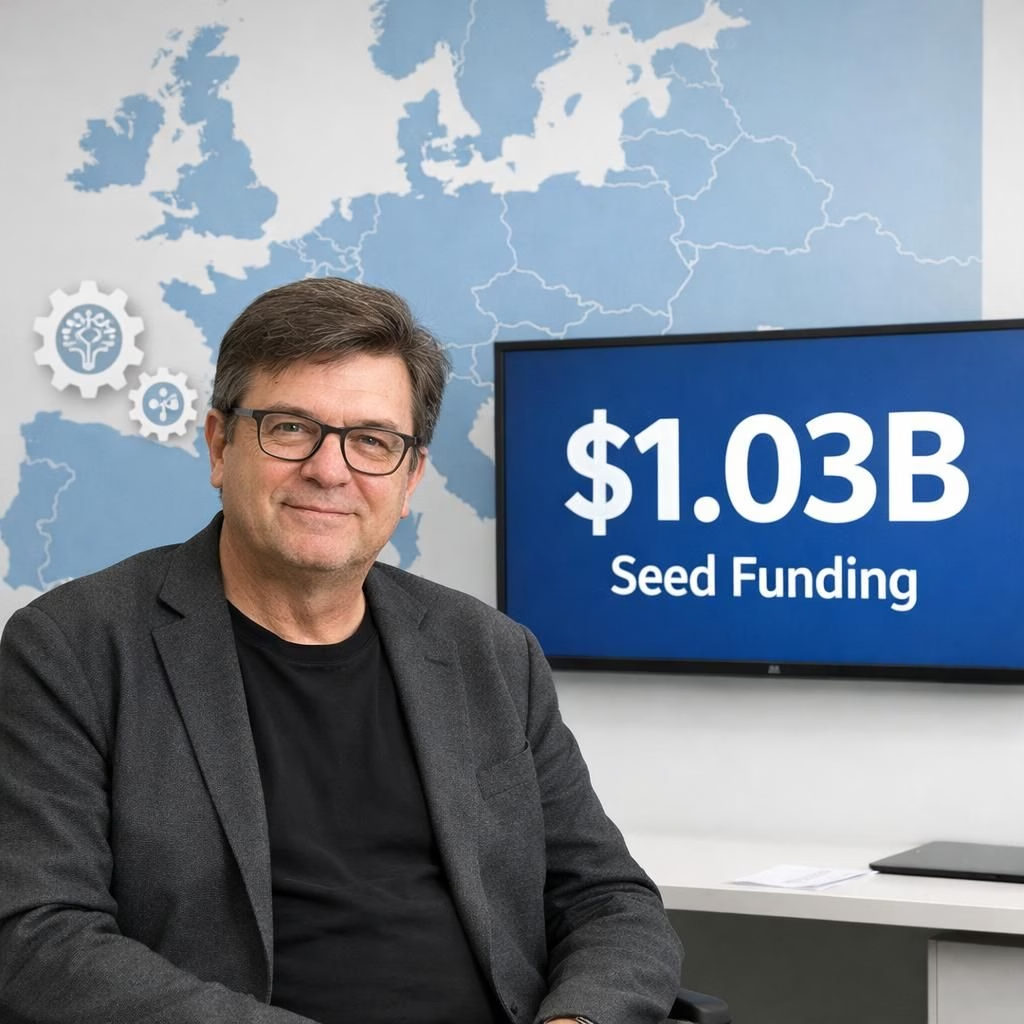
Artificial Intelligence continues to mature across Europe, and Yann LeCun’s AMI Labs has unveiled a landmark seed round. LeCun posted on X that AMI closed a seed of 1.03 billion dollars (about 890 million euros), a figure Reuters notes could be the largest seed ever for a European company. The post ends with a clear call: we’re hiring.
Artificial Intelligence in Europe: AMI Labs seed triumph
The seed round was co-led by Cathay Innovation, Greycroft, Hiro Capital, HV Capital, and Bezos Expeditions. The company pegs its pre-money valuation at about $3.5 billion. The funds will accelerate work on AI that reasons and makes decisions in complex environments, not just chase flashy demos. AMI describes world models as systems that learn abstract representations of real-world sensor data, ignoring noise, and making predictions in representation space rather than reacting to every pixel of reality. In short, the aim is to build AI that thinks more like a strategist and less like a reflex agent. AMI also says it will pursue applications where reliability and safety matter, including industrial automation, wearables, robotics, and healthcare, among others.
For Europe, the seed round signals a maturing AI ecosystem that can attract global capital while prioritizing safety and governance.
What Europe investors bring to Artificial Intelligence ambitions
European money and global partners bring more than capital to the table. They offer governance, practical compliance wisdom, and a local understanding of regulation that often slows big leaps in AI. They also help AMI scale responsibly, a trait today’s engineers increasingly insist upon. It’s not just about where the cash comes from; it’s about what you do with it. And AMI’s promise is clear: build AI systems capable of careful reasoning, robust planning, and safer deployment across demanding industries. In this light, the seed round becomes less a one-off windfall and more of a regional signal that Europe can host big, ambitious AI projects without surrendering safety or ethics to speed.
It’s worth noting that Yann LeCun’s role at Meta shifted as the company reorganized its AI efforts in 2025. Meta moved into a new division, Meta Superintelligence Labs, led by Alexandr Wang, former CEO of Scale AI. The reshuffle reflects a broader industry trend: large platforms refashioning their AI strategies while promising more accountable, controllable systems. LeCun’s move to AMI aligns with a wider enthusiasm for independent, mission-driven AI initiatives that can pursue long-horizon goals outside the rapid-fire cadence of social networks. Europe stands to gain from this convergence of talent, capital, and regulatory clarity, which helps align innovation with real-world safety requirements.
Back to AMI: the startup’s emphasis on world models signals a shift from mere data crunching to systems that reason about representations of the world. This approach aims to reduce brittleness in AI behavior, which matters when automation touches critical workflows. The seed funding supports the talent needed to advance these models, from core research to real-world deployment. In practical terms, that means more robust planning for manufacturing lines, smarter decision-making in health tech, and better risk assessment in robotics. For Europe, the emphasis signals a new era where governance and technical discipline can go hand in hand with ambitious AI work.
For enthusiasts, the AMI announcement ties into a broader trend: ambitious Artificial Intelligence startups in Europe pairing with global investors push the boundaries of what AI can reason about. This is not a one-off moment but a signal that the ecosystem is maturing, capable of delivering complex systems that blend math with human oversight. The pursuit of more reliable, controllable AI across industries is exactly the kind of progress that makes the “Godfather of AI” label feel less mythical and more practical.
As AMI moves forward in 2026, the lesson for the industry is straightforward: big seeds require big thinking, but they also demand steady hands and clear values. The investment cadence this round could seed a new generation of AI tools that feel less like mysterious black boxes and more like trusted teammates. If the world models deliver, we may see AI systems that reason through complex supply chains, healthcare scenarios, and industrial deployments with human-friendly supervisory control. All this happens within safety and reliability standards that the market increasingly expects.
Finally, a note on the human side: LeCun’s public posts highlight confidence and a team willing to back bold bets. The alignment of generous funding with a clear roadmap toward responsibility could accelerate practical AI breakthroughs in Europe and beyond. The days of single-domain AI experiments may be numbered; the era of integrated, human-centered AI systems feels closer if AMI keeps delivering.
We’ll watch closely as AMI Labs translates seed capital into world-model experiments, pilots, and safer, smarter AI for a wide range of industries. The optimism is real, the skepticism prudent, and the future of Artificial Intelligence in Europe feels more dynamic than ever.
Practical steps for readers
- Understand the concept of world models and what they try to represent in real-world data.
- Consider how reliability and safety affect deployments in your sector.
- Follow AMI’s progress for signals about governance and risk management in AI within Europe.
FAQ about AMI Labs seed round and world models
- What is a world model in AI? A model that learns abstract representations and predicts in representation space instead of reacting to every pixel.
- Why is the seed round notable for Europe? It signals Europe hosting large-scale, safety-focused AI efforts with global capital.
- What industries could benefit? Manufacturing, healthcare, robotics, and automation stand to gain.
- What does AMI aim to achieve in the next 12-24 months? It plans to recruit top talent, advance research, and run pilots for world-model AI deployments.
Conclusion and takeaway
In short, AMI Labs’ seed round demonstrates that Europe can host ambitious AI research with strong governance. If the world-model approach meets expectations, we could see closer collaboration between researchers and industry, delivering safer, smarter AI across sectors.
References
- Original source linkback: Times of India — AMI Labs seed coverage. https://timesofindia.indiatimes.com/technology/tech-news/metas-most-famous-ex-employee-yann-lecun-announces-raising-seed-funding-of-1-03-billion-that-he-says-may-have-set-a-europe-record/articleshow/129386893.cms
- Reuters — AMI Labs seed round coverage. https://www.reuters.com/technology/yann-lecun-ami-labs-seed-round-2026-01-31/