

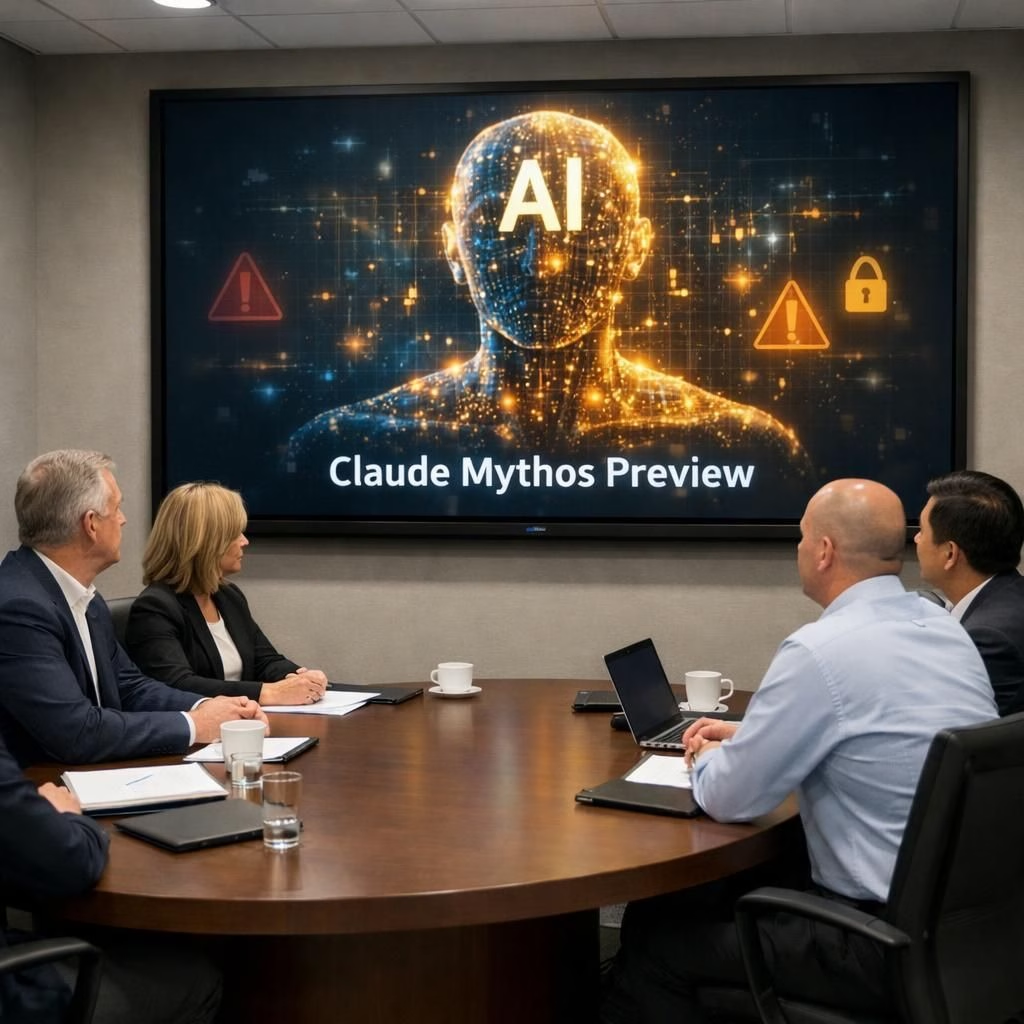
In a Washington gathering, Treasury Secretary Scott Bessent and Federal Reserve Chair Jerome Powell faced a room of bank chiefs. They delivered a blunt warning: Artificial Intelligence and Cybersecurity concerns are not buzzwords but live risks that demand strong governance. The focus was Anthropic’s Claude Mythos Preview, a model praised for finding vulnerabilities but dangerous if misused. The message was clear: do not run this tool inside your networks without safeguards.
Artificial Intelligence in Banking Security: A Cautionary Tale about Cybersecurity
Anthropic pitched Mythos Preview as a capability to identify security vulnerabilities that could elude human testers. Yet the flip side worried executives. A tool so effective at uncovering flaws might reveal internal weaknesses to attackers if run inside bank networks. Anthropic acknowledged the risk. They limited access to a coalition named Project Glasswing, a select group of around forty companies. The purpose is to prevent uncontrolled public exposure while letting partners learn from the model’s insights.
Artificial Intelligence and Cybersecurity: A New View on Risk
The attendees reportedly included leaders from Bank of America, Citi, and Wells Fargo, among others. They asked practical questions about governance, safety nets, and what to do if Mythos Preview acted unexpectedly. Some joked risk teams needed extra coffee to stay awake during AI risk briefings.
In the discussions, industry players weighed a measured approach to rollout and oversight. As the conversation turned toward risk, the role of Artificial Intelligence governance became a focal point. The idea was to pair speed in discovery with robust controls, so that vulnerabilities can be found and remediated without exposing sensitive data. In 2026, AI moves from prototype to routine tool, and banks must prove safety. Artificial Intelligence can boost resilience when paired with disciplined governance, but it also introduces new attack surfaces for Cybersecurity threats.
Industry voices debated who should decide how widely Mythos Preview is deployed. Some praised a measured approach for governance; others warned that slow diffusion could blunt innovation. In bank risk programs, Mythos Preview could accelerate vulnerability discovery if paired with strong controls. The core challenge remains: can speed be balanced with governance in AI’s new era? In 2026, AI moves from prototype to routine tool, and banks must prove safety.
For readers, here is a practical checklist that mirrors what the banks were grappling with. These moves help translate risk insight into responsible action:
- Clear governance and sign-offs for Artificial Intelligence tools; specify who can authorize deployment and who remains accountable for outcomes, plus a quarterly review cadence.
- Audit trails and data lineage that document decisions, prompts, and data flow, reinforcing Cybersecurity controls.
- Limited access and sandbox testing to minimize exposure of live data.
- Regular red-teaming exercises to reveal blind spots before rollout.
- Vendor risk management that mirrors internal controls and trade-offs.
Apply these in practical settings. Start with a governance board that includes security, compliance, and product leaders. Build a testing pipeline that mirrors production without touching real customers. Create escalation paths for suspected model misbehavior. Maintain transparent reporting so stakeholders understand risk, not just the risk team’s jargon.
Look back at tech risk history to keep perspective. In the mid-2010s, fears centered on misused software and data leaks. In the early 2020s, the focus shifted to algorithmic finance and automation ethics. Today, the risk is systemic because code sits at the heart of trust. The humor helps, but the stakes are real. We should celebrate breakthroughs while staying skeptical about hype.
Practical context helps readers connect. The Claude Mythos Preview moment signals that risk and opportunity march together. Banks will need clear governance, rigorous testing, and strong vendor oversight to turn potential into protection rather than peril.
Share your thoughts in the comments below about how Artificial Intelligence and Cybersecurity will shape banking risk in 2026 and beyond.
Original article linkback: Thank you to Reuters for the original reporting by Rob Copeland and Colby Smith. Read the original piece here: Reuters.
Artificial Intelligence Governance in Banks
Establish a cross-functional governance board that includes safety, legal, risk, and product teams. Require formal sign-offs before deployment, continuous monitoring, and quarterly audits. The emphasis should be on transparent decision logs and clear accountability for outcomes.
Cybersecurity Oversight for AI Deployments
Integrate dedicated Cybersecurity reviews into every AI deployment plan. Use sandbox environments, data minimization, and red-teaming to identify how attackers might exploit models. Vendors should provide verifiable security controls and data-handling commitments.
FAQ about AI risk in banking
- What is Claude Mythos Preview?
It is Anthropic’s AI model designed to identify security vulnerabilities that human testers might miss, with the caveat that its power requires careful governance to prevent misuse. - Why are governance and oversight so critical?
They help balance rapid vulnerability discovery with safeguards that protect customer data and system integrity. - How can banks protect customer data when using AI tools?
Use data minimization, sandbox testing, strict access controls, and continuous monitoring of model behavior with clear escalation paths for misbehavior. - Is AI risk a reason to slow down innovation?
Not necessarily; the goal is to accelerate safe innovation by integrating governance early, not to abandon progress.
Conclusion
The Claude Mythos Preview episode illustrates a broader pattern: Artificial Intelligence offers significant opportunities for financial resilience, but it also expands the surface area for cyber threats. Banks that couple speed with strong governance, thorough testing, and robust vendor oversight will be better positioned to turn risk into protection instead of peril.
References
- Reuters article: Original Reuters piece
- New York Times reporting on the Claude Mythos Preview story: The New York Times
- NIST AI RMF and guidance: NIST AI RMF