

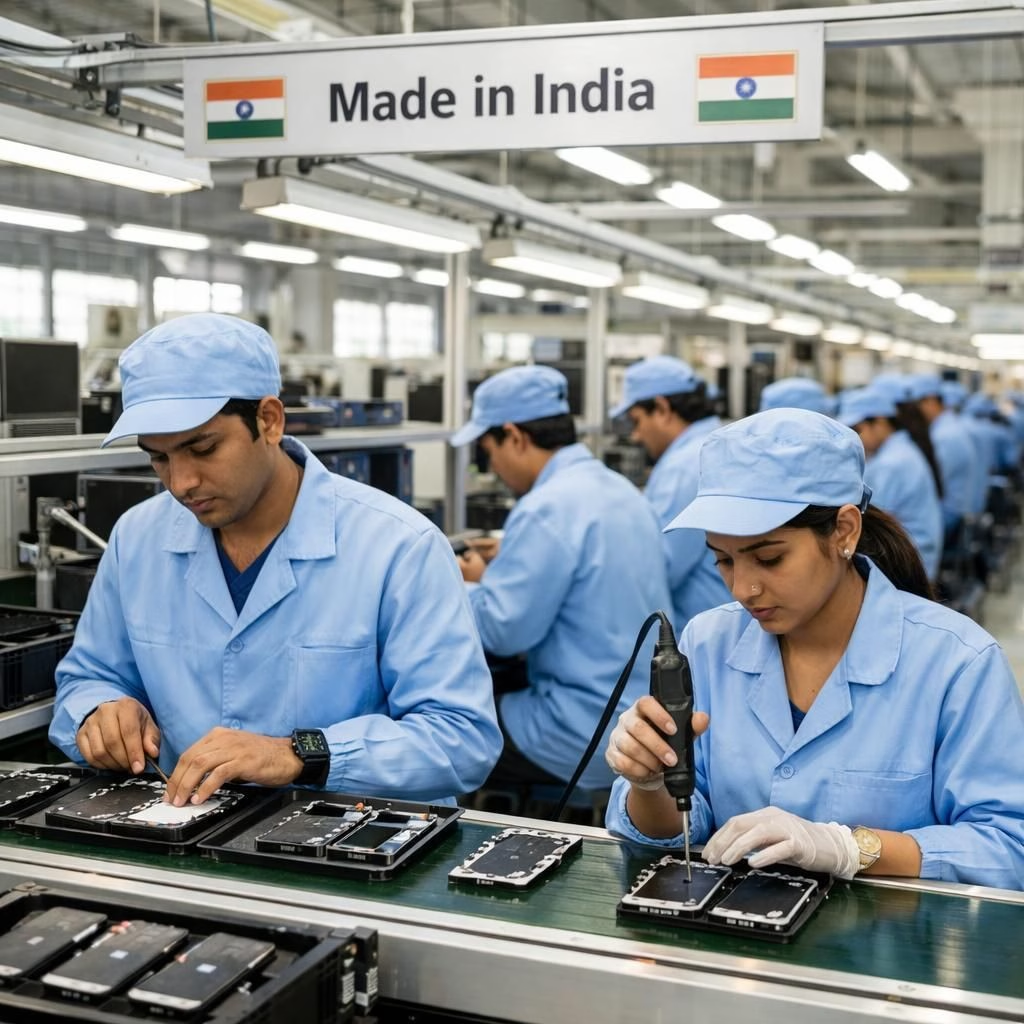
In 2025, Apple pressed the gas on iPhone India production, lifting output roughly 53 percent to about 55 million units as the company accelerates its pivot away from China amid ongoing US tariff pressures. The move is driven by a mix of bold policy signals—Manufacturing incentives ushered in by the Modi administration—and Apple’s own demand for a more resilient supply chain. The result is a clearer picture of a global fortress built not from brick and mortar alone, but from a factory floor that spans borders and currencies. With iPhone India at the heart of this strategy, Apple is recalibrating risk while keeping customers in mind.
iPhone India grows as the pivot point
Apple ramped up iPhone India production dramatically. In 2025 it assembled about 55 million units—up from 36 million in 2024—according to Bloomberg. All iPhone 17 variants—including Pro and Pro Max—are now made in India for the first time, a milestone that signals iPhone India is no longer a sideshow but a core engine of Apple’s global strategy. Foxconn, Tata Electronics, and Pegatron continue to build older models like iPhone 15 and iPhone 16 for domestic and export markets, reinforcing a multi-player ecosystem around iPhone India that keeps the line moving when tariffs loom or currencies wobble.
Manufacturing incentives shaping the playbook
The 2026–27 Union Budget’s five-year income tax exemption on foreign manufacturing equipment for Indian contract manufacturers gives Apple and its partners a fresh runway. This policy—part of the broader Manufacturing incentives framework—aims to offset higher local costs and attract more sophisticated machinery. The incentives, paired with a growing Indian supplier base, have drawn Foxconn, Tata Electronics, and Pegatron deeper into India’s assembly scene, and they open doors to potential new ties with CG Semi for display chips in Gujarat. The Manufacturing incentives are not a magic wand, but they tilt the cost curve in favor of India relative to other regions.
iPhone India and the US-shipment shift
Canalys data shows India overtook China in the April–June 2025 quarter as the top source of smartphones shipped to the US, capturing about 44% of the market while China slipped to roughly 25%. Foxconn’s India operations shipped about $4.4 billion worth of iPhones to the US in the first five months of 2025, more than the entire 2024 haul, according to Reuters. Apple even chartered cargo flights in March 2025 to move roughly $2 billion worth of iPhones from Chennai to beat looming tariff deadlines, a dramatic reminder that supply chains can be as strategic as any product roadmap.
Manufacturing incentives and the broader value chain
India’s role is expanding beyond final assembly. In the 2026–27 Budget, the government’s five-year tax exemption for foreign equipment helps Apple’s collaborators by reducing the fiscal sting of high-end machinery, and it signals a longer-term commitment to local value addition. Apple is also in early talks with Indian chipmakers, including CG Semi (Murugappa Group), to assemble and package display chips in Gujarat—an early test of domestic chip capability that could further deepen the local ecosystem around iPhone India. Despite progress, India still incurs higher production costs than China and Vietnam, and current subsidies expire on March 31, 2026. The policy landscape will need updates to sustain momentum, but the direction remains clear: a more diversified, regionally balanced supply chain is on the horizon, with Manufacturing incentives acting as a catalyst rather than a one-off perk.
Beyond the headlines, the people and processes matter. Tata Group has emerged as a major player, with its plants expected to account for up to half of India’s iPhone output over the next two years, according to earlier Bloomberg reporting. Foxconn, Pegatron, and Tata Electronics continue to produce older models for domestic sales and exports, but the real story is a shifting map of partnerships that centers iPhone India as a hub for both assembly and expanding value chains. This is not mere relocation; it is a strategic reorientation toward a more resilient, localized, and responsive production system that can weather tariffs and geopolitical shifts without collapsing into chaos.
From the policy angle, the five-year tax exemption on manufacturing equipment stands out as a practical lever. It aligns with Apple’s interests and helps fund capital investments that push the envelope on local production. And as Apple partners with Indian chipmakers to explore display-chip assembly in Gujarat, the $ news of innovation becomes a tangible plan rather than a talking point. The juxtaposition of capital incentives and operational gains creates a storyline where Manufacturing incentives and iPhone India appear in the same sentence more often than not, signaling a longer-term trend rather than a one-year blip.
To readers who enjoy the bite-sized version: India is moving from a peripheral role to a central, collaborative one in Apple’s global production network. The shift is incremental but meaningful, driven by policy choices, supplier diversification, and a market willingness to localize more of the value chain. The next cycles will reveal how quickly India can narrow cost gaps and how much of Apple’s future iPhone output settles into this new, distributed ecosystem. If you have thoughts on this shift, share them in the comments below and join the conversation.
Original article attribution and thanks: This analysis builds on reporting from Bloomberg and Reuters, whose deep dives into Apple’s India strategy helped shape this rewrite. Original article: Bloomberg News coverage ( thanks for the foundational reporting ) — https://www.bloomberg.com/
Practical steps for readers
- Monitor policy updates on manufacturing incentives and how they affect local production costs.
- Track quarterly iPhone India output to gauge the health of the supply chain.
- Watch for new supplier partnerships in Gujarat and other states as the ecosystem grows.
- Consider broader implications for global trade and how tariff timelines influence manufacturing choices.
FAQ
- What does this shift mean for iPhone pricing in India? Incentives can help contain costs, but pricing depends on multiple factors, including component costs, currency movements, and demand.
- Will Apple move more manufacturing away from China to India? The company is expanding in India, but diversification is ongoing and depends on policy, logistics, and supplier readiness.
- When do incentives expire? Current subsidies are set to expire on March 31, 2026, with potential updates to extend support if policy priorities shift.
- What are the risks to this strategy? Global tensions, supply chain bottlenecks, and cost gaps remain challenges even as the ecosystem builds.
Conclusion
India is moving from the periphery toward a central, collaborative role in Apple’s global production network. The shift is incremental but meaningful, driven by policy choices, supplier diversification, and a willingness to localize more of the value chain. The next cycles will reveal how quickly cost gaps narrow and how much of Apple’s future iPhone output settles into this distributed ecosystem.
References
Original source: https://timesofindia.indiatimes.com/technology/tech-news/iphone-production-in-india-jumps-53-in-2025-apple-now-assembles-all-versions-of-iphone-in-the-country/articleshow/129377415.cms