

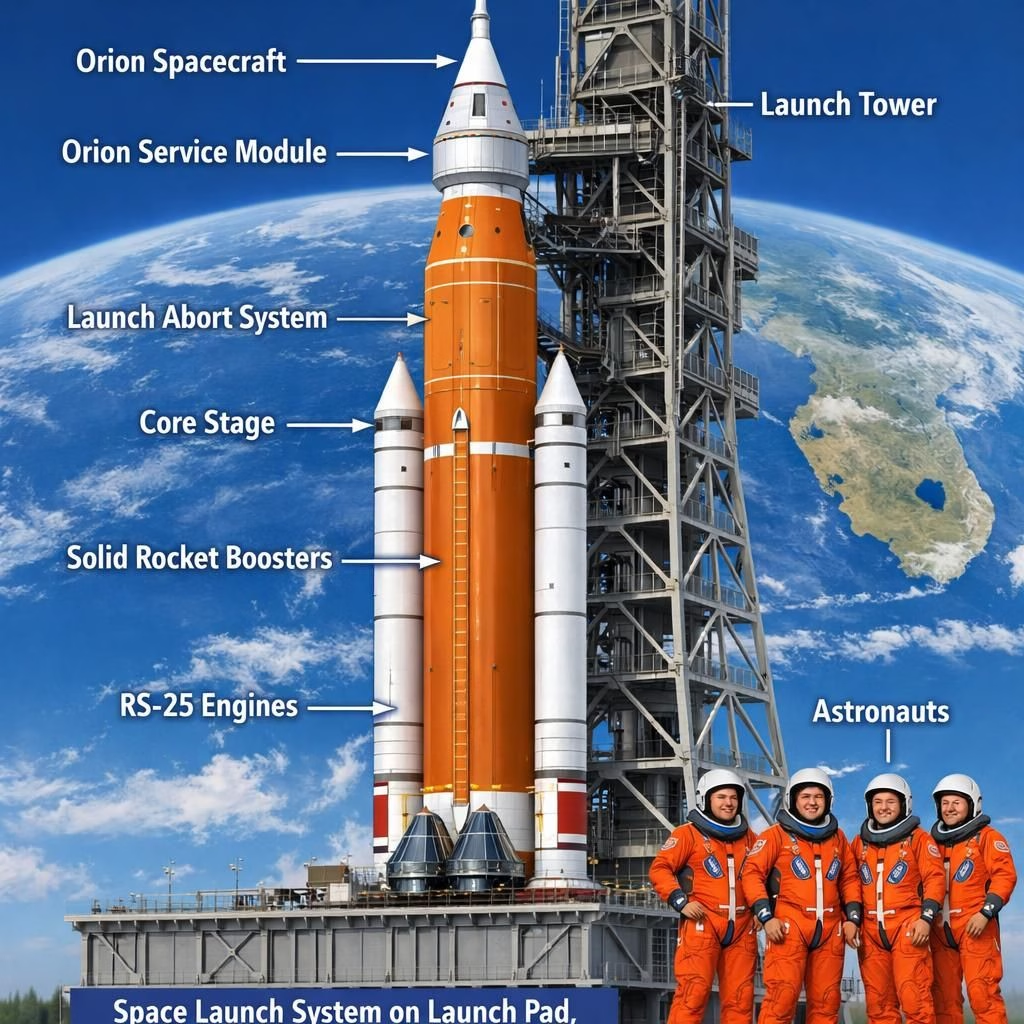
Artemis Moon moves from headline to practical experiment as NASA and partners run careful, nerdy drills toward long-term lunar life. Artemis, with a Moon focus, aims to prove life-support, navigation, and comms work reliably in deep space. This milestone isn’t a fireworks display; it’s a practical blueprint for housing, experiments, and snacks aboard the Moon‘s orbit. Artemis II launches in 2026 and tests the Orion spacecraft and four crewmates before any lunar landing; the crew includes commander Reid Wiseman, pilot Victor Glover, Christina Koch, and Jeremy Hansen.
They will travel about 400,000 kilometres on a free-return path and loop around the Moon for roughly ten days.
In practical terms, Artemis II works like a big dress rehearsal. The crew polishes procedures, the vehicle proves resilience, and mission control tunes its nerves.
Along the way, NASA and partners will test essential life-support systems, spacecraft navigation, and Earth communication. The mission will reveal how astronauts manage health, stress, and time in deep space, and it will show whether Orion can handle surprises with composure.
- Life-support systems are sustained and monitored for long-duration missions.
- Navigation accuracy and deep-space communication with Earth stay reliable on a moving platform.
- Human performance data helps refine crew selection and training for future missions.
- Free-return trajectory provides a safety net while enabling meaningful data collection.
This phase is a proof-of-concept that paves the way for more daring Moon missions while keeping risk in perspective.
Artemis Moon Awakens: new era in lunar exploration
When we say Artemis Moon approaches the Moon with a purpose, we mean it. The mission doubles as a rigorous systems test and a public-relations exercise that respects science and curiosity in equal measure. For the crews and engineers, it’s a daily puzzle solved with teamwork, precision, and a touch of humor about gravity. This is how a serious program stays accessible and exciting at the same time.
In deep-space planning, reliability matters more than romance. Still, the Moon offers a cosmic backdrop that makes the checks feel almost cinematic. The Orion systems must perform in vacuum, temperature swings, and space radiation, while the crew demonstrates that training translates into confident, calm operations thousands of kilometers from Earth.
Moon Milestones: Artemis leadership charts the journey
These milestones carry both symbolism and practical value. Koch becomes the first woman to travel to lunar space, a Moon milestone in Artemis history. Glover becomes the first Black astronaut to orbit the Moon, highlighting progress as a real, measurable outcome. Hansen becomes the first Canadian to circle the Moon, underscoring that space work remains a cooperative, multinational effort. Beyond optics, these milestones remind us that teamwork across agencies and borders underpins sustainable space exploration. Artemis II’s data and experiences feed directly into Artemis III’s plan to land near the Moon‘s south pole later in the decade.
What this means for the future of lunar exploration
The mission translates to practical impact on how we build, test, and plan the Moon habitats, resource utilization, and surface operations, shaping a sustainable road map for the Moon. If Orion demonstrates resilience, NASA and partners can accelerate the schedule for subsequent crewed Moon operations while keeping safety as the top priority. The broader takeaway is a blend of disciplined engineering and optimistic curiosity—two traits that have always defined human spaceflight.
As we track this mission in 2026, the mood blends excitement with pragmatic optimism. Artemis shows that big ideas succeed when teams communicate clearly, test relentlessly, and maintain a sense of humor about gravity. We celebrate international cooperation and the human drive to explore. Tell us your thoughts in the comments below and join the conversation about Artemis, Moon and the future of space exploration.
Original article and thanks: NASA Artemis II launch coverage. Thank you for the original source material: https://www.nasa.gov/artemis-ii.
External sources: NASA Artemis II official page and Artemis program overview.