

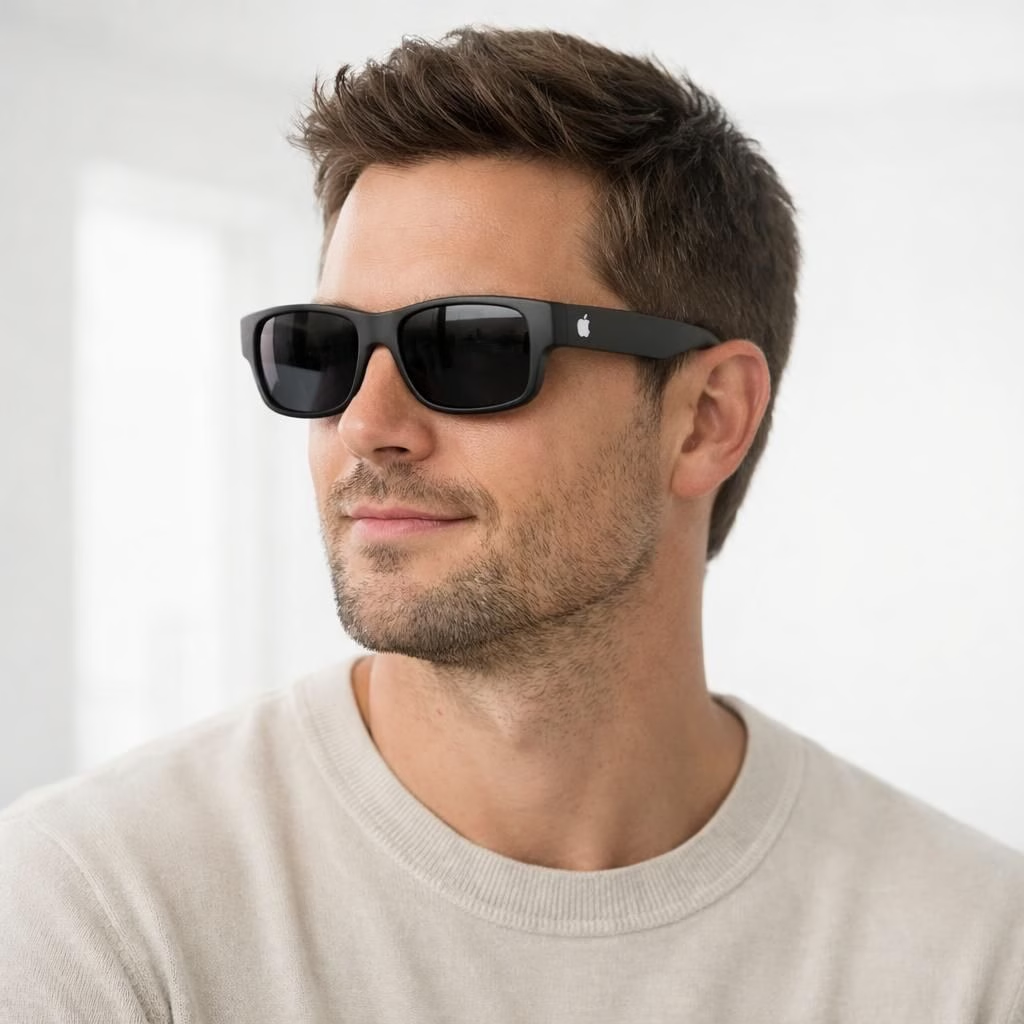
Apple is turning its legendary obsession with sleek hardware and tight software into a bold bid for the global glasses market. This isn’t a gadget drop or a quick fashion stunt; it’s a full-on attempt to turn everyday glasses into a connected experience that sits right in front of your eyes. Apple glasses would fuse iPhone integration, AI smarts, and health insights into a single, wearable daily companion that might actually make your existing frames feel boring.
The playbook mirrors a past success: enter a mature consumer category, weave the product into the iPhone ecosystem, and watch incumbents rethink how they monetize the space. The goal is to dethrone the dominance of entrenched players like EssilorLuxottica (Ray-Ban, Oakley, Persol, Oliver Peoples), Safilo, and Warby Parker. And yes, glasses from Meta’s Ray-Ban line are already a crowded competitor, with millions of units sold. In this race, Apple glasses aren’t just about style; they’re about turning a common accessory into a platform—one that could carry you through health checks, notifications, and augmented reality if the timing is right.
Apple glasses: Market disruption with style
There’s a sense of inevitability when you hear the numbers. The global glasses market sits at roughly a $200 billion addressable space. The World Health Organization estimates that around 2.2 billion people live with some form of vision impairment. If there’s a single company that can both reframe design sensibilities and redefine the product category, Apple feels like a strong contender. The idea is simple in theory: offer glasses that pair elegant aesthetics with iPhone-level AI, and consumers will trade up from ordinary glasses in search of a smarter, more connected everyday companion. Apple views the mass market, not the luxury niche, as the trophy here—the realm where volume creates momentum and data streams become a competitive advantage.
From a product-design perspective, Apple glasses would likely emphasize subtlety over showiness. Expect oval-shaped optics, a palette of frame styles, and hidden sensors that monitor health metrics while preserving the minimalist Apple look. The aim is a device that people wear daily, not something they store in a drawer after a weekend test. If designed well, these glasses could become as indispensable as a good pair of sunglasses, plus a little extra AI helper perched just outside the pupil.
Apple glasses: Timeline, competition, and strategy
Timeline chatter suggests late 2026 as a potential launch window, with broader availability likely to follow. The path to market isn’t friction-free. Delays in software readiness, sensor calibration, and the critical Siri experience are common risks that could push a debut back. Apple has historically prioritized seamless hardware-software integration, so expect a measured rollout that tests features in stages—starting with iPhone pairing, privacy safeguards, and battery efficiency before pushing into health and AR capabilities. The core strategy remains consistent: leverage the iPhone’s ecosystem to create a compelling value proposition for mass-glasses, while protecting against fragmentation by maintaining strict software standards and a streamlined user experience.
Competition is fierce and multi-faceted. Meta’s Ray-Ban line commands a sizable share of the smart glasses market and benefits from established retail partnerships and a robust AI feature set. Warby Parker, Luxottica, and Safilo have deep distribution networks and strong consumer loyalty. High-fashion eyewear brands will continue to thrive in the luxury lane, but the target here isn’t the couture segment. The target is the mass market—where billions of potential impressions convert into real revenue if the product is easy to adopt and obviously useful.
Apple glasses: Design, AI, and ecosystem leverage
Apple’s path echoes a familiar pattern: enter a broad consumer category, offer something that integrates with the iPhone, and lean on AI to create experiences that feel inevitable. The Apple glasses project sits atop years of hardware refinement and software ambition. At its core, the product would need to deliver reliable eye comfort, lightweight wearability, and a privacy-conscious interface that respects both user and bystander concerns. The blend of design elegance with practical features—health monitoring, subtle AR cues, and intelligent recommendations—could set a new basis for what people expect from everyday glasses.
One of the big levers is AI and the ability to sync conversations across devices via iCloud. If iOS 27’s Siri can handle cross-device context with reliability, the glasses will feel less like a novelty and more like a genuine extension of the user’s digital life. The challenge is keeping Siri fast and accurate while preserving battery life. If Apple nails this balance, the glasses won’t just help you see better; they’ll help you do more with less friction.
From a business perspective, Apple faces the same fundamental risk as any platform builder: timing. Every month of delay benefits rivals who already have a foothold and a clearer understanding of consumer desires. Apple could still turn timing into a win by releasing a well-curated, fully polished MVP that demonstrates value in real-world tasks—like hands-free navigation, calendar-driven reminders, or health alerts—before layering on more ambitious AR features. The early user feedback loop will be essential for shaping the roadmap and avoiding feature bloat.
Apple glasses: Luxury, practicality, and the daily user
The luxury segment will always have a place for refined frames from Cartier, Lindberg, and Jacques Marie Mage. But the mass-market trajectory requires a different balance: accessibility, affordability, and a straightforward use case. Apple’s track record suggests it will push for premium materials and understated branding, but not at the expense of accessibility. If Apple can deliver a comfortable, stylish product with a strong value proposition—improved vision, smarter notifications, and optional AR features—glasses could become a daily essential rather than a rare novelty.
The broader wearables landscape is already evolving beyond glasses. Companies are exploring AI pendants and workplace wearables, signaling a shift toward practical, business-friendly AI. Apple’s glasses could leverage this broader ecosystem, offering enterprise-friendly capabilities for work environments while remaining compelling for everyday consumers. The goal would be to create a scalable platform that supports a range of use cases, from health tracking to productivity, all while preserving the brand’s emphasis on privacy, security, and elegant design.
The bottom line is that the market opportunity is massive. The value proposition hinges on seamless iPhone integration, compelling design, and credible health and AI features. glasses, if executed well, could reset expectations for what a pair of glasses can do in a connected life. And yes, the public fascination with wearables means the conversation will stay lively for years to come, with premium design, practical features, and a dash of playful ambition guiding the way.
As with any new product, consumer awareness and education will be crucial. Apple must show how these glasses fit into daily routines, office life, commutes, and even moments of casual leisure. The product could do well by avoiding an overhyped reveal and instead presenting a credible, useful experience that earns trust through reliability and subtlety. If that balance lands, Apple glasses won’t merely ride a trend; they could redefine it.
Original material and analysis inspiration come from Bloomberg’s reporting on these topics. A note of gratitude for the original source material goes to Bloomberg and Mark Gurman for providing the groundwork that helped shape this exploration. You can explore the original reporting at Bloomberg.
So, what do you think? Will Apple glasses become your everyday essential, or will the current players stay ahead in the race? Share your thoughts and experiences in the comments below.
Thank you to the original Bloomberg reporting for the groundwork on this topic.
Practical: How to watch the Apple glasses rollout
- Check compatibility of Apple glasses with your iPhone model and OS version.
- Look for a polished MVP that demonstrates real-world tasks (hands-free navigation, health alerts, calendar reminders).
- Evaluate battery life and comfort during extended use.
- Review privacy controls and data-handling practices as the product scales.
FAQ
- When could we see the first Apple glasses release?
Bloomberg has indicated a late-2027 timing window in its reporting. Real-world timing can shift with software readiness and regulatory reviews.
- Will there be AR features at launch?
Early releases are likely to emphasize health, notifications, and hands-free tasks, with AR features expanding over time as software matures.
- How will this affect existing eyewear brands?
The move could pressure incumbents in the mass-market segment, similar to what happened in the watch industry a decade ago, but high-fashion glasses will continue to thrive in luxury niches.